Northern Lights in IvaloVisible Tonight?
Real-time aurora forecast updated every 15 minutes
Activity is close, but 100% cloud cover blocks the sky over Ivalo tonight.
Verify with the live sky camera →Friday night looks better: Kp 2.0 forecast with 2% cloud, a naked-eye chance.
Aurora tours in Ivalo
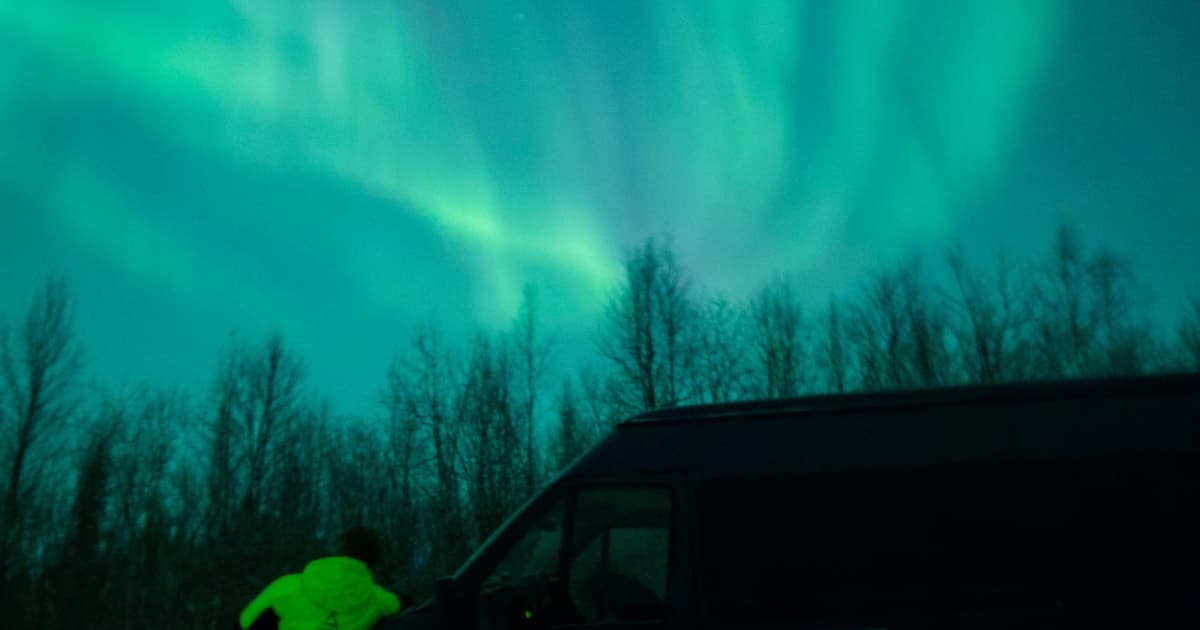
Local guides chase clear sky; on marginal nights that mobility is the difference.
Affiliate links: we may earn a commission at no extra cost to you.
Tonight, Hour by Hour
The four things that must line up over Ivalo, and how each hour of the night looks.
Kp 3.3 now, Kp 1 needed here
100% cloud cover around 6 AM
Dark from 4 AM
Dark rural skies; moon 21% lit
All times shown in Ivalo local time (GMT+3), not your device time.
10-Night Aurora Outlook
Planning a trip to Ivalo? Peak activity, cloud cover, and darkness for the nights ahead.
Kp ~ marks nights beyond NOAA's precise 3-day forecast, estimated from the 27-day outlook. Treat the far nights as a rough guide, not a promise.
Chasing by car?
Lake Inari and the Kaunispää fell road are short drives with huge open horizons: a car covers both in one night.
Affiliate links: we may earn a commission at no extra cost to you.
Find a base for your aurora trip
Compare accommodation near your viewing area. Check the exact property location and plan how you will reach dark skies.
Affiliate links: we may earn a commission at no extra cost to you.
Seeing the aurora in Ivalo
Ivalo is the northernmost airport town in Finland and the gateway to the Inari and Saariselka aurora country, so the northern lights over Ivalo are about as reliable as they get once real darkness returns. Sitting at nearly 69 degrees north, the town lies under the auroral oval, where even a quiet Kp 1 night can set the fell horizon glowing. Right now, in the midnight-sun weeks of high summer, the sky never gets dark, so the season is on pause until late August.
Our verdict is not a Kp number. The Kp index is a global, three-hour average, and treating it as a promise is the single biggest reason people drive out and see nothing. Instead we check four things for Ivalo specifically: whether forecast activity reaches the level this latitude needs, whether the sky will be clear, whether it will actually be dark, and how much moonlight and local light pollution will wash out. Only when all four line up do we say yes.
Why Ivalo and Inari sit under the auroral oval
Ivalo and the wider Inari region sit at close to 69 degrees north, directly under the auroral oval: the ring of near-permanent aurora that circles the pole. At this latitude you do not need a geomagnetic storm, because on an ordinary Kp 1 night the lights usually appear somewhere overhead, and a Kp 3 night can fill the sky from horizon to horizon. That is a completely different game from the mid-latitude states, where you have to wait for a big storm to drag the oval south.
The practical upshot is that the forecast question here is rarely whether there is activity, but whether the sky is clear and dark. That is why the verdict above leans so hard on cloud cover and twilight: over the fells around Ivalo they are the two things that actually decide your night. When the Kp number looks low, do not cancel a clear, dark evening; when it looks high, you still need a gap in the clouds.
Aurora season: midnight sun, polar night, and the equinoxes
Aurora season around Ivalo runs from late August through early April. From about mid-May to late July the midnight sun keeps the sky bright around the clock, and no aurora can be seen at any activity level, which is why a July visit is for hiking and the golden light rather than the lights. Real darkness, and with it the viewing season, returns in late August.
Midwinter is the payoff. Because Ivalo lies above the Arctic Circle it falls into polar night, or kaamos, for about a month around the solstice, when the sun never climbs above the horizon and viewing can start in the early afternoon. September and March add the equinox boost, when displays are statistically strongest and the weather is often milder, so those two windows are the sweet spots for a first trip.
Where to watch: the fells, the frozen lake, and glass igloos
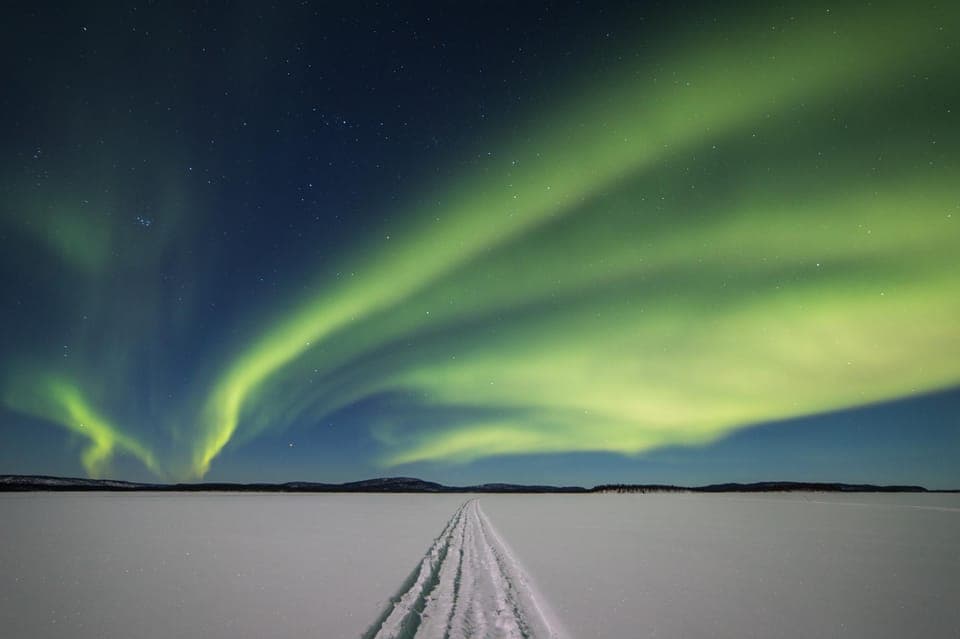
The best viewing is on the open fells and out on Lake Inari, minutes to an hour from Ivalo. Kaunispää and Kiilopää above Saariselkä rise above the treeline for a clean horizon, while Urho Kekkonen National Park behind them offers clearings and frozen ponds with no light at all. North of town, the shore of Lake Inari and the remote village of Nellim give you a vast frozen surface that doubles the show by reflecting it.
This is also glass-igloo country: the aurora cabins and glass-roofed suites around Saariselka, Kakslauttanen, and Lake Inari let you watch from a warm bed, and the wide horizons mean the lights often mirror on the lake or snow below. Wherever you base yourself, the move is the same as anywhere under the oval: get away from village lights, keep an eye on the cloud map, and be willing to drive a few minutes to the clear patch of sky.