Northern Lights in LofotenVisible Tonight?
Real-time aurora forecast updated every 15 minutes
Activity is close, but 100% cloud cover blocks the sky over Lofoten tonight.
Verify with the live sky camera →Thursday night looks better: Kp 4.0 forecast with 23% cloud, a naked-eye chance.
Aurora tours in Lofoten
Local guides chase clear sky; on marginal nights that mobility is the difference.
Affiliate links: we may earn a commission at no extra cost to you.
Tonight, Hour by Hour
The four things that must line up over Lofoten, and how each hour of the night looks.
Kp 0.3 now, Kp 1 needed here
100% cloud cover around 6 AM
Dark from 6 AM
Dark rural skies; moon 22% lit
All times shown in Lofoten local time (GMT+2), not your device time.
10-Night Aurora Outlook
Planning a trip to Lofoten? Peak activity, cloud cover, and darkness for the nights ahead.
Kp ~ marks nights beyond NOAA's precise 3-day forecast, estimated from the 27-day outlook. Treat the far nights as a rough guide, not a promise.
Chasing by car?
The islands are made for self-drive: beaches like Haukland and Uttakleiv are minutes from Leknes when the sky opens.
Affiliate links: we may earn a commission at no extra cost to you.
Find a base for your aurora trip
Compare accommodation near your viewing area. Check the exact property location and plan how you will reach dark skies.
Affiliate links: we may earn a commission at no extra cost to you.
Seeing the aurora in Lofoten
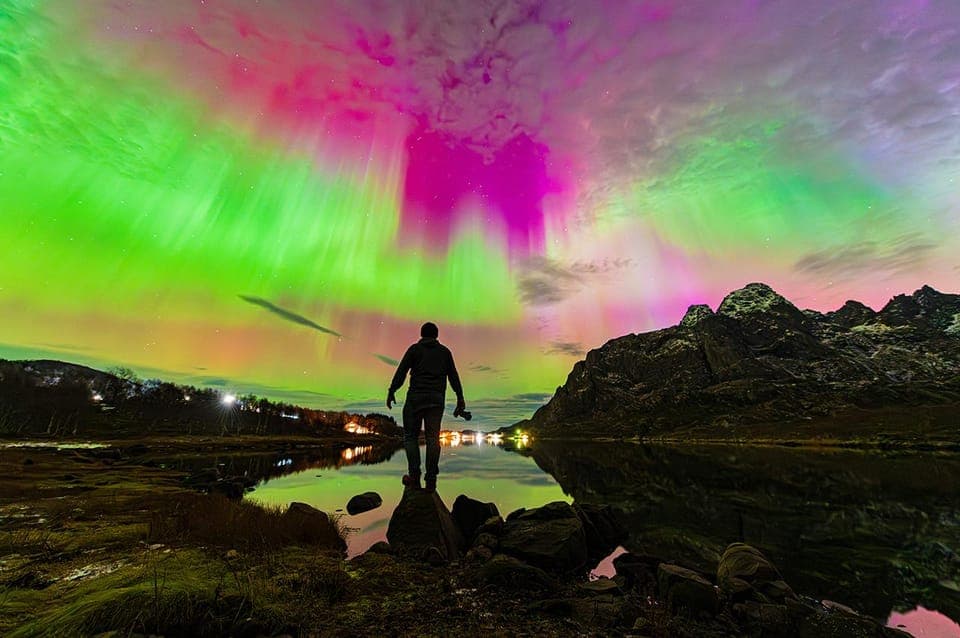
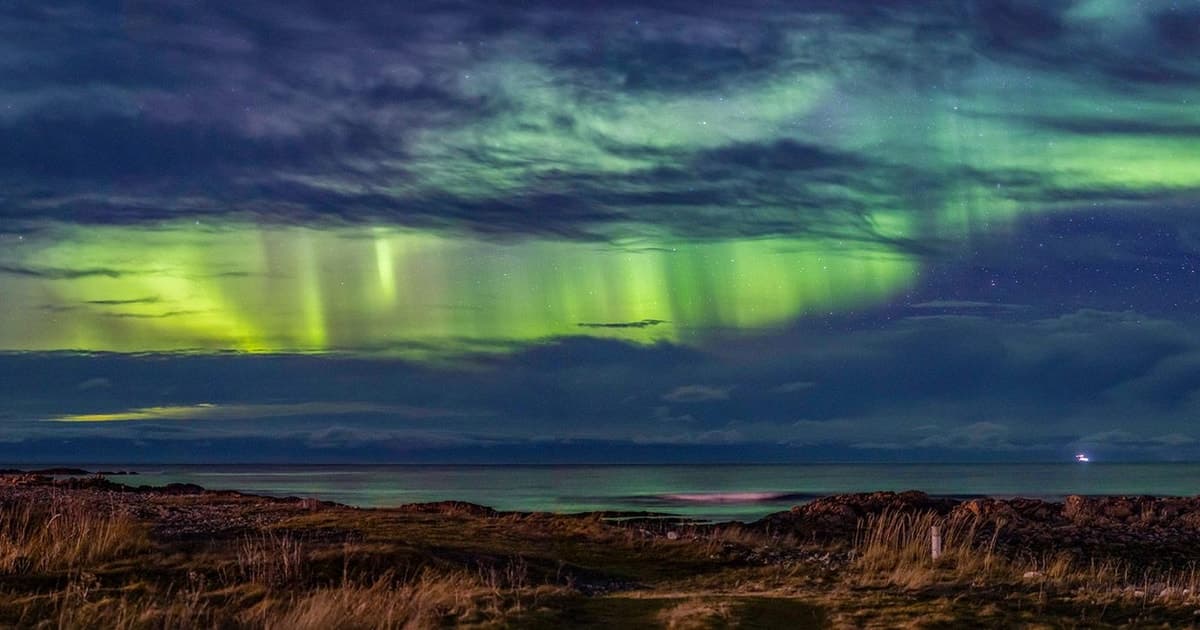
The northern lights in Lofoten are the reason photographers keep coming back: at 68 degrees north the aurora hangs over jagged peaks and white-sand beaches instead of a flat horizon. The islands sit right under the auroral oval, so activity is rarely the problem, and even a quiet Kp 1 night can paint green over Uttakleiv or Reine. What decides a Lofoten night is cloud and darkness, which is exactly what the verdict above turns into a plain yes or no.
Our verdict is not a Kp number. The Kp index is a global, three-hour average, and treating it as a promise is the single biggest reason people drive out and see nothing. Instead we check four things for Lofoten specifically: whether forecast activity reaches the level this latitude needs, whether the sky will be clear, whether it will actually be dark, and how much moonlight and local light pollution will wash out. Only when all four line up do we say yes.
Why Lofoten is one of the best places for the northern lights
Lofoten is one of the best aurora destinations on Earth because it sits at 68 degrees north, directly under the auroral oval: the ring around the pole where the lights live even on quiet nights. That means you do not need a geomagnetic storm here. On an ordinary Kp 1 night the aurora usually appears somewhere overhead, and a Kp 3 night can fill the whole sky. What sets Lofoten apart from Tromsø or inland Lapland is the backdrop: jagged granite peaks rising straight out of the sea, with white-sand beaches to put in the foreground.
The practical result is that the forecast question in Lofoten is almost never whether there is activity, but whether the sky is clear and dark. That is why the verdict above leans so heavily on cloud cover and twilight: they are the two things that actually decide your night. On a clear, dark evening the odds are firmly in your favour, and the islands reward anyone willing to wait out a cloudy spell.
When to go: Lofoten aurora season and the midnight sun
Aurora season in Lofoten runs from late September through early April. The sky has to be properly dark, and from late May to mid-July the midnight sun keeps it bright around the clock, so summer visitors see zero aurora no matter how strong the solar activity. Darkness returns in late August, and by late September the nights are long enough for reliable viewing.
The equinox months of September and March are statistically the strongest, when Earth's magnetic field couples more efficiently with the solar wind. Deep winter brings the most dark hours per night but also the harshest weather off the Norwegian Sea. If you are reading this in July, that is why the verdict above talks about the season instead of showing an hourly forecast: the midnight sun is up and there is nothing to see yet.
How to chase the aurora across the islands
The best move in Lofoten is to pick a north-facing beach and be ready to drive between them. Uttakleiv and Haukland on Vestvågøy are the classic pair: Uttakleiv for low, quiet aurora over its dark north horizon, and Haukland around the headland when a strong display climbs behind the peaks. Skagsanden on Flakstad and the open coast at Hov on Gimsøya give you the same dark sky with different mountain silhouettes.
Because Lofoten weather is patchy and fast-moving, mobility is everything: it can be socked in on one island and clear on the next, so a rental car plus this forecast beats sitting under a single cloud. Get out early, let your eyes dark-adapt for 15 minutes without looking at your phone, and point night mode at the horizon now and then, since the camera will catch an approaching band before your eyes do. Dress far warmer than you think, because standing still in coastal Arctic wind ends more sessions than clouds do.