Northern Lights in WhitehorseVisible Tonight?
Real-time aurora forecast updated every 15 minutes
Activity is close, but 100% cloud cover blocks the sky over Whitehorse tonight.
Verify with the live sky camera →Wednesday night looks better: Kp 3.0 forecast with 24% cloud, a naked-eye chance.
Aurora tours in Whitehorse
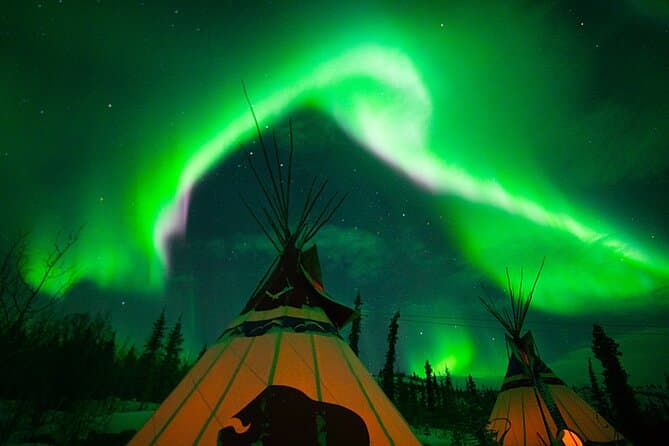
Local guides chase clear sky; on marginal nights that mobility is the difference.
Affiliate links: we may earn a commission at no extra cost to you.
Tonight, Hour by Hour
The four things that must line up over Whitehorse, and how each hour of the night looks.
Kp 3.0 now, Kp 3 needed here
100% cloud cover around 11 PM
Dark from 9 PM
Some local light glow; moon 22% lit
All times shown in Whitehorse local time (GMT-7), not your device time.
10-Night Aurora Outlook
Planning a trip to Whitehorse? Peak activity, cloud cover, and darkness for the nights ahead.
Kp ~ marks nights beyond NOAA's precise 3-day forecast, estimated from the 27-day outlook. Treat the far nights as a rough guide, not a promise.
Chasing by car?
Fish Lake Road and the Alaska Highway pull-offs are minutes from town: a car makes any clear forecast actionable.
Affiliate links: we may earn a commission at no extra cost to you.
Find a base for your aurora trip
Compare accommodation near your viewing area. Check the exact property location and plan how you will reach dark skies.
Affiliate links: we may earn a commission at no extra cost to you.
Seeing the aurora in Whitehorse
The northern lights in Whitehorse are a near-nightly show in season, because the Yukon capital sits close under the auroral oval at about 61 degrees north. Activity is rarely the problem here; even quiet Kp 2 nights can bring the aurora overhead, so a Whitehorse night usually comes down to cloud cover and darkness, not Kp. Drive 20 to 30 minutes out to Fish Lake or a dark lakeshore and the lights regularly fill the sky.
Our verdict is not a Kp number. The Kp index is a global, three-hour average, and treating it as a promise is the single biggest reason people drive out and see nothing. Instead we check four things for Whitehorse specifically: whether forecast activity reaches the level this latitude needs, whether the sky will be clear, whether it will actually be dark, and how much moonlight and local light pollution will wash out. Only when all four line up do we say yes.
When to go: aurora season in Whitehorse
Aurora season in Whitehorse runs from late August through mid-April. It is not that the sun goes quiet in summer: at about 61 degrees north the sky simply never gets fully dark from mid-May to early August, when a glow sits on the northern horizon through the short night and hides even a severe storm. Real darkness returns in the second half of August, and the statistically strongest displays cluster around the September and March equinoxes, when Earth's magnetic field couples most efficiently with the solar wind.
The two ends of the season feel very different. Late August and September bring milder nights, open lakes for mirror reflections, and aurora that appears before the deep cold arrives, at the cost of a shorter dark window. Deep winter from November through March is bitterly cold but delivers long, dark, and often crystal-clear nights with far more viewing hours, and it is the stretch most dedicated Yukon aurora trips are built around.
Near the oval: why Whitehorse punches above its latitude
Whitehorse sees more aurora than its latitude alone would suggest because it sits close under the auroral oval, the ring of aurora that circles the pole even on quiet nights. At about 64 degrees magnetic latitude the lights do not need a big geomagnetic storm to appear: Kp 2 is often enough for a naked-eye display low in the north, and a Kp 3 or 4 night can carry the aurora overhead. The common advice to wait for a very high Kp number is only half right here, because a strong storm can push the brightest part of the oval south of the city.
The second advantage is the weather. Whitehorse sits in the interior Yukon, sheltered by the coastal mountains, so it sees far more clear nights than coastal aurora capitals like Tromso or Reykjavik, which fight low cloud much of the season. The trade-off is cold: deep-winter nights routinely sit between minus 20 and minus 40, and you will be standing still for hours, so the practical Whitehorse question is less about activity than about clear sky and staying warm.
Where to watch and how to read tonight's forecast
The best viewing is any dark spot with an open northern horizon within about 30 minutes of town. Fish Lake, roughly 15 km up Fish Lake Road, sits high and wide open with almost no artificial light and is the local favorite for photographers and yurt tours; Schwatka Lake just south of downtown gives calm waterside reflections; and Grey Mountain to the east offers an elevated lookout above the city glow. For the darkest sky, Fox Lake sits 68 km north on the Klondike Highway, slightly further under the oval. Wherever you go, the goal is the same: an open north horizon, real darkness, and a way to stay warm.
Start with the verdict at the top of the page, which folds geomagnetic activity, cloud cover, and darkness into one answer, because in Whitehorse the activity is rarely the part that fails. Read the hourly cloud numbers and the dark window instead, and if it is clear and genuinely dark, aurora is likely to show, usually building toward solar midnight around 12 to 1 am local. Displays arrive in substorms with quiet gaps between them, so give it at least two hours, let your eyes dark-adapt for 15 minutes without looking at your phone, and dress for standing still in serious cold, because the cold ends more Whitehorse aurora sessions than clouds do.