How to See the Northern Lights: A Practical Field Guide
How to see the northern lights: the four-factor field checklist, activity, clouds, darkness, and moonlight, that decides every aurora night.

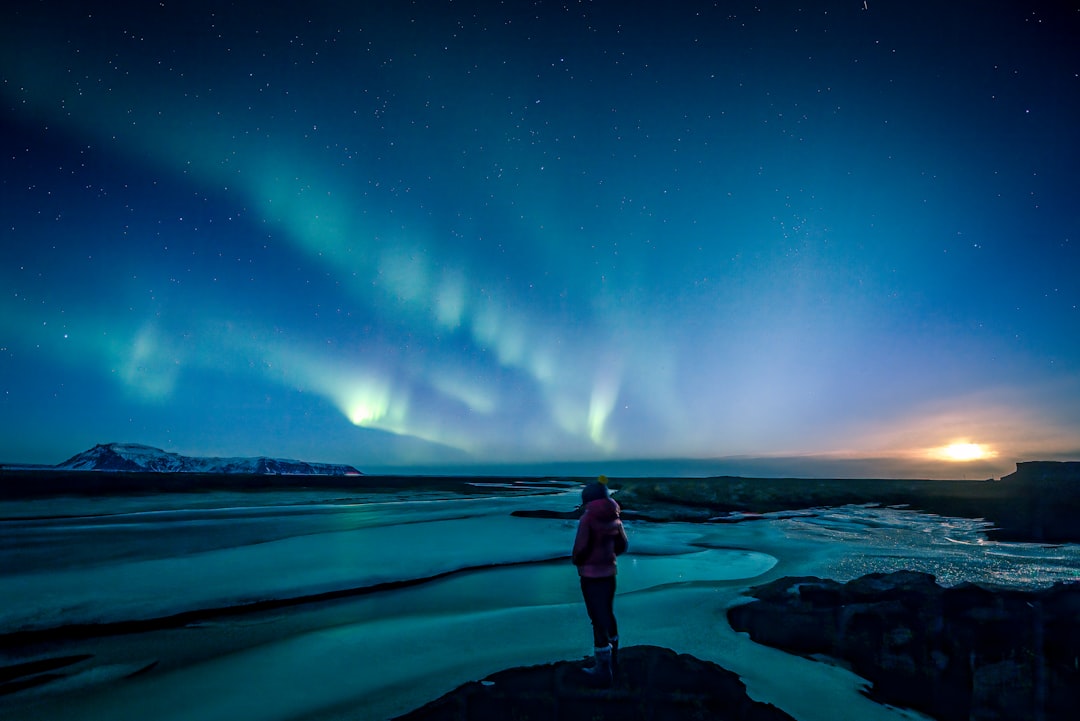
How do you see the northern lights?
To see the northern lights, get to a high enough latitude for the auroral oval to reach you, find a dark spot with an open view to the north, and pick a clear night during aurora season (roughly late August to mid-April). Then confirm four things line up: geomagnetic activity, cloud cover, darkness, and moonlight. Our live northern lights forecast combines all four into one plain verdict for your exact location.
Learning how to see the northern lights is less about chasing a single number and more about getting four separate things to line up on the same night, over your specific patch of sky. Most people who go looking for the aurora and come home empty-handed did everything half-right. They saw a viral "Kp 7 tonight" headline, drove somewhere dark, stared up for fifteen minutes, and saw nothing.
That is the whole game. This guide walks through the checklist the way a chaser actually uses it, then covers where to stand, when to go, how to read a forecast without being fooled by it, and the one expectation that saves most people from disappointment.
How to See the Northern Lights: The Four-Factor Checklist
Seeing the northern lights comes down to four things lining up on the same night: geomagnetic activity, clear skies, real darkness, and a sky that is not washed out by moonlight or city glow. Miss any one of them and the display you were promised never shows up. This is the single biggest thing that separates the people who see aurora from the people who drive home grumbling about hype.
Almost every guide online tells you to check the Kp index and go. That is one factor out of four. Here is the full checklist.
| Factor | The question to ask | Why it fails |
|---|---|---|
| Activity | Is geomagnetic activity strong enough for my latitude? | The oval sits too far north; Kp is high but centered over another continent |
| Clouds | Is the sky actually clear to the north? | Low cloud hides the horizon completely, the number one miss reason |
| Darkness | Is the sky fully dark right now? | Summer twilight at high latitude never lets it get dark enough |
| Sky washout | Is the moon or city light drowning it out? | A bright moon or urban skyglow erases a faint display |
The important word is "and." You need activity and clear skies and darkness and a clean sky, all at once, all where you are standing. A perfect Kp 7 storm is worthless under a solid deck of cloud. A crystal-clear moonless night is worthless if the activity is centered 800 miles north of you.
This is exactly why we built the northern lights tool to return a plain verdict instead of a raw number. It checks all four factors for your coordinates and tells you one of three things: "Not tonight," "Camera only," or "Visible to the naked eye." The rest of this guide is really just the four factors explained one at a time, so you can run the checklist in your head anywhere.
Where to See the Northern Lights
The best places to see the northern lights sit under or near the auroral oval, the ring of light that permanently circles the magnetic pole. The closer you are to that ring, the less activity you need and the more often the lights appear. According to the NOAA Space Weather Prediction Center, on a quiet night the southern edge of the oval sits around 66 degrees geomagnetic latitude and pushes roughly 2 degrees further south for each step up the Kp scale.
That single rule explains everything about location. Places directly under the oval barely need a storm at all. Fairbanks, Alaska sits near 65 degrees north, and on a clear, dark night even quiet Kp 1 activity is often overhead. Tromso, Norway at 69 degrees is the same story: activity is almost never the problem, only clouds are. Reykjavik is far enough north that Kp 2 to 3 is usually plenty.
Drop to mid-latitudes and the math flips. You are no longer under the oval, so you have to wait for a storm big enough to drag it down to you. From the Caithness coast in Scotland, around 58 degrees north, Kp 5 is often enough for a naked-eye show over the sea. The Upper Peninsula of Michigan needs roughly the same. Southern England or the lower US states need a severe storm, the kind that only turns up a handful of times a year, and even then the display often sits low and dim on the northern horizon.
Latitude is only half of "where," though. The other half is the ground you stand on.
- Escape light pollution. City glow washes out faint aurora the same way it drowns out faint stars. Drive until the skyglow drops behind you. Even 30 to 60 minutes out of a major city can be the difference between a gray smudge and visible green.
- Get an unobstructed view to the north. At mid-latitudes the aurora lives low on the northern horizon. A ridge, a treeline, or a row of houses in that direction will block the whole show. Open water, a hilltop, or flat open country facing north is ideal. NOAA notes that from a good vantage point you can see aurora even when it is 600 miles (1,000 km) further north of you.
- Face away from the display, not just up. Beginners tilt their heads straight back. Point yourself north and scan low first.
If you are still choosing between destinations, our ranking of the best places to see the northern lights compares them on darkness, Kp threshold and cloud climatology rather than scenery.
If you want to know what your own patch of sky needs tonight, our per-location aurora forecasts already know the Kp threshold for their latitude, so you are not left guessing. Whether it is worth paying a guide to drive you past the clouds depends entirely on which of the four factors limits your destination, which is the question our guide to choosing a northern lights tour works through.
The Best Time to See the Northern Lights
The best time to see the northern lights is on a clear, dark night between about 10 pm and 2 am local time, during aurora season from late August to mid-April, ideally close to the September or March equinox. Two separate clocks matter here: the clock over the year, and the clock over the night.
Over the year, it is about darkness, not the sun going quiet. The aurora happens year-round, but you cannot see it against a bright sky. At high latitudes the summer sky never gets dark enough, which is why Fairbanks and Tromso have a genuine off-season from roughly late April to late August despite the sun being at its most active. Real darkness returns in late August, and the season runs to mid-April. The statistically strongest displays cluster around the two equinoxes. That is the Russell-McPherron effect: as EarthSky explains, Earth's magnetic field couples more efficiently with the solar wind near the equinoxes, so the same solar activity produces bigger storms in September and March.
Over the night, it is about magnetic midnight. NOAA puts the best aurora "within an hour or two of midnight," between 10 pm and 2 am. That is when your location rotates under the most active part of the oval. A quiet 10 pm does not mean the night is over; the show often builds toward local midnight.
There is also a bigger clock running underneath all of this: the 11-year solar cycle. NASA and NOAA announced that Solar Cycle 25 reached its maximum in October 2024, and the storm on the night of May 10, 2024 was the strongest in about two decades, pushing naked-eye color as far south as the southern US and southern England. Activity is now easing off the peak, but the years right around a solar maximum stay the best window in a decade to try, which makes 2026 a still-strong season to plan around.
How to Read an Aurora Forecast Without Being Fooled
A Kp number on its own does not tell you whether you will see the aurora, and treating it like a promise is the number one reason people feel let down. Kp is a single global, three-hour average of geomagnetic activity. It is backward-looking, it describes the whole planet at once, and it says nothing about your latitude, your clouds, or your darkness.
Picture what that means in practice. An app pushes a "Kp 6" alert. That value might describe a burst that already ended, or activity centered over Scandinavia while you are in Ohio under thick cloud. The number was real. Your night was still a bust. If you want the full breakdown of what the index actually measures and how to use it properly, we wrote a companion guide on the Kp index, and a separate one on what causes the northern lights if you want the physics behind the glow.
The fix is to stop reading a global number and start reading a verdict for your exact spot. That is the entire point of our aurora forecast: instead of handing you a Kp value to interpret, it translates tonight's geomagnetic forecast against your latitude, folds in your cloud cover and darkness, accounts for the moon, and returns one answer plus an hour-by-hour timeline. A location-specific "yes, naked eye at 11:30 pm" is worth far more than a global "Kp 6 tonight."
Field Craft: What to Actually Do Once You Are Out There
Once you are standing under a dark sky, let your eyes fully dark-adapt for 20 to 30 minutes before you judge the night, and do not look at a bright screen the entire time. Your night vision depends on a pigment called rhodopsin rebuilding in the rod cells of your retina. The US National Park Service notes that this process makes your eyes thousands of times more sensitive to faint light, but it takes 20 to 30 minutes and a single glance at a white phone screen resets it.
A few habits separate a good aurora night from a frustrating one:
- Kill your phone brightness, or better, use red light. Rods are nearly blind to red, so a red flashlight or a phone in red-screen mode lets you check the map without wrecking your night vision.
- Commit two full hours. Aurora arrives in bursts called substorms, typically 15 to 40 minutes of activity with quiet gaps in between. People who give up after 20 minutes miss the show that starts at minute 25. If the forecast says tonight, stay out.
- Let your phone scout ahead. A modern phone on night mode collects several seconds of light per frame, so it will often pick up green on the northern horizon before your eyes register anything. Point it north every so often. If the camera sees color building, a naked-eye burst may be minutes away.
- Dress for standing still in the cold. In deep winter, the thing that ends most sessions is not clouds, it is frozen toes. You will be motionless for hours. Overdress.
Camera-Only vs Naked Eye: The Expectation That Saves the Night
The single biggest source of aurora disappointment is the gap between what a camera captures and what your eyes actually see. Understand this before you go and you will never feel cheated. Miss it and even a real sighting can feel like a letdown.
Here is the physics. Your eyes see color through cone cells, which need a fair amount of light to work. In near-darkness your vision switches to rod cells, which are far more sensitive but effectively colorblind. So a faint aurora that a long-exposure photo renders as vivid green and pink often reads to the naked eye as a pale gray or whitish glow, like a cloud that will not drift. That is not a failure of the aurora or your eyes. It is normal, and at mid-latitudes it is the majority of displays.
This is why the viral photos set a trap. Most of those images were shot at high latitude, during a strong storm, on a camera doing several seconds of exposure and often some processing. If you drive out to a Kp 4 night in Michigan expecting that, you will be disappointed even though you are looking straight at a genuine, photographable aurora.
So set the right expectation. On a strong night under the oval, the lights dance overhead in obvious color and there is no ambiguity. On a marginal night at mid-latitude, "camera only" is a real and worthwhile sighting: your phone will prove the aurora is there even when your eyes see only a soft glow. Our tool has a dedicated "camera only" tier for exactly this reason, so you know before you leave the house whether tonight is a naked-eye show or a photograph. Knowing which one you are chasing is half the battle. If tonight is a camera night, our guide on how to photograph northern lights covers the settings that turn a grey smudge into a green curtain.
Frequently Asked Questions
Can you see the northern lights with the naked eye?
Yes, but not on every night that a camera can. Under the auroral oval during a decent display, the lights are obvious to the naked eye in clear color and motion. At mid-latitudes, many displays are faint enough that your eyes see a pale gray glow while a phone on night mode captures green and red. Both are real sightings; they are just different experiences, which is why our forecast separates a naked-eye verdict from a camera-only one.
What Kp index do you need to see the northern lights?
It depends entirely on your latitude, which is why a bare Kp number is misleading. Directly under the oval, in Fairbanks or Tromso, Kp 1 to 2 is often enough. From Scotland or northern Michigan you generally want Kp 5 or higher. Southern England and the lower US states need a severe storm, roughly Kp 7 and up. Our location pages already know the threshold for each spot, so you do not have to memorize the table.
What time of night is best to see the northern lights?
Between about 10 pm and 2 am local time, peaking near magnetic midnight. That is when your location rotates under the most active part of the auroral oval. Displays come in bursts, so a quiet first half hour is normal; plan to stay out for at least two hours rather than giving up early.
Do I have to travel to Iceland or Alaska to see the aurora?
No. Destinations like Fairbanks, Tromso, and Iceland give you the best odds because they sit under the oval, so you need almost no storm. But during the strong storms of a solar maximum, the aurora reaches far lower latitudes: the UK, the northern US, and beyond. The trade-off is that away from the oval you need a bigger storm and a lot more luck with clouds and darkness. Check the verdict for your own location first before assuming you have to fly anywhere.
Run the Checklist Tonight
The northern lights reward preparation more than luck. Get to a dark, north-facing spot at the right latitude, pick a clear night in season near magnetic midnight, protect your night vision, and stay out for two hours. Above all, run the four-factor checklist instead of trusting a headline: activity, clouds, darkness, and moonlight all have to agree.
The fastest way to do that is to let the forecast do the arithmetic for you. Check the live northern lights verdict for your location before you head out, the same way travelers check whether Mt. Rainier is out before driving to the park. One plain answer, computed for your sky, tonight.
More Articles
What Causes the Northern Lights? The Science Behind the Aurora Borealis
What causes the northern lights? The sun sends charged particles that hit our atmosphere near the poles. The full science, in plain English.
The Kp Index, Explained: Why the Aurora Number Is Not a Promise
The kp index is a 0 to 9 scale of geomagnetic activity. Here is what the aurora number really means, and why a high value is no promise.
Northern Lights Tour: How to Choose One (and When to Skip It)
A northern lights tour can only fix two of the four things that decide whether you see aurora. Here is how to choose one, and when to skip it.