Aurora Borealis Colors: What Each One Means and Who Sees It
Aurora borealis colors explained: why green dominates, why red is only rare up north, and why your eyes see less color than your camera does.

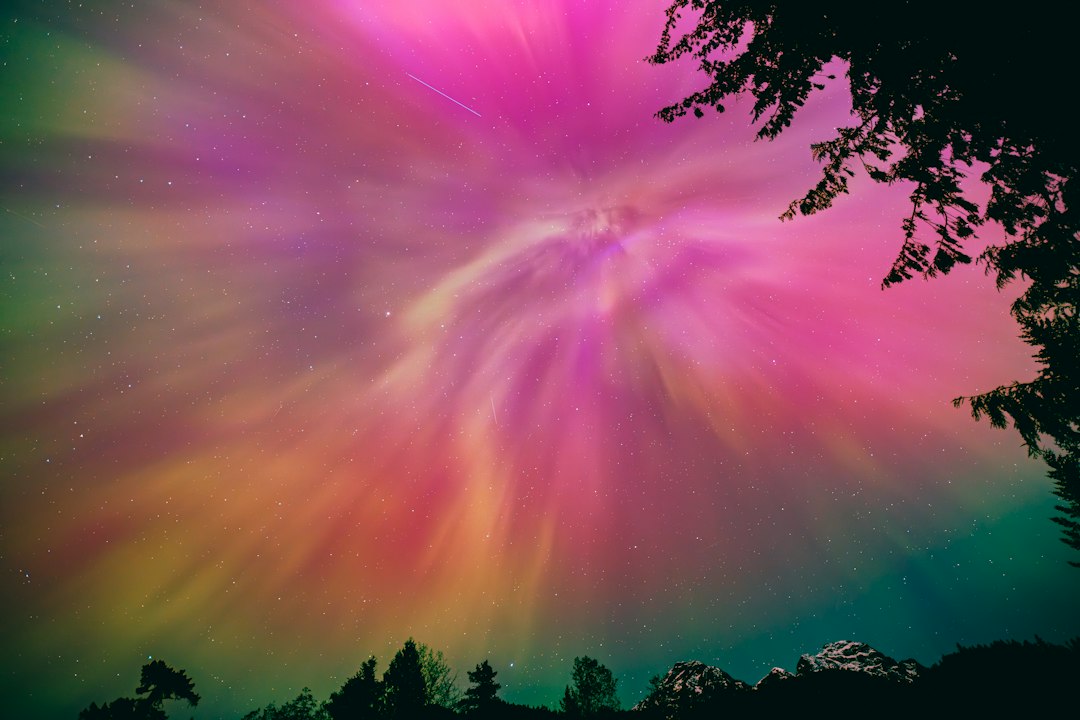
Aurora borealis colors come from two gases. Atomic oxygen glows green at 557.7 nanometers, roughly 100 to 150 km up, and deep red at 630.0 nanometers, higher than about 200 km. Nitrogen adds the blue, violet and pink tones, mostly along the lower edges and the sunlit tops of bright displays. Purple, yellow and magenta are mixtures of those few pure lines.
That covers the physics. The colors you actually see on a given night depend on three other things: how your eyes handle each wavelength in the dark, how far you stand from the aurora, and how much energy the storm is carrying. Those three explain why a phone photo can show a sky full of magenta while the person holding the phone saw a pale grey arc. They also explain why red, often called the rarest color, is the first one many people in Michigan or England ever see.
Aurora Borealis Colors at a Glance
The aurora shows five main colors: green, red, blue, purple and pink. Each comes from a specific gas at a specific height.
| Color | Source | Wavelength | Typical altitude | What it tells you |
|---|---|---|---|---|
| Green | Atomic oxygen | 557.7 nm | ~100 to 150 km | Normal, everyday aurora |
| Deep red | Atomic oxygen | 630.0 nm | ~200 to 300 km, higher in storms | High-altitude glow; dominant in storm aurora seen from far south |
| Pink / magenta fringe | Molecular nitrogen (red and blue bands) | Mixed bands | ~90 to 100 km | Unusually energetic electrons; the display is peaking |
| Blue / violet | Nitrogen molecular ion | 427.8 and 391.4 nm | Lower borders, or sunlit tops | Very bright displays, or aurora tops still in sunlight at dusk or dawn |
| Purple | Blend of red and blue | Mixed | Wherever both overlap | Mixing along your line of sight |
If you want the full chain from the sun to the sky, from coronal mass ejections down to the auroral oval, our explainer on what causes the northern lights covers it. This guide is about the colors themselves and which ones you will actually see.
Why Green Is the Most Common Aurora Color
Green dominates because at 100 to 150 km the air is dense enough that only a fast-emitting state of oxygen gets to release its light before a collision steals the energy. The color is decided by timing.
Excited oxygen holds its energy for a set time before releasing a photon. The green state lasts about 0.7 seconds. The red state lasts about 110 seconds. According to the Atmospheric Optics notes on auroral gases, an oxygen atom at 100 km is hit around 500 times a second, so any atom trying to hold its energy for 110 seconds gets knocked flat long before it can glow red. At 200 km the same atom is hit only about once every 7 seconds. That is still too often for many atoms to finish the 110-second wait, but enough of them do to make the red glow.
So the atmosphere sorts the colors by height:
- Below about 100 km: too crowded even for green. Only very energetic electrons reach this deep, where they excite nitrogen instead. That nitrogen glow is the pink fringe.
- 100 to 150 km: the green band, where most particles deposit their energy on an ordinary night.
- Above about 200 km: thin enough for red, but there is far less gas, so the red is usually faint unless a storm pours in a lot of energy.
Most auroral electrons stop in the green layer, so green wins on volume. The rest of the story depends on the viewer.
What Colors Do the Northern Lights Look Like to the Naked Eye?
To the naked eye, faint northern lights usually look grey or whitish-green, and red and blue only show up in bright displays. In dim light your eye switches from color-sensing cones to rods, and rods respond very unevenly to the three main auroral wavelengths.
To put numbers on it, we took the international standard curves for human night vision (CIE 1951 scotopic) and daylight vision (CIE 1924 photopic). Aurora brightness is measured in rayleighs, which count photons, so we converted both curves to sensitivity per photon at each emission line:
| Emission line | Wavelength | Night vision (rods), relative to green | Color vision (cones), relative to green |
|---|---|---|---|
| Green oxygen | 557.7 nm | 1 | 1 |
| Blue nitrogen ion | 427.8 nm | about 2/3 | about 1/80 |
| Red oxygen | 630.0 nm | about 1/120 | about 1/4 |
Per-photon sensitivity calculated from the CIE 1951 scotopic and CIE 1924 photopic luminous efficiency functions. Green is set to 1 in each column.
Two patterns stand out.
To dark-adapted eyes, red is close to invisible. Rods are about 120 times less sensitive to 630 nm red than to 557.7 nm green, photon for photon. Rods also do not see color at all. So a faint red glow that fills a camera frame can be truly invisible to a person standing next to the tripod, not just dim.
Blue loses either way. Rods register 427.8 nm fairly well, but only as grey. Cones, the cells that would let you see it as blue, are about 80 times less sensitive to it than to green. Blue is the hardest auroral color to see with the naked eye, even though it is not the rarest one in the sky.
Brightness is what lets color through. Aurora brightness is graded on the International Brightness Coefficient scale, where class I is about as bright as the Milky Way and class III matches moonlit cumulus cloud. Nobody sees the Milky Way in color, and a class I aurora is no different. As a display brightens toward moonlit-cloud levels, cones start to work. Green turns green first, red follows, and blue stays elusive.
A camera sensor has no rods-to-cones switch. It responds to all three lines at once and adds up light over a long exposure, so it records red and blue the eye never registers. This is the gap behind the "Camera only" verdict in our live aurora forecast, which flags nights when activity, clouds and darkness are good enough for a sensor but not for your eyes. If you plan to shoot, the northern lights photography guide explains how to set a camera so it shows the color without exaggerating it.
Is Red the Rarest Aurora Color? It Depends Where You Stand
Red is one of the least common aurora colors for viewers under the auroral oval, but it is often the dominant color for viewers far to its south during a storm. Red light comes from much higher up, so its tops stay above the horizon from hundreds of kilometers farther away.
Each color sits at a different height, so it can be seen from a different distance. We calculated how far from the aurora each altitude still sits 5 degrees above a flat horizon, about the lowest you can see past trees, haze and buildings:
| Emitting altitude | Typical color | Visible 5° up from this far away | Roughly equal to |
|---|---|---|---|
| 100 km | Pink lower border | ~690 km | 6.3° of latitude |
| 110 km | Green curtain base | ~740 km | 6.7° of latitude |
| 150 km | Upper green | ~920 km | 8.3° of latitude |
| 250 km | Red | ~1,280 km | 11.6° of latitude |
| 300 km | Red | ~1,440 km | 13.0° of latitude |
| 400 km | Red storm tops | ~1,710 km | 15.4° of latitude |
Spherical-Earth geometry with a 6,371 km radius, ignoring refraction. One degree of latitude is taken as 111 km.
Red tops at 300 km clear the horizon from about 700 km farther away than the green curtains below them. That gap is roughly six degrees of latitude.
Picture a storm with green curtains hanging along 53.5°N, the latitude of central Alberta. Viewers under them see the classic green show overhead. From the latitude of Duluth, about 6.7 degrees south, the green base is just skimming the horizon. From northern Colorado, another six degrees south, the green is entirely hidden below the horizon, yet the red tops of the same aurora still stand 5 degrees up. The same event looks like a green curtain in one place and a red glow in another.
Mid-latitude storm photos look the way they do because of this geometry. During the October 10, 2024 storm, observers logging sightings with the citizen-science project Aurorasaurus described "the reddest display I have ever seen," saw pink with the unaided eye, and reported diffuse red as far south as Florida. Big storms also add a lot of energy at high altitude, which boosts the red line directly. Cut-off curtains, high-altitude energy and bright enough light for cones all line up at once, which is why an aurora seen from the mid-latitudes is so often red.
So "red is the rarest color" is true in Tromsø or Fairbanks, where the oval sits overhead and red appears mainly as storm tops above the green. From Michigan or the UK, a low red or magenta glow on the northern horizon is a common way for a storm to show itself. How strong that storm needs to be for each latitude is covered in our solar storm guide.
Pink, Purple and Blue: The Nitrogen Colors
Pink, purple and blue aurora come from nitrogen, and they appear when unusually energetic particles reach deep into the atmosphere or when high aurora is lit by the sun.
Pink and magenta lower borders. When a substorm drives electrons hard enough to punch below the green layer, to around 90 to 100 km, they excite molecular nitrogen. Neutral nitrogen gives off red bands and ionized nitrogen gives off blue, and together they read as a pink or magenta hem along the bottom of the curtain. The National Park Service ties this colored lower border to electrons accelerated to very high energy, so a fast-moving pink fringe is a good sign that a display is near its peak. That is the moment to look up rather than at your screen, and if you are shooting, to cut the exposure to a couple of seconds.
Blue tops at dusk and dawn. In the hours after sunset and before sunrise, the ground can be dark while the upper atmosphere is still in sunlight. Nitrogen ions up there absorb sunlight at exactly 391.4 and 427.8 nm and re-emit it, so the tops of the rays glow blue or violet. This is called resonant scattering, and it is why the tops of curtains and rays sometimes show a deep blue. Look for it early in the evening and in the last hours before dawn.
Purple. Purple is rarely a single emission. It is usually red and blue overlapping along your line of sight, either red oxygen tops behind blue nitrogen, or a red glow seen through the edge of a curtain. Cameras render it much more readily than eyes do, for the reasons in the sensitivity table above.
Yellow, Orange and White: Colors Your Eyes or Camera Mix
Yellow, orange and white are not separate emission lines. They are blends of green and red, or the result of how a sensor or an eye processes the light.
- Yellow and orange show up where a green curtain and red glow overlap, typically at the transition from the green band to the red layer above it. In photos of big storms this is the warm band between the two colors.
- White or grey is how rods report aurora that is too faint for cones, which covers most aurora most people see from the edge of the oval. A pale arc to the north that does not move like a cloud is worth a test shot.
- Oversaturated phone color is a product of processing. Night modes stack and brighten frames, and some push saturation further. The color in the scene is real, but its strength may not be.
Red Glows That Are Not Ordinary Aurora: SAR Arcs and STEVE
Not every red or mauve glow in a storm photo is a classic aurora. Two related phenomena often appear in mid-latitude shots.
Stable auroral red (SAR) arcs are smooth, uniform bands of pure 630 nm red with no green at all. They form south of the main oval, where energy flowing down from the inner magnetosphere heats electrons in the upper atmosphere, and they glow in the high red-emitting layer well above the green. They are usually too faint to see with the eye, and the first one was only observed in 1956. A featureless red band arching east to west across a long exposure, with no rays and no green, is probably a SAR arc.
STEVE (Strong Thermal Emission Velocity Enhancement) is a narrow mauve or whitish ribbon, sometimes with a green "picket fence" below it. Citizen scientists in the Alberta Aurora Chasers group photographed it long before physicists had a name for it, and the first study describing it, led by a NASA scientist and co-authored by University of Calgary physicists, appeared in Science Advances in March 2018. A European Space Agency Swarm satellite crossed it at 450 km and measured unusually high temperatures and a very strong westward flow of ions. University of Calgary physicist Eric Donovan said it is "probably not an aurora, certainly not a traditional aurora." It appears south of the main oval, from southern Ontario and Michigan up to Alaska.
Reading the Colors During a Display
The colors in front of you tell you what the display is doing, which helps you decide whether to wait, move or start shooting. This is how the patterns above play out on a real night.
| What you see | What it means | What to do |
|---|---|---|
| Pale grey arc low in the north | Aurora too faint for color vision, or the base of a display beyond your horizon | Take a 5 to 10 second test photo; if it is green, wait for it to brighten |
| Red or magenta glow low in the north, no green | You are seeing the high red tops of an aurora whose green base is below your horizon | Head for a darker site with a clear northern view; things improve if the oval expands toward you |
| Even red band, no rays, no movement | Likely a SAR arc | Photograph it; it will not turn into a dancing curtain |
| Green curtain, slow drift | Quiet, ordinary aurora | Settle in; activity often surges later in the night |
| Green curtain with a fast pink lower edge | High-energy breakup, near peak | Stop scrolling and look up; shorten exposures |
| Blue or violet ray tops soon after dusk | Sunlit aurora tops | Shoot early in the evening; it fades as the shadow rises |
None of this helps if clouds or a bright moon hide the sky. The colors reach you only when activity, clouds, darkness and light pollution all line up over your spot, which is the four-factor checklist in our guide on how to see the northern lights.
Frequently Asked Questions
What is the rarest color of the aurora borealis?
Under the auroral oval, pure red and deep blue-violet are the least common colors, because red needs a lot of high-altitude energy and blue is hard for eyes to see. For viewers far south of the oval, red is often the dominant color during a storm, because only the high red tops reach above their horizon.
Why are the northern lights usually green?
Most auroral electrons lose their energy 100 to 150 km up, where atomic oxygen emits green light at 557.7 nanometers. Human eyes are also far more sensitive to that green than to the red or blue lines, so green is both the most common aurora color and the easiest one to see.
What causes pink or purple northern lights?
Pink and purple northern lights come from nitrogen. A pink or magenta lower edge appears when very energetic electrons reach about 90 to 100 km and excite molecular nitrogen. Purple is usually red oxygen light and blue nitrogen light overlapping along your line of sight.
Are the colors in aurora photos fake?
The colors are real emissions from oxygen and nitrogen, but long exposures and phone processing make them look stronger than your eyes would see. A camera on a tripod with neutral settings gives the most faithful result, while night modes on phones often push saturation further.
What Color Will You See Tonight?
Which aurora borealis colors you see depends less on physics than on brightness, distance and your own eyes. Near the oval on an ordinary night, expect grey-green that turns properly green as it brightens. From the mid-latitudes during a storm, expect red first, low in the north, and magenta in the camera. Blue and pink fringes are a reward for being under a strong display at the right moment.
Brightness is the one factor you can check ahead of time. Our northern lights forecast runs your exact location through activity, cloud cover, darkness and moon washout and tells you whether tonight is a naked-eye night, a camera-only night, or neither.
More Articles
What Causes the Northern Lights? The Science Behind the Aurora Borealis
What causes the northern lights? The sun sends charged particles that hit our atmosphere near the poles. The full science, in plain English.
How to Photograph Northern Lights: Camera and Phone Settings
How to photograph northern lights: real camera and phone settings, plus why your lens records aurora on nights your eyes see almost nothing.
How to See the Northern Lights: A Practical Field Guide
How to see the northern lights: the four-factor field checklist, activity, clouds, darkness, and moonlight, that decides every aurora night.