Solar Storm Northern Lights: Will the Storm Reach Your Sky?
Solar storm northern lights alerts are a gamble on timing. Cycle 25 data shows how often a storm's peak lands on your night, and what to do when one hits.

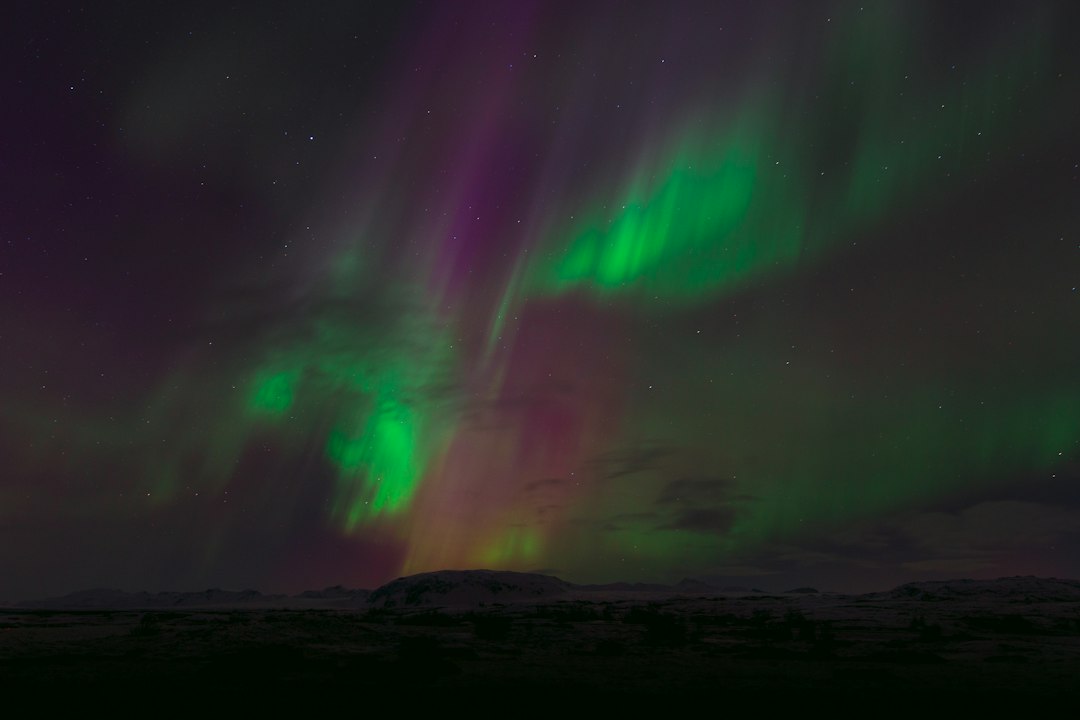
Solar storm northern lights happen when a burst of solar material hits Earth's magnetic field hard enough to push the aurora toward the equator. The bigger the storm, the farther south it reaches. But the part that decides your night is timing. The storm arrives on its own schedule. Across Solar Cycle 25, only 29% to 43% of strong-storm hours fell in darkness at the five cities we checked, roughly the same share as any random hour.
This guide covers what a solar storm alert actually means for the northern lights, built on 94 years of planetary Kp records. You'll see how often a storm's peak falls on your night, how long storms really last, why some huge ones fizzle, and what to do in the hours after an alert goes out. If a storm is underway right now, skip ahead and check the live northern lights forecast for your exact location.
How a Solar Storm Turns Into Northern Lights
A solar storm becomes visible aurora when a coronal mass ejection (CME) or a fast stream of solar wind reaches Earth carrying a magnetic field that points south, opposite to Earth's own. That orientation lets the sun's energy pour into the magnetosphere, and the auroral oval swells toward lower latitudes.
The term "solar storm" gets used for three different things, and only two of them make aurora:
- Solar flares are flashes of light and X-rays. They arrive in about eight minutes and can disrupt radio, but a flare alone does not cause aurora. It only hints that a CME may have launched with it.
- Coronal mass ejections are billion-ton clouds of magnetized plasma. According to NOAA's Space Weather Prediction Center, the fastest reach Earth in 15 to 18 hours, while slower ones take several days.
- Coronal hole streams are fast solar wind pouring out of gaps in the sun's corona. They produce frequent minor storms, and they come back roughly every 27 days as the sun rotates.
Once the material arrives, NOAA ranks the resulting geomagnetic storm from G1 (minor) to G5 (extreme), which lines up with Kp 5 through Kp 9. Our Kp index explainer covers that scale in full, and what causes the northern lights walks through the physics from the sun to the glow.
How Far South Each Storm Level Reaches
Each step up the Kp scale pushes the edge of the auroral oval roughly two degrees of geomagnetic latitude toward the equator, according to NOAA's aurora viewing guidance. A minor G1 storm reaches the northern-tier US and the Scottish Highlands, a strong G3 reaches New England and Pennsylvania, and only severe G4 to G5 storms reach the southern United States.
The table uses the naked-eye Kp thresholds behind our location forecasts. Each threshold assumes a dark site with a clear view north.
| Storm level | Kp | Where the aurora becomes visible to the naked eye |
|---|---|---|
| No storm needed | 1 to 3 | Fairbanks, Tromsø, Reykjavík, Shetland |
| G1 (minor) | 5 | Upper Michigan, Minnesota, North Dakota, Montana, Scottish Highlands |
| G2 (moderate) | 6 | Washington, Maine, Vermont, Oregon, northern England |
| G3 (strong) | 7 | Boston, Pennsylvania, Colorado |
| G4 to G5 (severe to extreme) | 8 to 9 | Much of the US and Europe; aurora reached the Florida Keys in May 2024 and Florida again in November 2025 |
Two caveats change how you should read this.
First, one storm level below your threshold is often still a camera-only show. A phone on night mode picks up green and pink that your eyes register as a pale gray glow. That gap between camera and eye is why our forecast has a separate Camera only verdict. The northern lights photography guide covers the settings that catch it.
Second, at the far southern edge you are not seeing aurora overhead. When Floridians photographed aurora on 11 November 2025, they were most likely seeing the high upper edge of a display far to the north, low on the horizon. NOAA notes that from a good vantage point you can see aurora even when it is about 1,000 km (600 miles) farther north. NASA's Astronomy Picture of the Day featured one of those Florida frames.
Solar Storm Northern Lights Are a Timing Gamble
At the five northern cities we checked, only 29% to 43% of strong-storm hours in Solar Cycle 25 fell in darkness, almost exactly the share you would get by picking random hours of the year. Storms do not wait for your night. They arrive when the CME arrives.
To measure this, we took every three-hour block in which Kp reached 7- or higher (strong-storm territory, G3 and above) from the start of Solar Cycle 25 in December 2019 through 2 October 2026, using the official GFZ Potsdam Kp record. That comes to 303 storm hours. We then checked, in 10-minute steps, whether the sun was at least 10 degrees below the horizon at each city during those hours. That is the same darkness cut-off our live forecast uses for naked-eye aurora.
| City | Share of strong-storm hours in darkness | Share of all hours in darkness (2020 to 2026) |
|---|---|---|
| Seattle | 38% | 40% |
| Minneapolis | 43% | 41% |
| Boston | 43% | 42% |
| Edinburgh | 37% | 37% |
| Tromsø | 29% | 31% |
The two columns are nearly identical. Strong-storm hours fall in darkness at almost exactly the rate darkness occurs. In practice, more than half of all strong-storm hours were spent in daylight or twilight in all five cities.
The storm-by-storm picture is even more lopsided. Here is every storm since 2019 that reached Kp 8- or higher, with the share of its Kp 7-and-above hours that fell in each city's darkness.
| Storm (UTC) | Peak Kp | Hours at Kp 7- or higher | Seattle | Minneapolis | Boston | Edinburgh | Tromsø |
|---|---|---|---|---|---|---|---|
| 4 Nov 2021 | 8- | 6 | 100% | 100% | 75% | 8% | 0% |
| 23 to 24 Mar 2023 | 8 | 9 | 28% | 50% | 67% | 89% | 61% |
| 23 to 24 Apr 2023 | 8+ | 15 | 33% | 47% | 57% | 43% | 0% |
| 24 Mar 2024 | 8+ | 6 | 0% | 0% | 0% | 25% | 33% |
| 10 to 12 May 2024 | 9 | 36 | 24% | 29% | 29% | 19% | 0% |
| 28 Jun 2024 | 8- | 3 | 0% | 0% | 0% | 0% | 0% |
| 12 Aug 2024 | 8 | 18 | 42% | 42% | 44% | 19% | 0% |
| 10 to 11 Oct 2024 | 9- | 21 | 45% | 52% | 52% | 52% | 52% |
| 1 Jan 2025 | 8 | 6 | 50% | 17% | 0% | 17% | 58% |
| 16 Apr 2025 | 8- | 6 | 8% | 0% | 0% | 8% | 0% |
| 1 Jun 2025 | 8- | 12 | 42% | 29% | 17% | 0% | 0% |
| 12 Nov 2025 | 9- | 12 | 88% | 100% | 88% | 54% | 50% |
| 19 to 21 Jan 2026 | 9- | 36 | 47% | 53% | 56% | 65% | 69% |
Three of these thirteen severe storms spent most or all of their strong hours in daylight on both sides of the Atlantic. The 24 March 2024 storm hit Kp 8+ for a single block in the European late afternoon and was over before dusk in the US. Tromsø, the "aurora capital," got zero dark storm hours from seven of the thirteen. Six of those fell between April and August, when the Arctic sky never gets dark enough.
November 2025 is what a lucky storm looks like. The CME struck at 7:10 p.m. Eastern, according to the USGS, so its peak landed squarely on the North American night. The US remembers it as one of the best displays of the cycle. Its peak Kp was no higher than October 2024's. Timing did the rest.
Forecasters cannot fix this for you a day ahead, either. A review of real-time CME model runs at NASA's Community Coordinated Modeling Center from 2010 to 2016 found a mean absolute arrival-time error of 10.4 hours (plus or minus 0.9) across 273 correctly predicted arrivals at Earth and at NASA's two STEREO spacecraft, with predictions tending to run about four hours early. A forecast "evening arrival" can easily turn into a mid-morning one.
Most Solar Storms Are Over in Six Hours
Most strong solar storms are short. Of the 39 separate episodes in Solar Cycle 25 when Kp reached 7- or higher (counting a single three-hour dip as part of the same episode), 17 spent just one three-hour block at that level, and 28 spent six hours or less. The median was six hours.
That changes how you should treat an alert. A storm that peaks during your afternoon is usually not saving its best for after dark. Only a handful of events, such as May 2024 and January 2026, held strong levels for a day and a half, long enough to give every longitude a turn.
The storm hours themselves are not continuous either. Within a stormy three-hour block, the aurora comes in surges called substorms, each lasting tens of minutes, with quieter gaps between them. Our post on how long the northern lights last explains that rhythm and why giving up during a lull is the classic mistake.
Why Some Big Solar Storms Fizzle
A big solar storm can produce disappointing northern lights when the magnetic field inside the arriving CME points north instead of south. Space weather forecasters call this the Bz component. A northward Bz shuts the door on most of the energy, however fast and dense the cloud is.
The January 2026 storm shows both problems at once. NOAA reported that G4 levels were first reached at 2:38 p.m. EST on 19 January, in broad daylight across the US. By the time North America got dark, the field had turned north for long stretches. As EarthSky put it, that sustained northward orientation "sharply limited the transfer of energy into Earth's magnetosphere," and many people who had been promised a severe storm saw little, even though the three-hourly Kp stayed high enough to keep the storm in the table above.
Nobody can measure Bz until the CME reaches the solar wind monitors at the L1 point, about 1.5 million kilometers (one million miles) upstream of Earth, where NOAA's SOLAR-1 observatory began operations in June 2026. According to NOAA, that typically gives 15 to 60 minutes of warning. This is why a storm watch issued two days ahead is a reason to stay ready, not a promise of a show. The real-time solar wind dashboard shows the Bz trace live. A common rule of thumb among chasers: a line that stays well below zero, around -10 nanoteslas or lower, for half an hour or more is the signal that matters.
When Solar Storms Happen: Equinoxes and the Declining Phase
Solar storms are most frequent around the March and September equinoxes and in the years just after solar maximum, not at the maximum itself. The 94-year GFZ record shows both patterns clearly.
The seasonal pattern first. From 1932 through 2025, here is the share of days in each month when Kp reached at least 5- (minor storm level) and at least 7- (strong storm level).
| Month | Days reaching Kp 5- or higher | Days reaching Kp 7- or higher |
|---|---|---|
| January | 17% | 1.4% |
| February | 22% | 2.1% |
| March | 28% | 4.1% |
| April | 28% | 5.0% |
| May | 21% | 4.0% |
| June | 17% | 2.5% |
| July | 18% | 2.5% |
| August | 21% | 3.1% |
| September | 26% | 4.7% |
| October | 26% | 4.2% |
| November | 20% | 2.5% |
| December | 15% | 1.0% |
March, April, September and October each bring a storm-level day about once every four days. December manages one in seven, and its rate of strong storms is a fifth of April's. The leading explanation for this equinox bias is the Russell-McPherron effect: the tilt of Earth's magnetic axis relative to the magnetic field carried in the solar wind. Around the equinoxes that geometry favors the southward coupling that drives storms.
For aurora chasers, this collides with darkness. December has the longest nights and the fewest storms. September and October offer the best compromise at mid-latitudes, with frequent storms and nights that are already long. In the Arctic, March is the stronger bet: storms are near their peak and the dark season still has a few weeks to run.
The yearly pattern matters just as much right now. Solar Cycle 25 reached its maximum in October 2024, with a smoothed sunspot number of 161 according to the Royal Observatory of Belgium's SIDC. Many people assume the storms faded after that. The Kp record says otherwise.
| Year | Solar cycle phase | Days reaching Kp 5- or higher | Days reaching Kp 7- or higher |
|---|---|---|---|
| 2001 | Cycle 23 maximum | 63 | 17 |
| 2003 | Cycle 23, two years past maximum | 158 | 17 |
| 2009 | Solar minimum | 4 | 0 |
| 2014 | Cycle 24 maximum | 23 | 0 |
| 2015 | Cycle 24, one year past maximum | 69 | 8 |
| 2020 | Solar minimum | 9 | 0 |
| 2024 | Cycle 25 maximum | 46 | 14 |
| 2025 | Cycle 25, one year past maximum | 97 | 13 |
| 2026 (to 2 Oct) | Cycle 25, declining | 48 | 6 |
2025 had 97 storm-level days, more than double 2024 and the most of any year since 2003. In both of the previous cycles, the busiest storm years came after the sunspot peak, when big coronal holes and the last powerful active regions combine. The famous Halloween storms of October 2003 struck about two years after Cycle 23's maximum in November 2001, as dated by SILSO's cycle table. 2026 is on pace for about 64 storm-level days, so the next two or three autumns remain well worth watching. (GFZ values from September 2026 onward are still preliminary.)
What to Do When a Solar Storm Alert Goes Out
When a solar storm alert goes out, check your own sky in the hours before dark and be ready to go out at short notice. Do not plan around the headline storm level. NOAA's alerts come in three tiers, and each one calls for a different response.
1. A Watch (one to three days out). NOAA usually issues geomagnetic storm watches after an Earth-directed CME is spotted, as explained on its alerts and subscriptions page. Confidence in timing and strength is low. Use the watch to plan. Find a dark spot with an open northern horizon, check the cloud forecast for both nights in the window, and note when the moon rises and sets.
2. A Warning (minutes to a few hours out). Warnings are based on solar wind measured upstream at L1, so the storm is real and close. This is the moment to check the Bz trace and your local verdict. If Bz is pointing firmly south and your sky is clear and dark, go.
3. An Alert (it is happening now). An alert means magnetometers on the ground have measured a given G-level. Because Kp is reported in three-hour blocks, the substorm behind the alert may already be fading. Stay out through at least one quiet spell. Substorms can recur every hour or two while the storm lasts.
A few habits pay off on storm nights in particular:
- Look higher and farther south than usual. In a strong storm the aurora can climb overhead or form a corona at the zenith, and a red glow can appear even to the south.
- Take a phone photo every few minutes, even when you see nothing. During storms the camera often catches structure before your eyes do, and it is the best early sign the oval is moving your way.
- Do not trust the headline Kp to describe your sky. A G4 storm under overcast is invisible. A G1 on a crisp, moonless night from a dark shore can beat it. Our field guide on how to see the northern lights covers the full checklist, and NOAA's own aurora viewing tips agree on the basics.
This is the gap our northern lights forecast is built to close. It takes the storm forecast and checks the other three things that decide whether you see it: your clouds, your darkness and the moon or light pollution washing out your sky. It then returns one of three verdicts, Not tonight, Camera only or Yes, naked eye, for the exact place you plan to stand.
Frequently Asked Questions
Will a solar storm bring the northern lights tonight?
Only if the storm's strong hours overlap your darkness, your sky is clear, and the CME's magnetic field points south. Across Solar Cycle 25, only 29% to 43% of strong-storm hours fell in darkness at the five cities we checked, about the same as any random hour. Check the live forecast for your location rather than the national headline.
Is a solar storm dangerous?
Not to people on the ground. Earth's atmosphere and magnetic field shield us. Severe storms can disturb power grids, GPS accuracy, high-frequency radio and satellites, which is why NOAA tracks them on its space weather scales.
Are solar storms over now that solar maximum has passed?
No. Solar maximum came in October 2024, but 2025 had more storm-level days than any year since 2003, and the busiest storm years of the two previous cycles also came after their peaks. Strong storms will grow rarer over the next few years, but they will not disappear.
More Articles
The Kp Index, Explained: Why the Aurora Number Is Not a Promise
The kp index is a 0 to 9 scale of geomagnetic activity. Here is what the aurora number really means, and why a high value is no promise.
What Causes the Northern Lights? The Science Behind the Aurora Borealis
What causes the northern lights? The sun sends charged particles that hit our atmosphere near the poles. The full science, in plain English.
How to See the Northern Lights: A Practical Field Guide
How to see the northern lights: the four-factor field checklist, activity, clouds, darkness, and moonlight, that decides every aurora night.