How Long Do Northern Lights Last? Minutes, Hours, and Whole Nights
Northern lights can brighten for minutes, recur over hours or accompany a multi-day storm. Learn what limits the time you can actually watch.

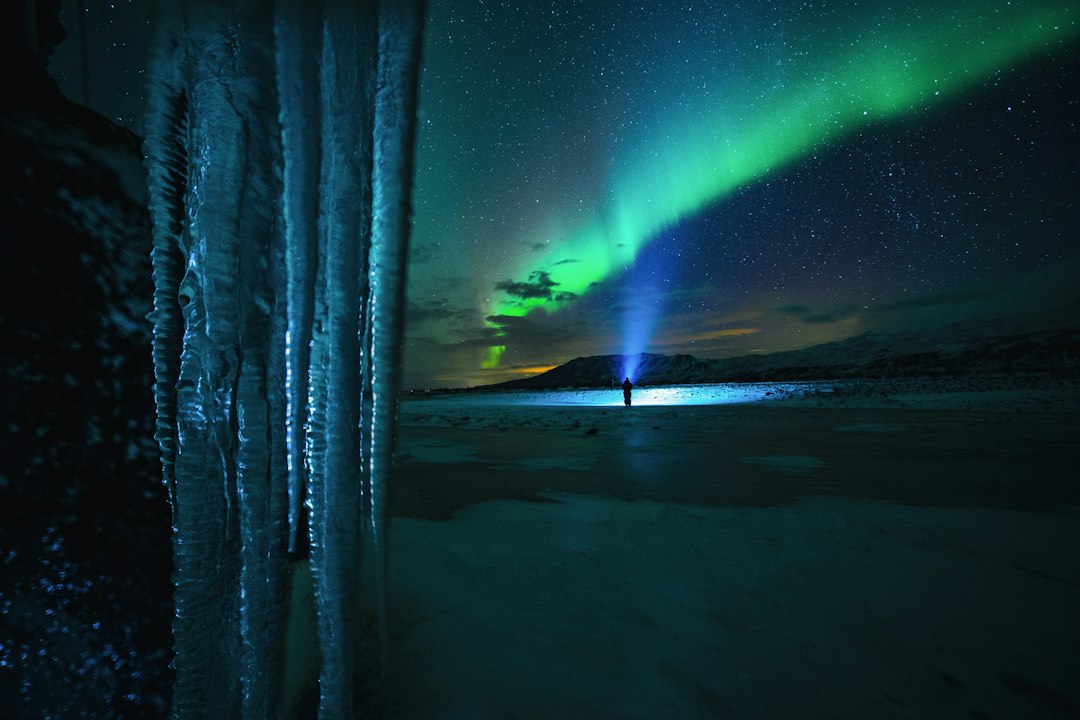
How long do northern lights last?
There is no single duration. A bright breakup may last minutes to tens of minutes, quieter aurora can persist or recur for hours, and geomagnetic storms can create opportunities on more than one night. For an observer, darkness and clear sky limit how long the display is visible locally—not how long the aurora itself exists. Our live northern lights forecast shows potential dark, clear and active hours for your location.
Ask how long do northern lights last and you will get answers ranging from "ten minutes" to "all night," both of which are true and neither of which helps you plan. The confusion comes from the fact that four completely different clocks are running at once: the bright flare-up, the substorm cycle it belongs to, the geomagnetic storm driving the substorms, and the solar structure driving the storm.
Then there is a fifth clock for the observer: the sun. Aurora can continue in daylight, but you generally cannot see it with the naked eye once the sky is too bright. At high-latitude destinations, the available dark window changes sharply with season.
Here is all five, in order of the one you will notice first.
How Long Do Northern Lights Last on Each of the Four Clocks
The four aurora clocks run from 15 minutes to several weeks, and each one answers a different planning question.
| Clock | Typical duration | What it decides |
|---|---|---|
| The breakup (expansion phase) | Often minutes to tens of minutes | Whether you are outside at the right moment |
| The substorm cycle | 1 to 3 hours, up to 4 per night | How many chances you get tonight |
| The geomagnetic storm | 6 hours to 3 days | Whether tomorrow night is also worth staying up for |
| The solar source | Days, recurring at 27 days | Whether to rebook for next month |
The breakup is the thing you came for. A quiet arc that has been sitting on the northern horizon for an hour suddenly brightens, splits into rays, and starts moving fast enough that you can see it change. The Geophysical Institute at the University of Alaska Fairbanks describes the full substorm sequence running from brightening through wavy motion to breakup "in as short a time as from one to three hours," with the violent part occupying a fraction of that. Auroral physicist S. I. Akasofu recorded as many as four substorms in a single night.
The substorm cycle is the growth, expansion, and recovery around that breakup. Energy loads into the tail of Earth's magnetosphere for an hour or two, releases in minutes, then unwinds into patchy, pulsating light that can drift on for hours. The long dull stretch is not a failed night. It is the growth phase, and it is the reason the aurora "came back" after you gave up and went inside.
The storm is the multi-hour disturbance the substorms live inside. The May 2024 event, the strongest in two decades, reached Kp 9 at 03:00 UTC on 11 May and stayed at storm levels from 10 May until it faded around 13 May. Even then, aurora was widely visible on two nights, not three days, because most of those storm hours fell in daylight somewhere.
The solar source influences how many nights may be active. A coronal mass ejection or a stream from a coronal hole can affect Earth for more than one night; neither supplies a guaranteed schedule. NOAA notes that coronal holes can persist across solar rotations, so a roughly 27-day recurrence is possible, not promised.
Your Latitude Changes the Answer Completely
How long the northern lights last for you depends on where you stand, because different latitudes see different parts of the same substorm. This is the single biggest thing missing from most duration guides, which give one number to everybody.
The auroral oval is a ring centred on the geomagnetic pole. If you are inside or near it, you have more opportunities to see aurora, including faint arcs between brighter bursts, but it is not visible every dark hour. Farther south, a stronger disturbance is usually needed for a local sighting.
| Where you are | What the night looks like | Realistic "duration" |
|---|---|---|
| Under the oval (Tromsø, Fairbanks, Abisko, Yellowknife) | More opportunities for quiet arcs and brighter bursts | Potentially hours, but no guaranteed display |
| Oval edge (Reykjavik, northern Scotland, Shetland) | A band may appear during active hours | Variable; check current activity and cloud |
| Below the oval (Michigan, Minnesota, Washington, northern England) | Stronger activity is usually needed | Brief or prolonged depending on the storm |
For a reader in Michigan or Washington State, the visible window often depends on how far south a disturbance extends and whether skies are clear at that moment. A person in Tromsø and one farther south can report very different experiences of the same storm; neither report establishes a fixed duration for the event.
It also changes how you wait. Under the oval, longer dark windows may offer another chance after a lull. Farther south, a brief active period can be easy to miss, so watch short-range forecasts and alerts.
The Ceiling Nobody Mentions: How Long Your Sky Is Actually Dark
Your visible window cannot exceed the hours when your local sky is dark enough, even if auroral activity continues elsewhere or into daylight. We computed that viewing window with the same solar elevation model our forecast uses, counting hours per night when the sun sits at or below 10 degrees under the horizon, the threshold our visibility methodology treats as dark enough for naked-eye aurora.
Hours of aurora-grade darkness per night, mid-month:
| Location | Sep | Oct | Nov | Dec | Jan | Feb | Mar | Apr |
|---|---|---|---|---|---|---|---|---|
| Tromsø, Norway (69.6°N) | 6.7 | 11.3 | 14.9 | 17.1 | 16.0 | 12.7 | 8.8 | 1.4 |
| Fairbanks, Alaska (64.8°N) | 7.8 | 11.3 | 14.2 | 15.8 | 15.0 | 12.4 | 9.4 | 5.1 |
| Reykjavik, Iceland (64.1°N) | 8.0 | 11.3 | 14.1 | 15.6 | 14.9 | 12.4 | 9.5 | 5.4 |
| Caithness, Scotland (58.6°N) | 8.7 | 11.3 | 13.5 | 14.7 | 14.1 | 12.2 | 9.9 | 6.9 |
| Marquette, Michigan (46.5°N) | 9.6 | 11.3 | 12.7 | 13.4 | 13.0 | 11.8 | 10.3 | 8.5 |
Read the April column twice. A traveller flying to Tromsø for an April aurora trip has a 1.4-hour window per night in which any of this is possible, while someone standing in a field in Michigan has 8.5 hours. In mid-August, when plenty of operators say the season has begun, Tromsø gets 0.0 hours of aurora-grade darkness. Zero. Fairbanks on the same date already gets 2.5, and by 1 September Tromsø has clawed its way to just 3.6 hours.
The other thing the table shows is the crossover. Around 15 October every latitude in the list converges on 11.3 hours, and after that the ranking flips: the far north goes from having the shortest nights to the longest. Latitude does not buy you viewing time until roughly mid-October. What it buys you before then is a lower activity threshold, which is a different advantage and the reason the best places to see the northern lights are still worth the flight in September.
One more subtraction. NOAA puts the best aurora "within an hour or two of midnight (between 10 PM and 2 AM local time)", a four-hour prime window. At Tromsø in April, only 1.4 of those four hours are dark. You are not just getting less night. You are getting less of the part of the night that matters.
Why No Forecast Can Tell You How Long It Will Last
No forecast can promise how long a particular bright arc will last. Some products update on shorter timescales than a three-hour Kp block, including NOAA's 30-minute aurora forecast, but they still do not give an exact start and stop time for a display at your viewpoint.
The Kp index, the number every headline quotes, is a three-hour average. A breakup lasting 25 minutes is roughly one twelfth of a Kp block, which means an intense burst gets averaged down and a mediocre but steady night gets averaged up. A vigorous substorm during a Kp 3 period will beat a flat Kp 6 every time. We go deeper into that in our explainer on what the Kp index really measures, but the short version is that Kp was built to describe planetary magnetic disturbance over three hours, not to time a light show over your field.
Upstream data does not rescue you either. NOAA's DSCOVR spacecraft measures the incoming solar wind from the L1 point about a million miles out, which typically allows 15 to 60 minutes of lead time before that wind reaches Earth. That is genuinely useful for deciding whether to put your coat on. It is useless for deciding whether to book Thursday or Friday.
Treat forecasts as guides to promising windows, not exact schedules. Our aurora forecast tool gives an hour-by-hour view of darkness, cloud and activity with a plain verdict of "Not tonight," "Camera only," or "Yes, naked eye." It helps choose when to go outside, but cannot time each burst.
How Long Should You Actually Stay Out?
If conditions are promising, allow several hours outdoors rather than expecting a show at one scheduled minute. There may be long quiet stretches between brighter phases, and some nights produce no visible display at all.
Three things eat the time you think you have:
Dark adaptation costs you the first half hour. Your night vision depends on rhodopsin rebuilding in the rods of your retina, and the US National Park Service puts that process at 20 to 30 minutes, reset by a single glance at a white phone screen. If a display lasts 20 minutes and you step out of a lit car as it starts, you will spend the entire event with eyes that cannot resolve it. Arrive early, kill the headlights, and use red light only.
Clouds move on their own clock. A gap in the cloud and a gap in the aurora rarely line up. Some of the best nights are a patchwork of ten clear minutes here and twenty there, which is another argument for staying put rather than driving between viewpoints.
Nights, not hours, are the useful trip-planning unit. A single-night sighting chance varies by place, season, cloud and activity; it is not a universal coin flip. Explore Fairbanks reports that with three or more nights out in the late evening hours, sighting probability exceeds 90 percent in its skies. More nights can improve your chance of a clear, active window, though a tour or cruise is not automatically better than a self-guided trip.
When should you pack up? Two rules. If the sky has been completely overcast for 90 minutes and the short-range cloud forecast shows no break, go to bed. If it is clear and quiet, stay: a dead sky at 11 PM is often the growth phase of a substorm that breaks at 12:30 AM.
What a Long Aurora Night Actually Looks Like
A long aurora night is not continuous. It is a sequence, and knowing the sequence keeps you from leaving during the boring part.
Here is the shape of a good night under or near the oval, with rough timings from the substorm cycle:
- Nothing, or a grey smudge low in the north. This is real aurora, too faint for colour vision. Your camera will already see green. Can last an hour or more.
- A defined arc. A pale green band across the northern sky, static, unimpressive in person, beautiful in a photo. This is the growth phase loading.
- Brightening and motion. The arc sharpens, rays appear, the whole structure starts drifting. You have minutes of warning.
- Breakup. Fast movement can last minutes to tens of minutes, sometimes with coronas or red and magenta above the green. Duration and intensity vary.
- Patchy, pulsating glow. The recovery phase. Blobs of light switching on and off across the sky, gradually fading. Can run an hour or two.
- Repeat, or not. On an active night the cycle reloads and you get another breakup one to three hours later.
The transition from step 4 to step 5 fools a lot of people into thinking it is over. It is not necessarily over; it is the second half of one cycle, and another may be loading. Photographers should also note that the shutter speed that worked in step 2 will smear everything in step 4, which we cover in detail in our guide to photographing the northern lights.
Frequently Asked Questions
Do the northern lights last all night? Sometimes, especially under the oval during active conditions, but not at full intensity throughout. Faint arcs and brighter bursts may alternate, and the timing is variable. Even during a strong storm, a local observer needs dark, clear sky to see them.
What time do northern lights appear? Most often between 10 PM and 2 AM local time, around magnetic midnight. NOAA notes that these active hours expand toward evening and morning as geomagnetic activity rises, so during a strong storm displays can start before 9 PM and continue past 3 AM.
How long do northern lights last in Iceland or Norway? The same physics applies, but the ceiling is darkness. Reykjavik gets about 8 hours of aurora-grade darkness in mid-September, 15.6 in December, and 5.4 in April. Cloud cover is the bigger constraint on both the Icelandic and Norwegian coasts, which is why a clear five-hour window there can be worth more than a cloudy fifteen.
If the aurora stops, how long should I wait for it to come back? Give it 60 to 90 minutes of clear sky before concluding the night is done. That covers a typical growth phase. If you are checking the four-factor field checklist and activity, cloud, darkness, and moonlight all still favour you, waiting is almost always the right call.
The Practical Takeaway
If you remember one thing, make it this: a bright burst, the broader auroral activity and your local viewing window are different clocks. Plan multiple dark, clear nights when possible, and use short-term forecasts to decide when to go outside.
Before you decide which night to stay up for, check how many dark, clear, active hours your location actually gets. Our hour-by-hour aurora timeline covers destinations from Fairbanks to northern Scotland, and it will tell you plainly when there is no point putting your boots on.
More Articles
How to See the Northern Lights: A Practical Field Guide
How to see the northern lights: the four-factor field checklist, activity, clouds, darkness, and moonlight, that decides every aurora night.
The Kp Index, Explained: Why the Aurora Number Is Not a Promise
The kp index is a 0 to 9 scale of geomagnetic activity. Here is what the aurora number really means, and why a high value is no promise.
Best Place to See Northern Lights: Compared by the Three Numbers That Matter
The best place to see northern lights is where dark nights, a low Kp threshold and clear skies overlap. We compare 17 destinations on all three.