Mt Fuji Cherry Blossom 2026: Best Spots, Peak Bloom & Visibility Guide
Plan your Mt Fuji cherry blossom trip with our 2026 bloom forecast, top sakura spots, and real-time visibility tips to see both Fuji and sakura together.

When do cherry blossoms bloom at Mt. Fuji?
Mt Fuji cherry blossoms typically peak between April 6 and April 13, roughly 7-10 days after Tokyo due to the higher elevation of the Fuji Five Lakes region. The best spots to see sakura with Mt Fuji include Chureito Pagoda, Lake Kawaguchiko's north shore, and Oshino Hakkai. Visibility of the mountain itself is critical for the full experience, so check conditions before you go.
The photograph of cherry blossoms framing a snow-capped Mt Fuji is one of Japan's most iconic images. Every spring, thousands of visitors travel to the Fuji Five Lakes region hoping to capture this exact scene. But getting the shot requires more than showing up during bloom season. You need the right timing, the right location, and most importantly, a clear view of the mountain.
Mt Fuji is only visible about 40-50% of spring days. Combine that with a cherry blossom window that lasts roughly one week, and you have a narrow opportunity. This guide covers the 2026 bloom forecast, the best sakura viewing spots, and how to use real-time visibility data to maximize your chances of seeing both Fuji and cherry blossoms together.
Table of Contents
- 2026 Cherry Blossom Forecast
- Best Mt Fuji Cherry Blossom Spots
- Mt Fuji Visibility During Cherry Blossom Season
- How to Plan Your Visit
- Getting There from Tokyo
- Photography Tips for Sakura and Mt Fuji
- Frequently Asked Questions
- Check Current Visibility
2026 Cherry Blossom Forecast
Cherry blossoms in the Mt Fuji area bloom significantly later than Tokyo. The Fuji Five Lakes region sits at 700-1,000 meters elevation, which delays bloom by 7-10 days compared to central Tokyo.
Expected 2026 Bloom Timeline
| Stage | Estimated Date | Notes |
|---|---|---|
| First bloom (kaika) | March 29 - April 2 | Earliest flowers appear |
| Half bloom | April 4 - April 8 | Trees 50% open |
| Full bloom (mankai) | April 6 - April 13 | Peak viewing window |
| Scattering begins | April 14 - April 18 | Petals start falling |
These dates are based on forecasts from the Japan Meteorological Corporation and local Yamanashi sources. Bloom timing varies by location within the region:
- Chureito Pagoda: Peak typically April 10-16 due to slightly higher elevation
- Lake Kawaguchiko north shore: Peak April 8-14
- Oshino Hakkai: Peaks 5-7 days after Kawaguchiko, around April 13-18
For up-to-date seasonal patterns, see our best time to see Mt Fuji guide, which covers visibility rates across all months.
Best Mt Fuji Cherry Blossom Spots
Chureito Pagoda (Arakurayama Sengen Park)
The most famous cherry blossom and Mt Fuji viewpoint in the world. The five-story red pagoda, framed by sakura, with Mt Fuji rising behind it is Japan's quintessential photograph.
Key details:
- 398 stone steps to the observation deck
- Free entry, but a color-coded ticketing system limits deck time to approximately 5 minutes during peak bloom
- Expect 30-60 minute waits during midday
- Arrive before 6 AM to minimize wait times
During peak bloom, crowds are substantial regardless of time of day. Weekdays are significantly less crowded than weekends. Read our full Chureito Pagoda guide for detailed access information, transport options, and photography advice.
Lake Kawaguchiko North Shore
The northern shore of Lake Kawaguchiko offers a more relaxed cherry blossom experience than Chureito Pagoda. Hundreds of cherry trees line the lakeside walking path, creating a stunning foreground for Mt Fuji across the water.
Highlights:
- Walking path stretches approximately 1.5 km along the north shore
- Less crowded than Chureito Pagoda with more room to photograph
- Fuji-Kawaguchiko Cherry Blossom Festival runs from March 28 through April 12
- Festival hours: 10:00 AM - 5:00 PM with food stalls and local crafts
Oishi Park at the eastern end of the north shore is particularly photogenic, combining seasonal flower gardens with unobstructed Fuji views. For a comparison of all major viewpoints, see our Mt Fuji viewing locations guide.
Oshino Hakkai
This UNESCO World Heritage site consists of eight crystal-clear ponds fed by Mt Fuji snowmelt. In spring, cherry trees surrounding the ponds create beautiful reflections, with traditional thatched-roof buildings and Mt Fuji in the background.
What makes it special:
- Cherry trees lining the Shinnashogawa River offer a quieter alternative to Kawaguchiko
- Wooden bridges provide striking foreground elements for photography
- Clearer water visibility during spring snowmelt season
- Peaks 5-7 days after Kawaguchiko, extending your viewing window
Fuji Motosuko Resort (Shibazakura Festival)
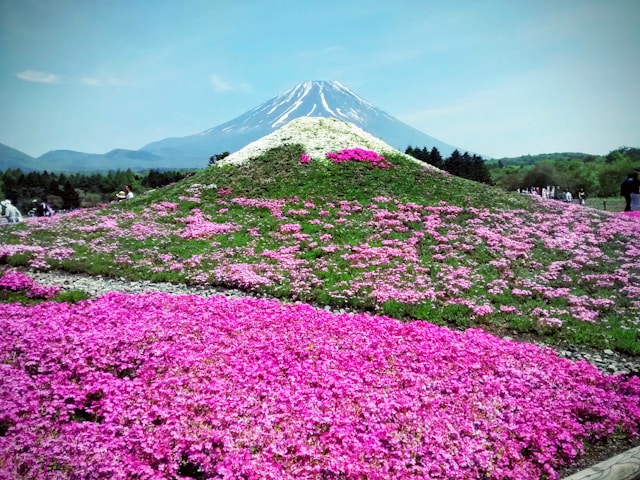
For a different spring flower experience, the Fuji Shibazakura Festival features 500,000 moss phlox plants in pink, white, and purple carpeting the ground with Mt Fuji as backdrop. This festival typically runs from mid-April through late May, overlapping with late cherry blossom season.
Mt Fuji Visibility During Cherry Blossom Season
Here is the challenge that most cherry blossom guides ignore: Mt Fuji is frequently hidden by clouds during spring. Seeing both sakura and a clear mountain requires careful planning.
Spring Visibility Statistics
| Month | Visibility Rate | Notes |
|---|---|---|
| March | ~48% | Transitioning from winter clarity |
| April | ~40% | Cherry blossom season, increasing cloud cover |
| May | ~30% | Humidity rising, frequent cloud buildup |
Compare this to winter months when visibility reaches 55-65%. Spring offers moderate odds, but they drop significantly as the season progresses. Our weather forecast guide explains the atmospheric factors in detail.
Best Time of Day for Clear Views
Morning is critical during cherry blossom season. Cloud cover builds through the day as temperatures rise.
- 6:00 - 9:00 AM: Highest visibility probability, clear skies before thermal clouds form
- 9:00 AM - 12:00 PM: Visibility begins declining, cumulus clouds often develop around the summit
- After 12:00 PM: Lowest visibility, clouds frequently obscure the mountain entirely
One visitor reported a perfectly clear Fuji at 9 AM that was completely hidden by clouds just 20 minutes later. The morning window is not just optimal, it is often your only chance.
How to Check Before You Go
Use our real-time Mt Fuji visibility forecast to check conditions on the day of your visit. The forecast updates every 15 minutes and provides a 0-100 visibility score based on cloud cover, humidity, and atmospheric conditions. Learn how we calculate these scores on our methodology page.
A score above 70 means good conditions for seeing both sakura and Mt Fuji. Below 50, consider adjusting your plans or focusing on cherry blossom spots that are beautiful regardless of mountain visibility.
How to Plan Your Visit
Stay Overnight at Kawaguchiko
The single most effective strategy for cherry blossom success. Staying near Kawaguchiko gives you:
- Early morning access before day-trippers arrive from Tokyo (first buses arrive around 10 AM)
- Multiple morning attempts if weather does not cooperate on day one
- Flexibility to visit different spots based on conditions
Book accommodation well in advance. Hotels and ryokans in the Kawaguchiko area fill months ahead during cherry blossom season.
Build in Flexibility
Cherry blossoms last only 7-10 days at peak. Combine that with variable visibility, and you need backup days. If possible:
- Allow 2-3 days in the area to catch both peak bloom and clear skies
- Check the visibility forecast each morning before deciding where to go
- Have indoor backup plans (Fujisan World Heritage Center, onsens, local restaurants) for cloudy days
What to Bring
The Fuji Five Lakes area sits at 800-1,000 meters elevation. Spring mornings are cold, especially if you arrive before sunrise for photography.
- Warm layers for early morning (temperatures can be 2-8°C in early April)
- Comfortable walking shoes for the Chureito Pagoda steps and lakeside paths
- Rain gear, as spring weather changes quickly
- Portable snacks and water for early starts before shops open
Getting There from Tokyo
The Fuji Five Lakes region is approximately 2 hours from central Tokyo. For a comprehensive transport breakdown, see our Mt Fuji day trip from Tokyo guide.
Quickest Options
| Route | Duration | Cost | Notes |
|---|---|---|---|
| Fuji Excursion train (Shinjuku to Kawaguchiko) | ~2 hours | ~4,130 yen | Direct, requires advance reservation |
| Highway bus (Shinjuku to Kawaguchiko) | ~2 hours | ~2,200 yen | Book ahead during cherry blossom season |
| Car rental | ~1.5-2 hours | Varies | Parking is limited and paid during festival |
During cherry blossom season, buses and trains fill quickly. Book the Fuji Excursion at least a week in advance, and highway buses several days ahead.
Photography Tips for Sakura and Mt Fuji
Cherry blossom photography at Mt Fuji presents a unique challenge: you are combining a nearby subject (blossoms) with a distant mountain. For detailed camera settings and techniques, see our Mt Fuji photography guide.
Quick Settings Reference
| Setting | Recommendation |
|---|---|
| Aperture | f/8 to f/11 for depth of field covering blossoms to mountain |
| Focal length | 35-70mm for classic compositions |
| Time of day | Golden hour (6-7 AM) or soft morning light (7-9 AM) |
| White balance | Slightly warm to enhance pink tones |
Composition Ideas
Chureito Pagoda: The classic shot uses a 50mm focal length to frame the pagoda with sakura branches. Note that tripods are banned on the main observation deck.
Kawaguchiko lakeside: Use blossoms as foreground framing with the lake and Mt Fuji behind. Wide-angle lenses (24-35mm) work well for including both sakura canopy and mountain.
Oshino Hakkai: Reflections in the crystal-clear ponds create natural symmetry. Overcast light reduces glare on the water surface for better reflections.
Frequently Asked Questions
When is the best time to see cherry blossoms at Mt Fuji?
Full bloom around Mt Fuji typically occurs between April 6 and April 13, roughly 7-10 days after Tokyo. Chureito Pagoda peaks slightly later, around April 10-16. Check Japan Guide's cherry blossom forecast for updates as the season approaches.
Can I see Mt Fuji and cherry blossoms on a day trip from Tokyo?
Yes, but it requires an early start. Take the first Fuji Excursion train from Shinjuku (departing around 7 AM) to arrive by 9 AM. However, staying overnight significantly improves your chances of catching clear morning conditions. See our day trip planning guide for detailed itineraries.
What if Mt Fuji is not visible during cherry blossom season?
The cherry blossom spots are beautiful regardless of mountain visibility. Chureito Pagoda's sakura-lined stairway, Kawaguchiko's lakeside paths, and Oshino Hakkai's ponds all offer excellent photography even without Fuji. Check our visibility forecast each morning and prioritize mountain-facing spots on clear days.
Is it worth visiting Chureito Pagoda if I miss peak bloom?
Early bloom (April 2-6) and late bloom with scattering petals (April 14-18) both offer photogenic conditions with smaller crowds. The falling petal effect during late bloom can create dramatic photographs, especially in light wind.
Check Current Visibility
Ready to see if Mt Fuji is visible right now?
Check Mt Fuji Visibility - Real-time visibility score updated every 15 minutes.
Also explore visibility for Mt. Rainier in Seattle and Denali in Alaska.
More Articles
Lake Motosu: The 1,000-Yen View, and When It Actually Appears
Lake Motosu is the deepest, clearest Fuji Five Lake and home of the 1,000-yen note view. Access, camping, costs, and when the reflection appears.
Mt. Fuji from Hakone: Best Viewpoints and Visibility Guide
Can you see Mt. Fuji from Hakone? Yes, on about half of all days. Here are the best viewpoints, when to go, and how to check conditions.
Hakone Ropeway: Fares, Route, Mt. Fuji Views and When It Closes
The Hakone Ropeway now charges one flat fare. Real 2026 prices, exactly where Mt. Fuji appears, and the closures nobody warns you about.