Hakone Shrine: Torii Queue, Fuji View and Getting There
Hakone Shrine's lake torii faces away from Mt. Fuji. Where to stand to get both, when the queue is short, and the bus stop that is skipped midday.

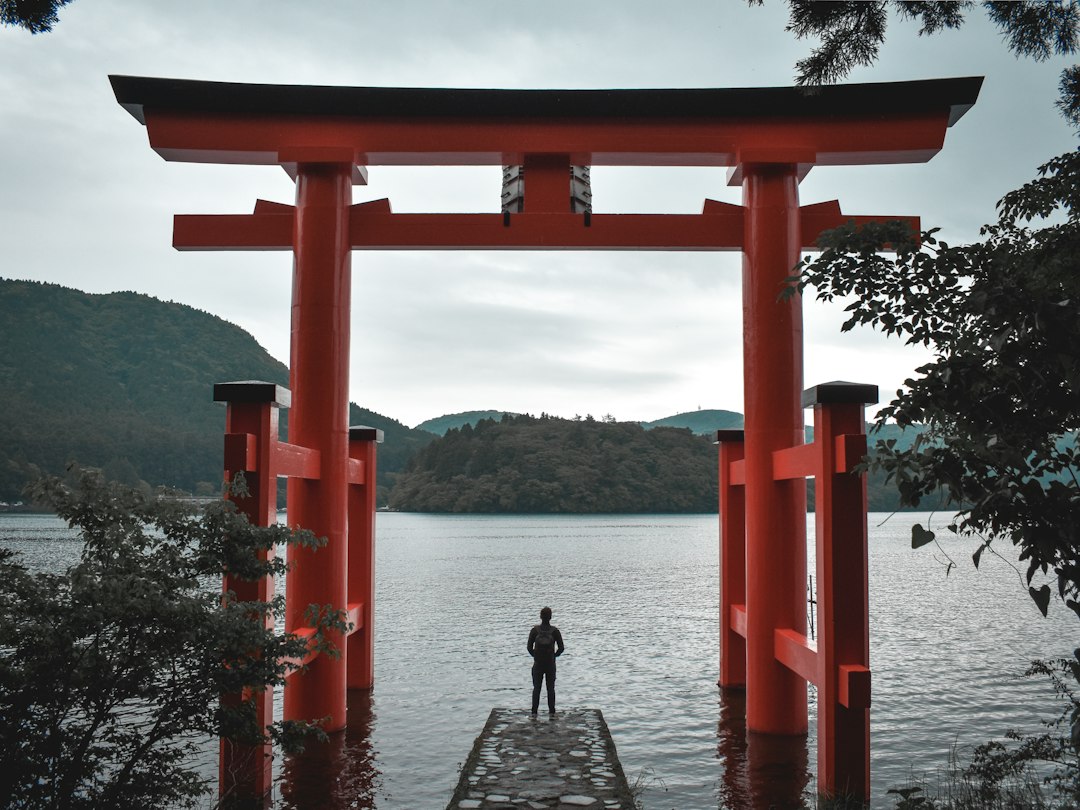
Hakone Shrine (Hakone Jinja) is the forested Shinto shrine on the southern shore of Lake Ashi whose red torii stands in the water. Most visitors come for two pictures: the gate over the lake, and the gate with Mt. Fuji behind it. They are not the same picture. They are not even taken from the same place.
From the famous spot at the foot of the torii you are looking south, and Mt. Fuji sits behind your right shoulder, hidden by the shrine's own hill. The shot with both is taken from the Moto-Hakone waterfront about half a kilometre away. This guide covers where to stand for each, how the sun and the queue change through the day, and how to get there without missing the bus stop that closes at midday.
| Hakone Shrine at a glance | |
|---|---|
| Admission | Free. The grounds and lakeside torii are always open. |
| Treasure hall | 9:00 to 16:30 (last entry 16:00), ¥500 adults, ¥300 elementary pupils |
| Amulet and goshuin office | 8:15 to 17:00 |
| Time needed | 30 to 60 minutes, plus any torii queue |
| Nearest stop | Moto-Hakone-ko bus stop or boat pier, about 10 minutes' walk |
| Mt. Fuji from the torii itself | No. The gate faces south, and Fuji is to the west-northwest behind a wooded hill. |
Can You See Mt. Fuji from Hakone Shrine?
You cannot see Mt. Fuji from the torii or from the main hall, but you can see both together from the Moto-Hakone port waterfront, where the gate sits almost directly below the summit. We checked this with a line-of-sight calculation on Japan's GSI 10-metre elevation model. It samples the ground every 15 metres from each spot toward Fuji's 3,776-metre summit and allows for Earth's curvature and normal atmospheric refraction.
The torii stands at the edge of a small bay with the shrine's hill rising behind it. The lake lies to the south, so the view through the gate looks south across Moto-Hakone bay toward a wooded headland. Fuji is 32 km away at a compass bearing of 303 degrees, about 120 degrees to the right of where the camera points. Even if you turn around, the forested slope rising 100 to 150 metres away hides that direction. Even without the trees, the slope itself would hide the summit.
The picture changes once you walk to the other side of the bay.
| Where you stand | Distance to Fuji | Where the torii is | How much of Fuji shows |
|---|---|---|---|
| At the torii (the queue spot) | 32.3 km | In front of you, facing south | None. The wooded shrine hill blocks it. |
| Main hall, top of the steps | 32.2 km | Below you, hidden by trees | None. The forested slope blocks it. |
| Lakeside walkway, south end of Moto-Hakone port | 32.8 km | 490 m away, within 1 degree of the summit | The upper cone: roughly the top 400 to 1,650 m, depending on how tall the trees on the headland are |
| Narukawa Art Museum terrace, about 25 m above the lake | 32.8 km | 570 m away, about 2 degrees left of the summit | Similar or slightly more, because the extra height clears more of the treeline |
| Lake cruise, approaching Moto-Hakone | Varies | Changes as the boat turns | Varies. This is the only place you can read the "Heiwa" plaque, which faces the water. |
The elevation model is bare earth, so it leaves out trees. The headland behind the torii is forested, which is why the table gives a range. With no trees, about the top 1,650 metres of Fuji would clear the ridge. With 20 to 30 metres of forest on it, that drops to somewhere between 400 and 1,000 metres. Either way you see the upper cone rising above the treeline, never the whole mountain from base to summit. A Japanese Fuji-photography guide to Moto-Hakone port describes the same thing. The spot is an easy, uncrowded shot, but Fuji's lower slopes are always cut off.
Two practical consequences follow from the geometry:
- Zoom in. From the walkway, every 10 metres of the torii's height covers about 1.2 degrees of your view, and the visible part of Fuji covers roughly 1 to 3 degrees. The two appear at similar sizes and both look tiny on a phone's standard lens. Use 2x to 4x zoom, or a 70 to 135 mm lens on a camera.
- Move along the shore. Tens of metres change which trees sit under the summit. Walk south along the waterfront until the cone clears the treeline, then line the gate up beneath it.
For other Fuji viewpoints around the caldera, including Komagatake and the ropeway, see our Mt. Fuji from Hakone guide.
Best Time to Visit Hakone Shrine: Queue, Light and Fuji
The best time to visit Hakone Shrine is before 9:00, when the torii queue is shortest, the sun is not in your eyes, and Mt. Fuji is most likely to be out. All three favour the morning, so the choice is easy.
The queue. Everyone wants the same frame: standing at the stone landing under the torii. Only one party can stand there at a time, so a queue forms along the lakeside steps. It is longest from late morning to mid-afternoon on weekends, holidays and in the autumn foliage season, and it can be almost empty at dawn.
The sun. The classic shot faces roughly south. Around the middle of the day from November to February, the sun sits nearly straight ahead, only 30 to 40 degrees up. The gate then turns into a silhouette against glare on the water. At 8:00 to 9:00 in winter the sun is 40 to 60 degrees to your left, which gives side light that brings out the red. The side of the gate facing you only gets direct sun between the spring and autumn equinoxes, and then only early in the morning and late in the afternoon. For the Fuji shot from the waterfront you face west-northwest, so the morning sun is behind you and lights both the gate and the mountain.
Fuji's odds. Mt. Fuji clears up most often in the early morning. The longest public record of this comes from Fuji City, which has logged the mountain from its city hall at set times every day since 1990. Across 1991 to 2025, Fuji was fully visible at 08:00 on 36.6% of days, at noon on 23.3%, and at 16:00 on 22.5%. That is one viewpoint on the Shizuoka side, not Lake Ashi, but the morning advantage is the same pattern our visibility scoring model picks up across the region.
A simple order for a clear morning:
- Check the forecast first. If the live Mt. Fuji visibility score says the mountain is hidden, skip the waterfront and go straight to the torii.
- If Fuji is out, go to the waterfront first. Morning clarity fades faster than the queue grows. Five minutes of shooting is enough.
- Walk to the torii, about 10 minutes along the shore road, and join the queue while it is still short.
- Climb to the main hall last. The forest and buildings do not change with the light or the crowd.
Staying at an inn on the lakeshore is the easiest way to be there at dawn. Our Hakone ryokan guide shows which lakeside areas also see Fuji from the room.
Hakone Shrine Month by Month
Hakone Shrine is worth visiting in any month, but Fuji's odds and the shrine's calendar change a lot through the year. The Fuji column shows the share of mornings with the mountain fully visible at 08:00 in Fuji City's 35-year record. Use it for relative odds, not as an exact figure for Lake Ashi.
| Month | Fuji fully visible at 08:00 (Fuji City, 1991-2025) | At the shrine |
|---|---|---|
| January | 60.0% | New Year (hatsumode) crowds in the first days. Kuzuryu Honmiya new-year festival on the 13th. |
| February | 52.6% | Setsubun festival on the day before the start of spring (2 or 3 February) |
| March | 40.7% | Quiet weekdays, cold dawns |
| April | 36.3% | Spring colour around the lake; crowds build toward late-April holidays |
| May | 30.2% | Golden Week crowds in the first week |
| June | 12.4% | Himeshara (Japanese stewartia) flowers from mid-June to mid-July |
| July | 9.9% | Kosui-sai lake festival on 31 July. In 2026 the area around the torii was closed from 13:00 to 15:00 that day for a purification rite. |
| August | 14.6% | Main annual festival (reitaisai) on 1 August. Lake Ashi summer festival week runs to 6 August. |
| September | 27.2% | Typhoon season. Fuji's odds start to recover. |
| October | 41.1% | Festival at the summit shrine, Hakone Motomiya, on 24 October |
| November | 53.9% | Autumn foliage and heavy weekend crowds |
| December | 61.7% | Year-end purification rite (Shiwasu Ohharae) on 31 December |
Monthly festivals (tsukinami-sai) are held at Hakone Shrine on the 1st and 15th of most months, and at the Kuzuryu main shrine on the 13th. Anyone can attend. December and January give the best chance of the torii-and-Fuji shot. June to August are the months to come for the forest, the rituals and the misty torii instead. For month-by-month detail on the mountain, see the best time to see Mt. Fuji.
What to See at Hakone Shrine
Hakone Shrine is a walk up through five torii gates to the main hall, with the lake gate (the sixth) reached by a side path down to the water. The whole visit takes 30 to 60 minutes without a queue.
The approach. The first torii straddles National Route 1 at the entrance to Moto-Hakone. According to the shrine, it is the largest torii in Japan built across Route 1, and Hakone Ekiden relay runners pass under it every January. The second and third gates lead into a flat avenue of old cedars. At the fourth gate, next to the purification fountain, the main approach climbs about 90 stone steps, passing the small Soga Shrine on the left. A side path with no steps runs through the woods for anyone who wants to avoid the stairs. Wheelchair users can take the lift from the treasure hall, according to the shrine's grounds guide.
The main hall. At the top, the vermilion hall is built in the gongen-zukuri style and sits in deep forest. Kuzuryu Shrine's Shingu (new shrine) stands just to its right, with the Ryujinsui dragon-spout water basin beside it. Look for the Anzan-sugi, a sacred cedar the shrine says is over 1,000 years old, and the Yatate-no-sugi cedar. On the slope behind the hall, a pure stand of himeshara trees is a prefectural natural monument. It is described as the northernmost such grove on Honshu.
The Heiwa no Torii. The lake gate was built in 1952 to celebrate two events: the investiture of Crown Prince Akihito and Japan's regained independence under the San Francisco Peace Treaty. In 1964, the shrine's 1,200th anniversary and the Tokyo Olympics, it received a plaque reading "Heiwa" (peace). The calligraphy is by former prime minister Shigeru Yoshida, who signed the treaty. It is the only gate at the shrine built in the ryobu style, with the extra support posts on each leg. The plaque faces the lake, so according to the Hakone Tourist Association you can only read it from a boat.
The treasure hall. Opened in 1907 and rebuilt in 2007, it holds a set of Heian and Kamakura-period statues of Shinto deities, among them a seated male deity from the early 11th century that is an Important Cultural Property. Entry is ¥500.
The history in brief. According to the shrine's own chronicle, worship on Mt. Hakone began with the mountain itself: the peak of Kamiyama, venerated from Komagatake. In 757 the monk Mangan built a shrine on the present site. As Hakone Gongen, it blended Shinto with Buddhism and mountain asceticism. It became the guardian shrine of the warrior class. Minamoto no Yoritomo made pilgrimages here, and Tokugawa Ieyasu funded a major rebuilding in 1612. It took the name Hakone Jinja when Shinto and Buddhism were separated in the early Meiji era. The year 2027 marks 1,270 years since its founding, and the shrine is running commemorative projects toward it.
Kuzuryu Shrine and the Three-Shrine Circuit
Kuzuryu Shrine has two sites. The Shingu stands next to Hakone Shrine's main hall. The Honmiya (main shrine), dedicated to the nine-headed dragon god of Lake Ashi, is in a lakeside forest about 30 minutes' walk from Hakone-en. Visiting Hakone Shrine, the Kuzuryu Honmiya and the summit shrine Hakone Motomiya is known as sanja mairi, the three-shrine pilgrimage. The shrine recommends it on its official site.
Getting to each one, per the shrine's access page:
- Kuzuryu Honmiya on foot. A lakeside path links Hakone-en and Kojiri. The Kuzuryu forest entrance is at the halfway point, about 30 minutes from either end. The path passes through Kuzuryu no Mori, which charges ¥600 entry. Entry is free for worshippers on the morning of the 13th and on other festival days.
- Kuzuryu Honmiya by boat. Paid motorboats run from the Hakone Hotel pier and the Hakone-en pier. Arriving by boat, you pay no forest entry.
- The 13th-of-the-month festival. A pilgrimage boat leaves Moto-Hakone at 9:20 for the 10:00 monthly festival at the Honmiya. Tickets cost ¥2,000 per person at the Moto-Hakone office of the Hakone Ashinoko Yuransen boats (not the pirate ships), and priests take registrations from 8:00 to 9:05. In bad weather the rite moves to the Shingu.
- Hakone Motomiya. Take the Komagatake ropeway from Hakone-en to the summit station (about 7 minutes, ¥2,200 return), then walk about 8 minutes to the shrine. The Hakone Freepass does not cover this ropeway; it only gives 10% off the return fare. On a clear day the summit is one of the best Fuji viewpoints in Hakone. Details are in our Hakone Ropeway guide.
Getting to Hakone Shrine
The simplest way to reach Hakone Shrine is Hakone Tozan Bus route H from Hakone-Yumoto station to Moto-Hakone-ko. It costs ¥1,210 one way and is timetabled at about 32 minutes. Allow longer on holidays, when Route 1 often backs up. From the stop it is about 10 minutes' walk along the lakeshore. Hakone Tozan Bus changes some timetables on 1 October 2026, so check Hakone Navi for current departures.
The midday bus-stop trap. There is a stop called "Hakone-jinja Iriguchi" (Hakone Shrine Entrance), which sounds like the obvious choice. Since April 2022, however, buses have skipped it in the middle of the day. The shrine's access page says 10:00 to 16:00, but the gap in the current route H timetable is wider: buses toward the lake stop there only until about 9:00 and again from about 17:30. During the day, ride to Moto-Hakone-ko and walk.
By lake cruise. If you are doing the Hakone loop, take the Tozan train to Gora, the cable car and ropeway to Togendai, then the sightseeing boat to Moto-Hakone. The boat costs ¥1,700 one way. Coming in on the boat gives you the lake-side view of the torii and, on a clear day, Fuji behind you to the right for much of the crossing. The Hakone Freepass (¥7,100 for two days from Shinjuku) covers the train, bus, ropeway and cruise. If you are also heading to the Fuji Five Lakes, compare it with the Fuji Hakone Pass.
From Kawaguchiko. Our Hakone to Kawaguchiko route guide covers the bus connections between the two areas, in either direction.
By car. The shrine has its own car parks, run on a one-way system, next to the second and third torii. The shrine warns that Route 1 up from Yumoto often backs up on holidays. Arrive before 9:00 or approach from the Mishima or Numazu side.
Hakone Shrine FAQ
Is Hakone Shrine free to visit?
Yes. The grounds, the main hall and the lakeside torii are free and open at all hours. Only the treasure hall charges admission: ¥500 for adults and ¥300 for elementary pupils.
Can you see Mt. Fuji from the Hakone Shrine torii?
Not from the torii itself. The gate faces south across Moto-Hakone bay, and Fuji lies to the west-northwest behind the shrine's wooded hill. For the famous photo with both, stand on the lakeside walkway at the south end of Moto-Hakone port, about 490 metres from the gate. From there the torii sits just below the summit.
How long is the wait for the Hakone Shrine torii photo?
It depends on when you arrive. At dawn there is often little or no wait. The line is longest from late morning to mid-afternoon, especially on weekends, holidays and in the November foliage season. Arrive before 8:30 to keep it short.
Is Hakone Shrine worth visiting on a cloudy day?
Yes. The cedar forest, the steps and the red gate in mist are the shrine's own attraction, and fewer people come out for the torii photo when the view is grey. Skip the Fuji waterfront, which only pays off when the mountain is out.
More Articles
Mt. Fuji from Hakone: Best Viewpoints and Visibility Guide
Can you see Mt. Fuji from Hakone? Yes, on about half of all days. Here are the best viewpoints, when to go, and how to check conditions.
Hakone Ropeway: Fares, Route, Mt. Fuji Views and When It Closes
The Hakone Ropeway now charges one flat fare. Real 2026 prices, exactly where Mt. Fuji appears, and the closures nobody warns you about.
Hakone Ryokan: Where to Stay, Fuji Views and Onsen Water
Choosing a Hakone ryokan? Terrain data shows which areas can see Mt. Fuji, where each area's bath water comes from, and how to time the stay.