Lake Ashi: Boats, Fuji Views and When to Go (2026)
Lake Ashi sees Mt. Fuji from only a third of its surface. Where the view opens, which boat to take, 2026 fares, and why the first sailing is too late.

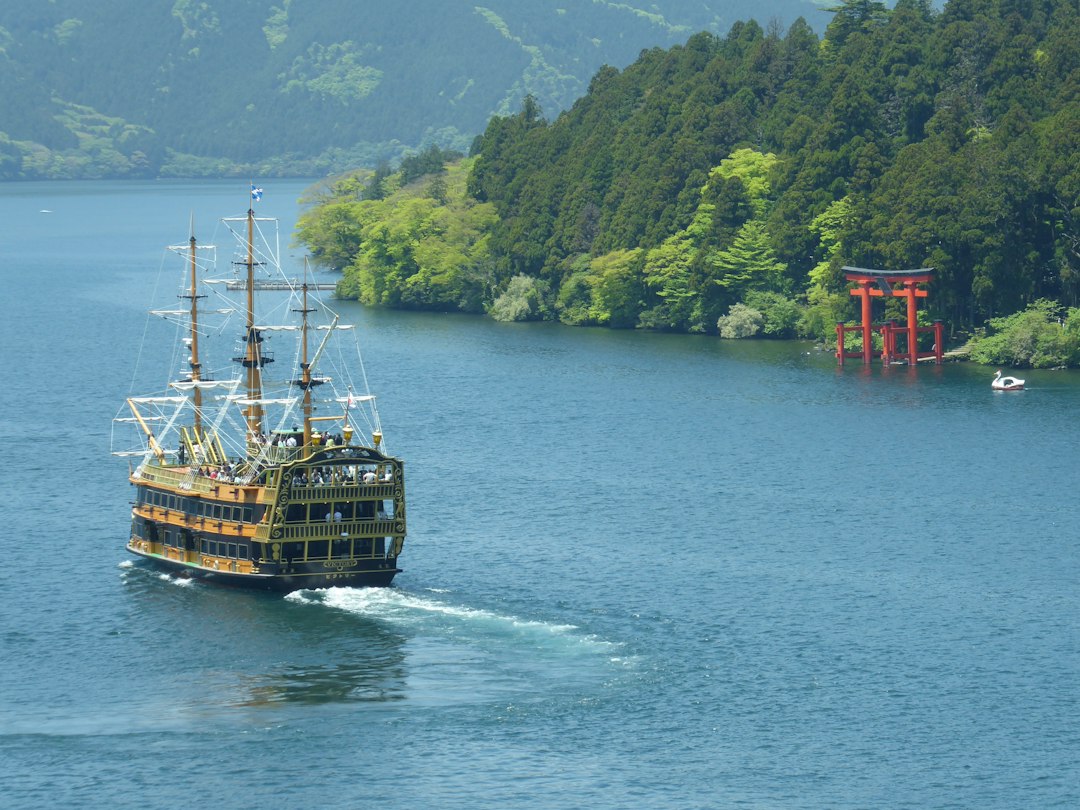
Lake Ashi (Ashinoko) is the crater lake inside the Hakone caldera, about 723 m above sea level, where the pirate ships sail and the red torii of Hakone Shrine stands in the water. On a clear morning Mt. Fuji rises over its far end. On most other mornings it doesn't, and even on clear days the mountain is visible from far less of the lake than the postcards suggest.
We ran a terrain line-of-sight scan over the whole lake surface. Mt. Fuji is visible from only about a third of it, and from none of the northern end where the ropeway drops you off. This guide covers where on Lake Ashi the view actually opens, which of the two boat companies to use, what everything costs in 2026, and why the best hour for Fuji ends before the first boat sails.
| Lake Ashi at a glance | |
|---|---|
| Where | Southwest corner of the Hakone caldera, Kanagawa. About 7 km north to south, about 19 km around, up to 43.5 m deep |
| Elevation | About 723 m, roughly 600 m above Hakone-Yumoto |
| Distance to Fuji's summit | 28 km from the north shore, 32-33 km from the south shore |
| Boats | Hakone Sightseeing Cruise (pirate ships, Hakone Freepass) and Hakone Yusen (catamarans, separate ticket) |
| Best Fuji window | Before about 10:00, November to February |
| Free things | The shoreline walk, the cedar avenue, Onshi Hakone Park, Hakone Shrine grounds |
Where You Can See Mt. Fuji from Lake Ashi
In our terrain model, Mt. Fuji is visible from roughly one third of Lake Ashi's surface, all of it in the southern half and along the eastern shore. The northern 2 km of the lake, including Togendai and Kojiri ports, has no line of sight to the summit at all.
The reason is the caldera wall. Fuji sits about 30 km away at a bearing of 300-305°, which means you're looking west-northwest over the outer rim of Hakone. From the north end of the lake that rim is only a kilometre or two away and stands 300-400 m above the water, so it covers the whole mountain. From the south end, you look up the length of the lake before the line of sight meets the rim. The rim is much farther away there, so it sits lower in your view, and the top of Fuji clears it.
We sampled 654 points across the water at 100 m spacing using the Geospatial Information Authority of Japan's 10 m elevation model, with Earth curvature and refraction included. From 1.5 m above the water, 33% of the points can see some part of Fuji. From 14 m up, roughly a pirate ship's top deck, that rises to 39%. The model is bare earth. Trees on the far ridges shave off more, so treat every figure below as a best case.
| Spot on Lake Ashi | Distance to summit | Fuji above the blocking ridge | What you get |
|---|---|---|---|
| Togendai port | 27.8 km | None (blocked by about 500 m) | No Fuji |
| Kojiri port | 28.3 km | None (blocked by about 500-550 m) | No Fuji |
| Hakone-en port | 30.4 km | About 800 m | Upper cone over the west rim |
| Moto-Hakone waterfront, 250 m south of the pier | 32.6 km | About 1,500-1,600 m | The best view on the lake |
| Moto-Hakone pier itself | 32.6 km | None | Blocked by the shrine headland |
| Hakone Shrine lake torii | 32.3 km | About 650 m | Exists, but the gate faces the other way |
| Onshi Hakone Park | 32.7 km | About 1,050 m | Clean view from the observation deck |
| Hakone-machi port | 33.0 km | About 750 m | Upper cone only |
Two things stand out. First, "Fuji above the ridge" means only the top part of the mountain shows. Even from the best spot on the Moto-Hakone waterfront, roughly the lower 2,200 m of Fuji are hidden behind the caldera rim, and the summit sits only about 5° above the horizon. Lake Ashi gives you a snow cap floating over a dark ridge, not the full symmetrical cone you see from Kawaguchiko. Our Mt. Fuji from Hakone guide compares the two areas in detail.
Second, the famous torii shot doesn't happen at the torii. The Hakone Shrine guide shows the exact spot on the waterfront where the gate lines up under the summit.
Lake Ashi Boats: Pirate Ships or Catamarans?
Two companies run boats on Lake Ashi, and their tickets are not interchangeable. The pirate ships (Hakone Sightseeing Cruise, Odakyu group) link Togendai with Hakone-machi and Moto-Hakone and are included in the Hakone Freepass. The catamarans (Hakone Yusen, Fuji Kyuko group) mostly loop the southern half of the lake between Hakone-Sekisho-ato, Moto-Hakone and Hakone-en, with some sailings to Kojiri, and need their own ticket.
| Hakone Sightseeing Cruise (pirate ships) | Hakone Yusen (catamarans) | |
|---|---|---|
| Ships | Victory (2007), Royal II (2013, refitted July 2026), Queen Ashinoko (2019) | SORAKAZE (2024), Daichakai (December 2025) |
| Ports | Togendai, Hakone-machi, Moto-Hakone | Hakone-Sekisho-ato, Moto-Hakone, Hakone-en, Kojiri |
| Main fare (adult) | Togendai to Moto-Hakone or Hakone-machi ¥1,700; round trip ¥3,000 | 40-min half-lake loop ¥2,400; 1-day hop-on pass ¥2,900 |
| Short hop | Hakone-machi to Moto-Hakone ¥600 | Sekisho-ato to Moto-Hakone ¥600 |
| Upgrade | Special Cabin +¥800, with its own private deck | All seats unreserved; open 360° top deck |
| Hakone Freepass | Standard cabin included | Not valid |
| First sailing (Mar 20 to Nov 30) | 9:30 Togendai and Hakone-machi, 9:40 Moto-Hakone | 9:20 Sekisho-ato, 9:30 Moto-Hakone (not on the 13th) |
| Last sailing | About 16:25-17:00 depending on port | About 16:30-17:10 |
Fares are from the Hakone Sightseeing Cruise fare page and Hakone Yusen's route page. Both companies raised prices recently: the pirate ships on 1 October 2025 (Togendai to Moto-Hakone was ¥1,200 before that) and the catamarans on 1 April 2026.
Which one should you take? If you're riding the Hakone loop on a Freepass, the pirate ship is already paid for, and it's the only boat that reaches Togendai and the Hakone Ropeway. The catamarans make sense if you're based at the south end, want an open deck without paying a cabin supplement, or are heading to Hakone-en and the Komagatake Ropeway.
Two schedule quirks matter in late 2026. Daichakai is out of service for inspection from 14 November to 29 December 2026, and on those dates Kojiri gets a single 10:10 catamaran departure. The pirate ships switch to a separate winter timetable after 30 November; check hakonenavi.jp before planning around a specific sailing.
Which side of the pirate ship faces Fuji
When you sail south from Togendai, Fuji is behind you and to the right. When you sail north from Moto-Hakone, it's ahead of you and to the left. In both directions you only see it in the southern half of the lake.
Out of Togendai, the first 7-10 minutes cross the zone with no line of sight, so don't rush to the rail. The summit appears once the ship is level with the Hakone-en peninsula and grows as you approach the southern ports. Heading south, the standard-cabin rear deck is the right place to be, since it faces back toward the mountain. Heading north, Fuji sits off the bow on the left for the first ten minutes and then sinks behind the rim. That direction suits the Special Cabin's private upper deck if the sky is clear and you want the cone in front of you instead of over your shoulder.
Why the First Boat Sails After Fuji's Best Hour
The best time to see Mt. Fuji from Lake Ashi is early morning, and the boats don't start until 9:20-9:40. The free shoreline is open from dawn.
Lake Ashi has no long-term Fuji record of its own, but Fuji City in Shizuoka has logged the mountain from its city hall at 08:00, 12:00 and 16:00 every day since 1990. Across 1991-2025, Fuji was fully visible at 08:00 on 36.6% of days, at noon on 23.3%, and at 16:00 on 22.5%. That's roughly a one-third drop between breakfast and lunch at that viewpoint. Fuji City looks at the mountain from the south, so its exact numbers won't match Lake Ashi. The pattern is what matters: clouds tend to build around Fuji as the day warms, and a clear 8:00 sky is often gone by noon.
Our live Mt. Fuji visibility score gives you an hour-by-hour forecast for the mountain, and the trends page shows how recent days have played out. The scoring formula is documented on the methodology page.
So flip the usual plan. On a clear morning:
- Be on the Moto-Hakone waterfront by 7:30. Walk 250 m south from the pirate ship pier to the lakeside path near the reflection car park. The water is often stillest at this hour, which is when the upside-down "sakasa Fuji" reflection happens.
- Walk the cedar avenue south. The 500 m stretch of the old Tokaido between Moto-Hakone and Onshi Hakone Park is lined with tall cedars planted in 1618. It takes 10-15 minutes.
- Climb to Onshi Hakone Park's observation deck (free, from 9:00). It looks straight up the lake toward Fuji.
- Take the first boat north from Hakone-machi at 9:30 or Moto-Hakone at 9:40, and ride with Fuji off the bow before heading up the ropeway.
This sequence also lines up with our Hakone hub advice to ride the loop in reverse, starting from the lake. If you arrive by ropeway at Togendai at 11:00 instead, the odds of a clear summit are already falling, and you'll spend the first ten minutes of the cruise in the blind zone anyway.
Lake Ashi Month by Month
Lake Ashi is clearest from November to February and wettest from June to October. The nearest weather station, at Ashinoyu just east of the lake, averages about 3,560 mm of rain a year according to JMA's 1991-2020 normals for its Hakone station.
| Month | Fuji fully visible at 08:00 (Fuji City, 1991-2025) | Rain at Ashinoyu | What's happening at the lake |
|---|---|---|---|
| January | 60.0% | 128 mm | Hakone Ekiden runners finish at the lake on 2 January. Cold, dry, clear |
| February | 52.6% | 151 mm | Fuji's snow cap at its fullest. Short winter boat schedule |
| March | 40.7% | 285 mm | Pirate ships switch to the long timetable on 20 March |
| April | 36.3% | 322 mm | Cherry blossom along the south shore, usually mid to late April |
| May | 30.2% | 327 mm | Fresh green on the slopes; Golden Week crowds |
| June | 12.4% | 420 mm | Rainy season. Himeshara trees flower at Hakone Shrine |
| July | 9.9% | 425 mm | Worst month for Fuji. Summer festival week begins 31 July |
| August | 14.6% | 346 mm | Fireworks over the lake in the first week |
| September | 27.2% | 449 mm | Wettest month; typhoon cancellations possible |
| October | 41.1% | 404 mm | Clarity returns late in the month |
| November | 53.9% | 197 mm | Autumn leaves, usually early to mid November. One of the busiest months in Hakone |
| December | 61.7% | 108 mm | Best Fuji odds of the year, and quieter until the New Year rush |
Fuji City's figures are for one observation point, but they rank the months in the same order you'd expect at the lake. December and January are the safest bets. July is a gamble.
During festival week (31 July to early August), fireworks go up over the lake on most nights. In 2026 the opening Kosui-sai display on 31 July was billed at about 5,000 shells over Moto-Hakone bay.
What to Do Around Lake Ashi When Fuji Hides
Most of what's worth doing at Lake Ashi doesn't need the mountain. Almost everything sits within a 2 km walk of Moto-Hakone and Hakone-machi.
- Hakone Shrine. The forested shrine and its lakeside torii are free and always open. The photo queue at the torii is shortest before 9:00.
- Hakone Sekisho (Checkpoint). A reconstruction of the Edo-period checkpoint where travellers on the Tokaido were inspected. It's ¥500, or ¥400 with the Freepass, and open 9:00-17:00 (16:30 from December to February), per the official site.
- The cedar avenue and Old Tokaido. Free, shaded, and just as good in rain. The cobbled Old Tokaido climbs east from Moto-Hakone if you want a real hike.
- Onshi Hakone Park. A former imperial villa on a small peninsula, free, with lake views in every direction.
- Hakone-en and the Komagatake Ropeway. The ropeway rises from the east shore to the top of Mt. Komagatake, with a 360° view and Hakone Motomiya shrine. It costs ¥2,200 return and isn't covered by the Freepass. On a clear day it's the highest easy Fuji viewpoint in Hakone.
- Kuzuryu Shrine. The dragon-god shrine on the east shore, a 30-minute forest walk from Hakone-en. On the 13th of each month a pilgrimage boat runs from Moto-Hakone. Details are in the Hakone Shrine guide.
- Narukawa Art Museum. Modern Japanese painting above Moto-Hakone, with a long glass wall facing the lake and, on clear days, Fuji.
- A bath. Several lakeside hotels have hot-spring baths. Our Hakone onsen guide lists day-use baths, prices and tattoo rules.
How Lake Ashi Formed, and Where Its Water Goes
Lake Ashi formed about 3,000 years ago, when volcanic activity at Mt. Kami, Hakone's central peak, sent lava and rock debris across the Haya River valley and dammed it, according to Japan's tourism agency. The water backed up against the southwest wall of the caldera. The lake is 43.5 m deep at its deepest, and its shape follows that wall, which is why it bends around Hakone-en instead of forming a neat circle.
The lake drains in two directions. The natural outlet is the Haya River, which leaves through a sluice at Kojiri and runs down through Yumoto to Odawara and the Pacific. The second outlet is man-made. Between about 1666 and 1670, at the request of the headman of Fukara village on the Shizuoka side, an Edo merchant had a 1,280 m tunnel dug by hand under Kojiri Pass. The diggers worked from both ends, and the two bores met with about a metre of error. According to Japan's Ministry of Agriculture, the Fukara canal still carries about 1 m³ of lake water per second west to Susono and Gotemba, and up to 10 m³ at peak. A lake in Kanagawa has been irrigating rice fields in Shizuoka for over 350 years.
The lake also has a reputation for fog. In 1937 the poet Yosano Akiko wrote a tanka about white fog spreading wider than the lake, so that a lost boat sounds its whistle, and Hakone Yusen still prints it on its route page. Fog and strong wind are still what delays or suspends the boats today.
Getting to Lake Ashi
The fastest way to Lake Ashi from Hakone-Yumoto is the bus to Moto-Hakone-ko, about 32 minutes for ¥1,210 and covered by the Freepass. The scenic way is the full loop: train to Gora, cable car to Sounzan, then the ropeway over Owakudani down to Togendai.
- From Tokyo: Odakyu Romancecar from Shinjuku to Hakone-Yumoto in about 80 minutes, then the bus. Our Fuji Hakone Pass guide explains when the bigger pass beats the Freepass.
- From the ropeway: The ropeway ends at Togendai port. The boat leaves from the same building.
- Driving: Port car parks fill early on fine weekends. Hakone Yusen's FAQ notes that the Sekisho-ato and Kojiri lots are free on weekdays only.
- Continuing to Kawaguchiko: Lake Ashi is the natural starting point. See Hakone to Kawaguchiko for bus routes and timings.
If you want to wake up on the lake, the south shore hotels around Moto-Hakone and the east shore near Hakone-en are the only areas where our terrain model shows a Fuji view at ground level. Our Hakone ryokan guide has the district-by-district line-of-sight results.
Lake Ashi FAQ
Can you see Mt. Fuji from Lake Ashi?
Yes, from the southern and eastern parts of the lake on clear days, mostly before 10:00 and mostly from November to February. Only the upper part of the mountain shows above the caldera rim. From Togendai and Kojiri at the north end it's blocked entirely.
Is the Lake Ashi pirate ship worth it?
Yes, if you're on the Hakone Freepass or riding the loop, since it's the link between the ropeway and the south shore. Without a pass, it costs ¥1,700 for a 25-40 minute crossing, and the best Fuji views on the lake are free from the Moto-Hakone shore.
How long should you spend at Lake Ashi?
Half a day covers the boat, Hakone Shrine, the cedar avenue and the checkpoint. Staying overnight on the south shore is the only practical way to be at the water before the day-trippers and before the clouds build.
Is Lake Ashi covered by the Hakone Freepass?
The pirate ships are, in standard cabin, along with the bus to Moto-Hakone and the Hakone Ropeway to Togendai. The Hakone Yusen catamarans, the Komagatake Ropeway and the Special Cabin supplement are not. The Freepass gets ¥100 off the Hakone Sekisho entry.
Before You Head to the Lake
Lake Ashi doesn't need Fuji to be worth the trip. But if the mountain is the reason you're going, the deciding factor is the hour, not the boat. Check the Mt. Fuji visibility forecast the evening before and again at sunrise. If the score is high, go straight to the Moto-Hakone waterfront and catch the boat afterwards. If it's low, ride the pirate ship anyway, walk the cedars, and save the view for a December morning.
More Articles
Hakone: Where Fuji Shows, How the Loop Runs, When to Go
Hakone is a volcanic caldera 80 minutes from Tokyo. Which parts actually see Mt. Fuji, which way to ride the loop, and 2026 prices for each leg.
Hakone Shrine: Torii Queue, Fuji View and Getting There
Hakone Shrine's lake torii faces away from Mt. Fuji. Where to stand to get both, when the queue is short, and the bus stop that is skipped midday.
Mt. Fuji from Hakone: Best Viewpoints and Visibility Guide
Can you see Mt. Fuji from Hakone? Yes, on about half of all days. Here are the best viewpoints, when to go, and how to check conditions.