Fuji-Q Highland: Rides, Passes and When Fuji Is Visible
Fuji-Q Highland guide: 2026 pass prices, coaster specs, closure calendar and how often Mt. Fuji is visible from the park by month and hour.

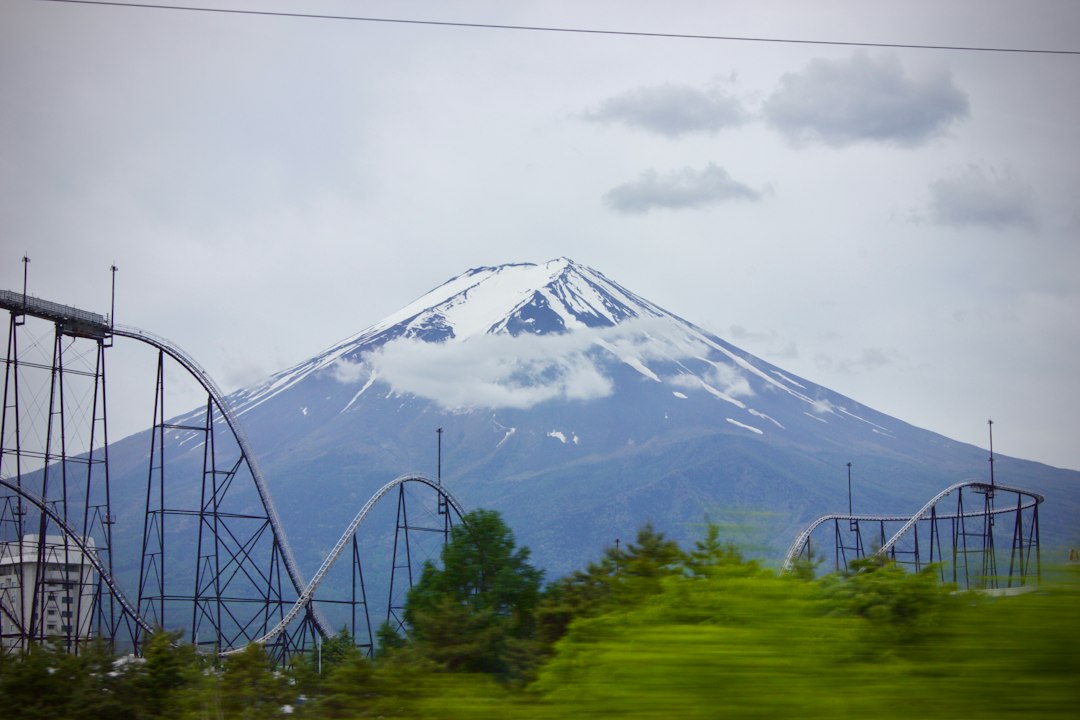
Fuji-Q Highland is a free-entry amusement park in Fujiyoshida, Yamanashi, sitting 14.8 km north-northeast of Mt. Fuji's summit. Its four big coasters (FUJIYAMA, Eejanaika, Takabisha and ZOKKON) are the reason most people come. The mountain behind them is the reason the photos look the way they do. That second part is not guaranteed, and it follows patterns you can plan around.
This guide covers what Fuji-Q Highland costs in late 2026, what each coaster does, which rides are closed, and how often Mt. Fuji is actually visible from the park, broken down by month and hour.
Contents
- Can You See Mt. Fuji From Fuji-Q Highland?
- Ride the Big Coasters Before Noon
- Where the Fuji View Is Best Inside the Park
- Fuji-Q Highland Tickets and Passes in 2026
- The Rides, and What Is Closed Right Now
- Winter at Fuji-Q: Cheaper, Clearer, Shorter, Windier
- Getting to Fuji-Q Highland
- Fuji Viewpoints Near the Park
- Frequently Asked Questions
Can You See Mt. Fuji From Fuji-Q Highland?
By our estimate from ten years of cloud data, Mt. Fuji is clear from Fuji-Q Highland on about 3 in 10 mornings across the year, and on close to half of all mornings in December and January. In June, the estimate falls below 1 in 10.
Those numbers come from ten years (2016 to 2025) of hourly historical cloud data from Open-Meteo, the same data source behind our weighted atmospheric model. We counted an hour as "Fuji visible" when total cloud over the summit grid cell was 30% or less and low cloud over the park was 50% or less. These are modelled cloud estimates, not observations from the park. The grid cells are coarse (the low-cloud cell used for the park is centred about 10 km northeast of the gate), so read the table as a ranking of good and bad months, not as a precise probability for any given day.
| Month | 9 AM | Noon | 3 PM | Visible at some point, 9 AM to 5 PM |
|---|---|---|---|---|
| January | 48% | 43% | 45% | 69% |
| February | 44% | 33% | 29% | 65% |
| March | 33% | 25% | 29% | 53% |
| April | 32% | 25% | 22% | 47% |
| May | 20% | 19% | 18% | 37% |
| June | 9% | 7% | 7% | 22% |
| July | 18% | 7% | 6% | 26% |
| August | 20% | 8% | 6% | 35% |
| September | 18% | 9% | 7% | 30% |
| October | 21% | 13% | 15% | 36% |
| November | 41% | 37% | 37% | 65% |
| December | 48% | 46% | 44% | 73% |
Two things stand out. First, the season matters more than anything else you control. December's 9 AM estimate is roughly five times June's. Second, the last column is much higher than any single hour. On a lot of days the summit appears for an hour or two, then hides again, so a cloudy first look is not a reason to give up on the photo.
The pattern lines up with a long-running ground record from the other side of the mountain. Fuji City, south of Fuji in Shizuoka, has recorded at 8 AM whether the whole mountain is visible since May 1990. Its 1991 to 2025 record puts December (61.7% of days) and January (60.0%) at the top and July (9.9%) at the bottom. That is a different viewpoint with its own local weather, so it confirms the seasonal shape rather than the exact numbers for Fuji-Q. Our best time to see Mt. Fuji guide walks through the seasonal causes in more detail.
Ride the Big Coasters Before Noon
The best time to see Mt. Fuji from Fuji-Q Highland's coasters is the first two hours after opening, because in our cloud data the summit is most often clear in the morning in every month, and the drop through the day is steepest in summer. Fuji City's 35-year record shows the same daily shape: the whole mountain was visible on 36.6% of days at 8 AM, 23.3% at noon and 22.5% at 4 PM.
The summer estimates make the case bluntly. In August, 20% of days have a visible Fuji at 9 AM, but only 6% at 3 PM. Of the August mornings that start clear, just 15% are still clear at 3 PM. July (27%) and September (21%) are barely better. In December and January, by contrast, about two-thirds of clear mornings stay clear into the afternoon.
That has a practical consequence for queue strategy. If the mountain matters to you, do not start with whatever has the shortest line: ride FUJIYAMA, the coaster with the best summit view, as soon as the park opens, even if the wait is longer. Save the indoor attractions, like the Attack on Titan and Fuji Airways simulator rides or the Senritsu Meikyu haunted hospital (an extra fee even with a pass), for the cloudy afternoon.
There is a lighting reason too. From the park, Fuji's summit lies at a bearing of 199 degrees, just west of due south. The sun passes that same bearing between about 12:00 (June) and 13:05 (January). In October to February, when the sun sits only 29 to 44 degrees up at that moment, it ends up in the top of your frame, directly behind the mountain. Midday shots come out hazy and backlit. Morning light comes from the left (east) and gives the slopes shape; late-afternoon winter light comes from the right.
Where the Fuji View Is Best Inside the Park
The best Fuji view inside Fuji-Q Highland is from the FUJIYAMA Tower Skydeck, a 55 m observation deck facing the mountain, which you can visit without riding anything.
Height does not make Fuji look bigger here. From the park entrance (about 843 m above sea level), the summit stands 11.1 degrees above the horizon. From FUJIYAMA's 79 m high point, it stands 10.8 degrees up, slightly lower, because you are closer to the summit's level. What height buys you is a clean foreground: from the deck you look over the park roofs and the Aokigahara forest to the full width of the mountain, slopes to base.
For comparison, Chureito Pagoda sits about 17 km from the summit with Fuji about 10 degrees up, so the mountain looks roughly the same size from Fuji-Q as it does in one of Japan's most photographed Fuji views.
| Spot | What you get | Cost |
|---|---|---|
| FUJIYAMA Tower Skydeck (55 m) | Full mountain, FUJIYAMA trains passing in front | From ¥1,000, or included with a One-Day or Afternoon Pass |
| FUJIYAMA Walk | Harnessed loop on an open, railless walkway at the top of the tower | From ¥1,000 (from ¥500 with a One-Day or Afternoon Pass) |
| Riding FUJIYAMA (79 m high point) | The whole mountain straight ahead for a few seconds | ¥2,000 or a pass |
| Main gate area and Takabisha | Coaster track framed against the peak | Free with entry |
Prices are from the official FUJIYAMA Tower ticket page. The tower's terms say its tickets are refunded if bad weather stops the activity. Park passes, by contrast, cannot be refunded after purchase.
Fuji-Q Highland Tickets and Passes in 2026
Fuji-Q Highland admission is free, but you still need a free admission ticket from the gate or online, and every ride costs money unless you hold a pass. The big four coasters cost ¥2,000 per ride.
Pass prices change by date. These are the official ranges from the Fuji-Q ticket page in October 2026:
| Pass | Adult (18 to 64) | Junior and high school | Elementary | Preschool (1+) and 65+ |
|---|---|---|---|---|
| One-Day Pass | ¥6,000 to ¥7,900 | ¥5,500 to ¥7,400 | ¥4,400 to ¥5,100 | ¥2,100 to ¥2,600 |
| Afternoon Pass (from 1 PM) | ¥4,100 to ¥6,000 | ¥3,800 to ¥5,700 | ¥3,500 to ¥4,200 | ¥1,700 to ¥2,100 |
| Thomas Land Pass (12 rides) | ¥3,000 to ¥3,500 | ¥3,000 to ¥3,500 | ¥2,500 to ¥2,800 | ¥2,000 to ¥2,300 |
| Sunset Night Pass (from 4 PM) | ¥3,700 or ¥4,000 | ¥3,500 or ¥3,700 | ¥3,000 or ¥3,100 | ¥1,500 or ¥1,600 |
| Annual Pass | ¥26,300 | ¥23,000 | ¥16,600 | ¥8,300 |
The Sunset Night Pass is sold on site only, and only on days the park stays open until 7 PM or later. A virtual-queue version of the One-Day Pass, which lets the official Q-chan app hold your place in line, costs ¥2,000 more than that day's One-Day Pass. The One-Day Pass with priority early entry is not sold from December 2026 to 5 February 2027.
The monthly price calendars show which days are cheap. For an adult One-Day Pass:
| Month (2026) | ¥7,200 days | ¥7,600 days | ¥7,900 days |
|---|---|---|---|
| October | 0 | 12 | 19 |
| November | 2 | 10 | 18 |
| December | 8 | 9 | 13 (closed 10 Dec) |
The cheaper days fall Tuesday to Thursday, and the ¥7,200 days in December are the Tuesdays to Thursdays from 1 to 17 December. December is also the month with the best all-day Fuji estimate in our data. The bottom of the ¥6,000 to ¥7,900 range does not appear in these three calendars.
Which pass fits a Fuji view? In summer, the Afternoon Pass is the cheapest way to ride everything, and it starts exactly when the mountain is least likely to be out (6 to 7% at 3 PM from July to September). In November to February, afternoon odds hold up at around 30 to 45%, so the Afternoon Pass loses very little. The Sunset Night Pass is a ride deal, not a Fuji deal; after dark, the mountain is a silhouette at best.
The Rides, and What Is Closed Right Now
Fuji-Q Highland's headline rides are four large coasters, each with official height and age limits.
| Coaster | Opened | Key stats | Height limit | Max age |
|---|---|---|---|---|
| FUJIYAMA | 1996 | 79 m high, 70 m drop, 130 km/h, 2,045 m, 3 min 36 s | 110 cm+ (110 to 130 cm with a companion) | 64 |
| Eejanaika | 2006 | 76 m high, 126 km/h, 14 rotations, seats spin as you ride | 125 to under 200 cm | 54 |
| Takabisha | 2011 | 121-degree drop, 43 m, 100 km/h, 4.4 G | 125 cm+ | 54 |
| ZOKKON | 2023 | Motorbike-style seats, 4 launches, backward section | 120 to under 195 cm | 64 |
Source: official ride pages at fujiq.jp. FUJIYAMA turns 30 in 2026, Eejanaika 20 and Takabisha 15, and the park's anniversary ticket bundles are sold online until 31 October 2026, for use through 1 November.
Do-Dodonpa is gone. The launched coaster was shut in August 2021 after the park said four riders had suffered broken bones on it between December 2020 and August 2021, as the BBC reported at the time. On 13 March 2024, operator Fuji Kyuko's board decided to end the ride's operation, according to the company's securities filing.
Scheduled closures matter more than most visitors expect. The park publishes a monthly hours and maintenance calendar, and in October and November 2026 each of the big four had at least one full maintenance day per month, with some closed only until noon. A morning closure on FUJIYAMA is precisely the morning you would have wanted it. Since passes cannot be refunded or changed after purchase, check the calendar before you buy.
Other closures as of late October 2026:
- Ferris wheel: closed for renewal from 9 November 2026 to 31 January 2027.
- Tentekomai: closed from 5 October 2026 to late July 2027 for construction.
- Red Tower: suspended indefinitely because of demolition and construction work nearby.
That construction is for a new splash coaster due in summer 2027, the park's first large new ride since ZOKKON. The official announcement describes a forward-and-backward launched coaster that climbs a vertical 44 m tower and drops into a pond of Fuji spring water, built beside Eejanaika at a cost of about ¥4 billion.
Winter at Fuji-Q: Cheaper, Clearer, Shorter, Windier
Winter is the best season for Fuji views at Fuji-Q Highland, but it comes with shorter hours, closed days and stronger wind.
Shorter hours. The park runs 9:00 to 19:00 on most days in October and November 2026, closing at 18:00 from late November. In December, 18 days are 10:00 to 17:00. In January 2027, 20 days are 10:00 to 17:00 and the park is closed on six (13, 14, 20, 21, 27 and 28 January). Late opening costs less than it sounds, because winter cloud cover barely changes between 9 AM and noon (46% visible at noon in December). On 31 December, the park stays open until 1 AM for New Year.
Cold. Fujiyoshida sits at around 850 m. Winter mornings are well below freezing, and the wind at the top of a 79 m lift hill makes it feel colder still. Dress for a ski slope, not a city.
Wind. The clear winter days tend to be the windier days. In our data, January to April days that were clear at 9 AM had an average peak daytime gust of about 40 km/h at the park, versus 31 to 35 km/h on cloudy days. Those are model figures and an association, not a forecast, and Fuji-Q does not publish a wind limit. The official ticket terms say only that ride operation may change with the weather. In practice, expect the tallest coasters to pause in strong gusts, and keep the indoor attractions as a buffer.
Getting to Fuji-Q Highland
Fuji-Q Highland is easiest to reach by highway bus from Busta Shinjuku, which stops beside the park in about 1 hour 40 minutes in normal traffic. The official Fujikyu bus page lists adult fares from ¥2,200 one way, or ¥2,000 when booked and paid online.
The highway buses drop off at a terminal in the car park of the Highland Resort Hotel & Spa, next to the park. By train, Fuji-Q Highland Station sits on the Fujikyu line, one stop (2 to 3 minutes) before Kawaguchiko, close to the second entrance. The direct Fuji Excursion limited express from Shinjuku stops here as well. Our Fujikyu Railway guide covers fares, the Otsuki transfer and the sightseeing trains, and Kawaguchiko from Tokyo compares every route side by side.
If you are staying at the lake, Kawaguchiko Station is one stop away, which makes it practical to spend the morning at the park and the late afternoon at the lakeshore, or the reverse.
The bus timing is worth thinking about. An early bus that reaches the park at opening puts you on FUJIYAMA during the best visibility window of the day. A mid-morning bus puts you in the queue at 11:30 in summer, when the summit is usually gone.
Fuji Viewpoints Near the Park
The best way to back up a cloudy day at Fuji-Q Highland is to keep one Fuji viewpoint in reserve for the next clear morning, because the park is within a few train stops of several.
- Chureito Pagoda: three stops away at Shimoyoshida, then 398 steps. About 17 km from the summit, a little farther than the park, with the classic pagoda foreground.
- Mt. Fuji Panoramic Ropeway: a short walk from Kawaguchiko Station, with Lake Kawaguchi in front of the mountain.
- Oishi Park: on the north shore of the lake, free and always open, good in the first hour after sunrise.
All three are covered in our broader Fuji Five Lakes guide. If you only have one day in the area, put the viewpoint first and the park second. A view at 7:30 AM followed by coasters at 10 AM uses the clear part of the day for the thing that needs it.
Frequently Asked Questions
Is Fuji-Q Highland free to enter? Yes. Entry is free, but you need a free admission ticket from the gate or online, and rides are paid individually (¥2,000 for each big coaster) or covered by a pass. A One-Day Pass costs ¥6,000 to ¥7,900 for adults depending on the date.
Can you see Mt. Fuji from Fuji-Q Highland? On clear days you get a full, unobstructed view of the mountain from the gate, the coasters and the FUJIYAMA Tower deck. Our estimate from ten years of modelled cloud data puts that at about 3 in 10 mornings overall and close to half of mornings in December and January, but under 1 in 10 in June.
Is Fuji-Q Highland worth it? For thrill-ride fans, yes. The big four are among the most intense coasters in Japan, and on a clear day the backdrop is unmatched. For families with small children, Thomas Land and its cheaper pass make more sense than a full One-Day Pass, since height limits rule out the big coasters.
What happened to Do-Dodonpa? It was shut in August 2021 after riders reported fractures between December 2020 and August 2021, and in March 2024 the operator decided to end its operation for good. A new splash coaster is under construction for summer 2027.
Before You Buy the Pass
The pass is non-refundable, so buy it last. Check the park's maintenance calendar for your date, then look at the Mt. Fuji visibility forecast the evening before. If the morning score is high, take the earliest bus and ride FUJIYAMA first. If it is low, the coasters are just as fast in the cloud, and the mountain can wait for tomorrow's viewpoint.
More Articles
Fujikyu Railway: The Scenic Train to Mt. Fuji and Kawaguchiko
A complete guide to the Fujikyu Railway (Fujikyuko Line): routes, fares, scenic trains, which side to sit, and whether Mt. Fuji will actually be visible.
Kawaguchiko from Tokyo: Transport, Timing, and the View Most Visitors Miss
How to get to Kawaguchiko from Tokyo by bus, train, or car, plus the timing trick that decides whether you see Mt. Fuji.
Chureito Pagoda: The Iconic Mt Fuji Viewpoint Guide
Plan your visit to Chureito Pagoda for the classic Mt Fuji view. Get access details, best times for photography, cherry blossom season tips, and how to avoid crowds.