Mount Takao: Trails, Fuji Views and Diamond Fuji Odds
Mount Takao guide: trails, 2026 cable car fares, where Mt. Fuji is actually visible from the summit, and how often it shows by month and hour.

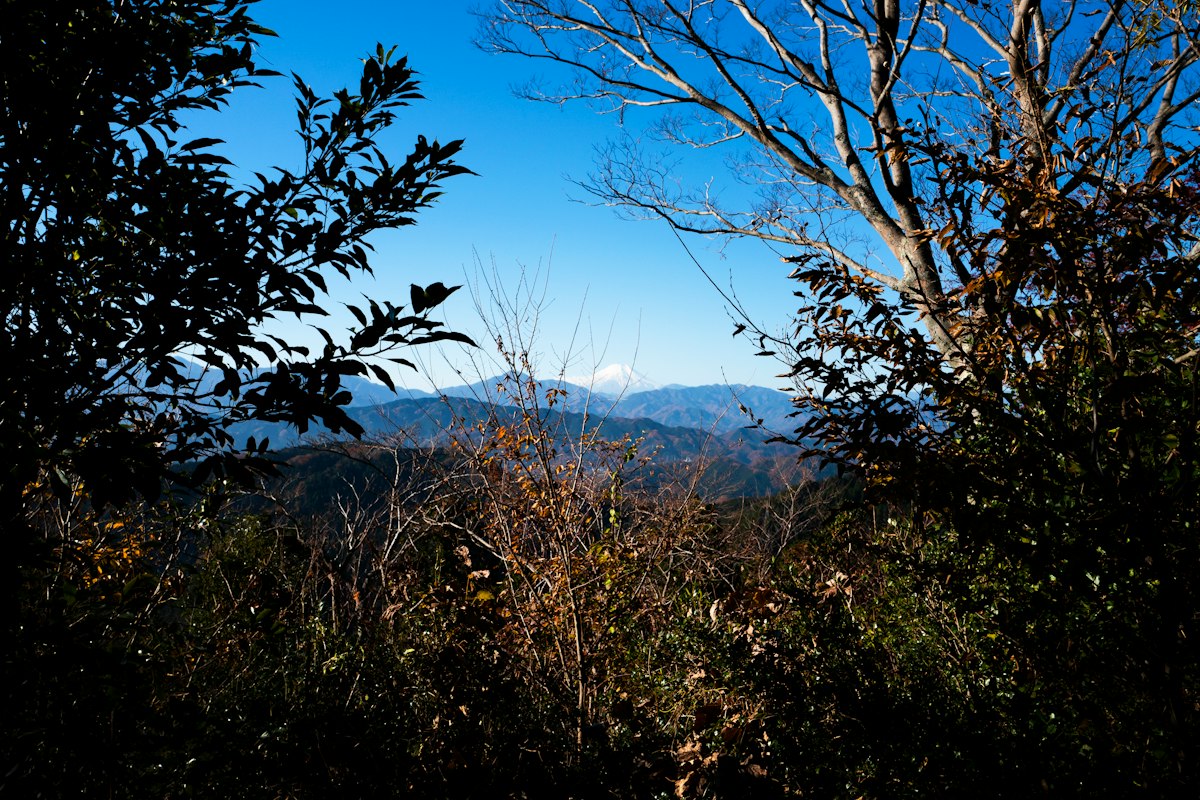
Mount Takao (Takao-san) is a 599 m mountain in Hachioji, on the western edge of Tokyo, about 50 minutes from Shinjuku by Keio limited express. It has a temple founded nearly 1,300 years ago, a cable car on Japan's steepest funicular grade, and some of the busiest trails in Japan, used by about 2.5 million hikers a year by the Takao Visitor Center's count. On a good day it also has Mt. Fuji, 55 km to the west-southwest.
That last part is the one nobody can promise. Fuji shows from only two places on the mountain, it is a smaller sight than most photos suggest, and on an average day it is hidden. This guide covers the trails, the 2026 prices and the logistics, then works through where and when Fuji is actually visible from Mount Takao, using terrain data and ten years of modeled hourly cloud data.
Mount Takao at a Glance
| Height | 599 m (1,965 ft) |
| Location | Hachioji, Tokyo; Meiji no Mori Takao Quasi-National Park |
| Nearest station | Takaosanguchi (Keio Takao Line), about 190 m |
| From Shinjuku | About 50 min by limited express, ¥430 one way |
| Cable car | ¥490 one way, ¥980 round trip, 6 minutes |
| Summit hike from the station | About 100 min on Trail 1, Trail 6 or Inariyama |
| Mt. Fuji from the summit | 55 km away, bearing 238° (west-southwest) |
| Best months for Fuji | December and January |
Can You See Mt. Fuji From Mount Takao?
Yes, you can see Mt. Fuji from Mount Takao, but only from the summit plaza and the Momijidai viewpoint five minutes west of it. Everywhere else on the standard routes, the mountain's own ridges or a dense cedar forest are in the way.
To check this we ran a line-of-sight scan along the bearing to Fuji's summit from each main stop on the mountain, using the Geospatial Information Authority of Japan's 10 m elevation model with Earth curvature and standard refraction. The model is bare earth, so it shows where terrain blocks the view. Trees are an extra layer on top.
| Spot on Mount Takao | Fuji in line of sight? | What blocks it |
|---|---|---|
| Summit plaza (599 m) | Yes | Nothing; the plaza is open to the west |
| Momijidai (5 min west of summit) | Yes | Nothing; it is an official Diamond Fuji spot |
| Yakuo-in temple (about 520 m) | No | The slopes above the temple and its old-growth cedars |
| Takaosan cable car station (472 m) | No | The summit ridge, about 1 km away |
| Kiyotaki and Takaosanguchi stations | No | The mountain itself |
| Kobotoke-Shiroyama (670 m, about 1 hr further west) | Yes | Nothing |
The viewing terrace beside the cable car top station faces east, toward the Kanto Plain and central Tokyo. It is a good view, and people sometimes assume Fuji is somewhere in it. It is not. Fuji is behind you and the summit ridge.
How big Fuji looks from the top
From the summit plaza, Fuji's peak sits only 3.1 degrees above horizontal. The lower slopes are hidden behind a ridge of about 1,400 m in the mountains of Tsuru, Yamanashi, roughly 36 km out. What you see is everything above roughly 1,800 to 1,900 m: the top 1,900 m or so of the cone, about 2 degrees tall, or around four full moons stacked on top of each other.
That is why Fuji looks small from Takao without a long lens. In winter the visible part is mostly the snow-covered cone, which helps it stand out. In late spring and summer, with little snow and more haze, it fades into the blue ridges in front of it. For how the view compares with the bigger, closer sightlines, see our guide to seeing Mt. Fuji from Tokyo, which covers the city's observation decks at roughly 100 km.
How Often Mt. Fuji Is Visible From Mount Takao, by Month and Hour
By our cloud-based estimate, Mt. Fuji can show from Mount Takao at some point on roughly two days in three in December and January, but on only about one day in three or fewer from June to September, and the hour you reach the summit matters almost as much as the month.
No public body logs Fuji sightings from Takao, so we built an estimate from the Open-Meteo historical weather archive for 2016 to 2025, which is modeled reanalysis data, not observations of the mountain. An hour counts as "visible" when the cloud cover over Fuji's summit is 30% or less and the low cloud over both the Takao area and the midpoint of the 55 km sightline is 50% or less. This mirrors the cloud inputs in our visibility score methodology. It does not model haze, which matters a lot at 55 km, so read these figures as an upper estimate rather than a measured sighting rate.
| Month | 7 AM | 9 AM | Noon | 3 PM | 4 PM | Any hour 8 AM-4 PM | Clear at 9 AM, still clear at 3 PM |
|---|---|---|---|---|---|---|---|
| Jan | 44% | 46% | 39% | 42% | 44% | 67% | 65% |
| Feb | 37% | 42% | 29% | 25% | 30% | 61% | 43% |
| Mar | 33% | 31% | 24% | 26% | 23% | 50% | 56% |
| Apr | 30% | 31% | 22% | 20% | 23% | 45% | 49% |
| May | 21% | 19% | 17% | 18% | 17% | 34% | 63% |
| Jun | 13% | 9% | 6% | 6% | 8% | 22% | 35%* |
| Jul | 17% | 16% | 6% | 5% | 7% | 28% | 24% |
| Aug | 24% | 19% | 9% | 5% | 7% | 36% | 16% |
| Sep | 17% | 17% | 8% | 6% | 6% | 31% | 20% |
| Oct | 18% | 20% | 11% | 14% | 17% | 33% | 45% |
| Nov | 41% | 40% | 33% | 32% | 36% | 63% | 51% |
| Dec | 43% | 47% | 43% | 41% | 40% | 68% | 63% |
| Year | 28% | 28% | 21% | 20% | 21% | 45% | 49% |
*June has only 26 clear 9 AM hours in ten years, so its last column is a small sample.
Three patterns are worth planning around.
Winter holds all day; summer does not. In December and January the odds barely change between 7 AM and 4 PM. The dry northwesterly winter monsoon keeps skies over the Kanto side clear for whole days. In July, August and September a clear 9 AM was gone by 3 PM in roughly three to four cases out of five in this data, consistent with daytime heating building cloud over the mountains between Takao and Fuji. If you climb in summer and want Fuji, you need to be on top early.
November is almost as good as midwinter. At 63% for "visible at some point in the day," November beats February and every month from March to October. It also lines up with the autumn leaves, and the summit is very crowded on November weekends.
Early morning beats midday and afternoon. Across the year, the noon and 3 PM figures run 7 to 8 points below 9 AM. Late winter and spring show it most clearly: in February and March, noon runs a quarter to a third below 9 AM.
The seasonal shape is similar to Fuji City's record of Fuji observations from city hall on the mountain's south side, where 8 AM full visibility over 1991 to 2025 peaks at 61.7% in December and bottoms out at 9.9% in July, as covered in our Shizuoka viewpoint guide. That is a different viewpoint and a direct observation, so it confirms the calendar pattern rather than the Takao percentages.
To see what today looks like before you commit to the train, check the live Mt. Fuji visibility score. If the summit is buried at 7 AM, Takao is still a fine hike, but you will not see Fuji from it.
Diamond Fuji From Mount Takao
Diamond Fuji from Mount Takao happens around the winter solstice, when the setting sun drops onto Fuji's summit at about 4:10 to 4:15 PM. The cable car operator's official viewing window for 2025 ran from December 17 to 28, with the best viewing between 4:00 and 4:15 PM from the summit and Momijidai. The 2026 dates had not been posted as of early November, but the geometry does not change from year to year.
Why the window is about ten days long
From the summit plaza, Fuji's peak sits on a bearing of 238.0° at an apparent height of 3.1°. We computed where the sun's center crosses that height each day. Through December its setting point barely moves, because near the solstice the sun's track stalls at its southernmost position:
| Date | Sun at Fuji's height | Sun's position vs. Fuji's highest point |
|---|---|---|
| Dec 9 | 4:09 PM | 1.1° right (north) |
| Dec 15 | 4:10 PM | 0.6° right |
| Dec 20-23 | 4:12-4:13 PM | 0.35° right (closest) |
| Dec 28 | 4:16 PM | 0.6° right |
| Jan 3 | 4:21 PM | 1.1° right |
The sun's disc is about 0.53° wide, and Fuji's flat summit, with its crater about 800 m wide, spans roughly 0.8° from Takao. So between about December 17 and 28, the sun sets onto the flat top of Fuji rather than beside it. By our calculation, from the summit plaza it never lands exactly on the highest point, Kengamine. It lands slightly right of it. The clock time drifts later by about 30 seconds a day even while the position holds, so a 4:00 PM arrival is enough to catch it throughout the window.
The odds of a clear Diamond Fuji evening
Using the same cloud model, 4 PM was clear on 41% of the days between December 17 and 28 over 2016-2025. That works out to about five usable evenings per window, but it varied a lot: 2018 and 2019 had one each, while 2017 had eight. If you are in Tokyo for the whole window, you are likely to get a chance. If you have one specific evening, the cloud odds are about two in five, and haze can lower that.
Practical notes from the official guidance
- In 2025 the cable car ran until 6:00 PM during the window instead of the usual 5:15 PM weekdays and 5:30 PM weekends. The extension is cancelled in bad weather.
- It is a 40-minute walk from the cable car top station to the summit. Bring a headlamp for the way down, and descend on Trail 1, the paved route that passes the cable car station.
- The summit fills well before 4 PM on clear December weekends. Arrive at least an hour early for a spot with a clean western sightline.
For other sunset Diamond Fuji spots and their dates, including the Tokyo observation decks and Lake Yamanaka, see our Mt. Fuji sunset guide.
Mount Takao Hiking Trails
Mount Takao has six numbered nature trails plus the Inariyama ridge trail, and the three that climb from the station to the summit each take about 100 minutes up. All are well marked, and none needs more than walking shoes in dry weather.
| Trail | Distance | Time (up) | Character |
|---|---|---|---|
| Trail 1 (Omotesando) | 3.8 km | ~100 min | Paved, steep in places; passes the cable car station, the octopus cedar and Yakuo-in |
| Trail 6 (Biwa Falls) | 3.3 km | ~100 min | Shaded forest path and stream bed; the most natural route, wet after rain |
| Inariyama Trail | 3.1 km | ~100 min | Ridge path with stairs and roots; an east-facing lookout halfway |
| Cable car top to summit | Upper Trail 1 | ~40 min | Paved, via the octopus cedar and Yakuo-in |
Distances and times are from the Takao Visitor Center course map, which gives about 80 minutes for each route down. The climb from the trailheads near Kiyotaki Station, at 201 m, to the summit is about 400 m.
Trail 6 is uphill only until December 6, 2026. The Tokyo Takao Visitor Center has made the section from Biwa Falls to the Trail 5 junction one-way, all day, from October 31 to December 6, 2026, to manage autumn crowds. During that period, plan your descent on Trail 1 or Inariyama.
A combination that works for most people: up Trail 6 or Inariyama for the forest, then down Trail 1 past the temple, with the option to ride the cable car or chairlift for the lower half if your knees object.
Takao is also the Tokyo end of the Tokai Nature Trail, which runs all the way to Minoo near Osaka. The first stretch west along the ridge to Kobotoke-Shiroyama is one of the best extensions of a Takao day: roughly an hour each way, with its own Fuji view and far fewer people.
Cable Car, Chairlift and 2026 Prices
The Mount Takao cable car and chairlift cost the same: ¥490 one way and ¥980 round trip for adults, ¥250 and ¥500 for children aged 6 to 11, according to the operator's fare table.
Both run from 8:00 AM (cable car) and 9:00 AM (chairlift). The last departure depends on the month:
| Month | Cable car, weekdays | Cable car, weekends and holidays | Chairlift |
|---|---|---|---|
| Jan-Feb | 5:15 PM | 5:30 PM | 4:00 PM |
| Mar | 5:30 PM | 6:00 PM | 4:00 PM |
| Apr-May | 6:00 PM | 6:30 PM | 4:00 PM (Apr), 4:30 PM (May) |
| Jun | 5:45 PM | 6:00 PM | 4:30 PM |
| Jul-Aug | 6:00 PM | 6:30 PM | 4:30 PM |
| Sep-Nov | 5:45 PM | 6:00 PM | 4:30 PM |
| Dec | 5:15 PM | 5:30 PM | 4:00 PM |
The chairlift is open-air and takes 12 minutes, twice as long as the cable car.
What changed in 2026:
- Tap-and-go IC cards. Since November 1, 2026, you can tap Suica, PASMO and other transit IC cards at the cable car and chairlift gates without buying a ticket first. One card per person, and auto-charge does not work at these gates, so top up beforehand.
- Monkey park fee rise. The Monkey Park and Wild Plant Garden near the top station went from ¥500 to ¥600 for adults on September 1, 2026.
- Cable car centenary. The line opened on January 21, 1927, and turns 100 on January 21, 2027. Expect commemorative goods and events around that date. The steepest section, 31° 18′, is the steepest funicular grade in Japan.
The Takao ticket (Takaosan Kippu) bundles a discounted Keio round trip with a discounted cable car or chairlift ride, either round trip or one way. Bought separately, the train from Shinjuku and a round-trip cable car ride cost ¥1,840. Buy it from Keio ticket machines at your departure station (not at Takaosanguchi) or as a QR ticket on Keio's TAMa-GO site, and check the current price on Keio's ticket page. It is not sold December 31 to January 3.
Getting to Mount Takao From Tokyo
The easiest way to reach Mount Takao is the Keio Line from Shinjuku to Takaosanguchi: about 50 minutes on a limited express and ¥430 one way. Some limited expresses run straight through; others head for Keio-Hachioji, in which case change at Kitano. On many weekends and holidays Keio also runs the seat-reserved Mt. TAKAO train from Shinjuku, which needs a seat ticket on top of the fare.
JR Pass holders can take the Chuo Line to Takao Station and change to the Keio Line for one stop. From Takaosanguchi, the cable car's Kiyotaki Station and the start of Trail 1 and Trail 6 are a five-minute walk.
Driving is possible but tight. The Hachioji city lot by the cable car has 80 spaces, and its daily cap rises from ¥800 on weekdays to ¥2,000 on weekends, holidays and every day in May and November. It fills early on autumn weekends.
To see Fuji up close instead, our day trip from Tokyo guide compares the routes to the Fuji Five Lakes, about two hours from Shinjuku.
When to Go: Fuji Hours, Cable Car Hours and Crowds
The best time to visit Mount Takao for a Fuji view is a weekday morning between December and February, reaching the summit before 10 AM. That is when the clear-sky odds are highest and the summit is quietest.
There is a catch in the timing. The first cable car leaves at 8:00 AM, and the walk from the top station takes 40 minutes, so the earliest you can reach the summit by cable car is around 8:45. That is fine in winter, when the odds hold all day. In summer, when Fuji is most likely to show early and is usually gone by noon, hiking up from the station is the only way to get there in the best window. Start up Trail 1 or Inariyama at 6:30 and you are on top before 8:30, before the first cable car crowd arrives.
Autumn leaves peak in mid to late November. On November 8, 2026, the visitor center reported the summit at about 60% color and the Yakuo-in area and Momijidai at about 30%, with the trees along the cable car just starting to turn. Color usually peaks at the summit in mid to late November and moves downhill into early December. November is also the busiest month of the year. If you can only go on a weekend, aim for the first cable car or start hiking before 8 AM. For other autumn color spots with Fuji in the frame, see our Mt. Fuji autumn leaves guide.
Winter is the underrated season. December to February brings the best Fuji odds of the year, clear afternoons, a snow-white cone and fewer people, apart from the Diamond Fuji evenings. Frost and the shimobashira ice flowers, thin ribbons of ice that grow from the stems of a mint-family plant, appear on cold mornings along the trails. Paths can be icy in the shade after snow, so light traction helps. The winter Mt. Fuji guide explains why the cold months are the clear ones.
Summer is hot, humid and the worst season for Fuji. Takao Beer Mount, a beer garden by the cable car top station, runs from May 30 to November 29 in 2026; on its evening-opening days the cable car runs until 9:15 PM.
What Else Is on the Mountain
- Yakuo-in. The temple was founded in 744 by the monk Gyoki, according to temple tradition. It is one of the three head temples of the Shingon Chisan school and is known for its tengu, the long-nosed mountain spirits whose statues guard the main hall. It sits on Trail 1, about 20 minutes below the summit.
- Monkey Park and Wild Plant Garden. ¥600 for adults, beside the top station.
- Takao Visitor Center. On the summit, free, 10 AM to 4 PM, closed Mondays (or the next weekday after a Monday holiday). It posts trail closures and autumn color updates.
- TAKAO 599 MUSEUM. A free natural-history museum a few minutes' walk from Takaosanguchi Station, good for a rainy day.
- Tororo soba. Buckwheat noodles with grated mountain yam, the local specialty, served at shops on the summit and near Kiyotaki Station.
- Keio Takaosan Onsen Gokurakuyu. A hot spring bath beside Takaosanguchi Station. Admission is ¥1,100 on weekdays and ¥1,300 at weekends, holidays and busy periods such as the autumn leaves season. Bring your own towel, and note that tattoos are not allowed.
Frequently Asked Questions
How long does it take to climb Mount Takao?
About 100 minutes up from Takaosanguchi Station on Trail 1, Trail 6 or the Inariyama Trail, and a little less coming down. With the cable car, the walk from the top station to the summit takes about 40 minutes. Plan on three to four hours for a relaxed round trip with a stop at Yakuo-in.
Is Mount Takao hard to hike?
No. Mount Takao is a beginner mountain with a climb of about 400 m. Trail 1 is paved the whole way, though steep in places. Trail 6 and Inariyama are natural paths with roots, steps and some mud, but they need no technical skill.
Can you see Mt. Fuji from Mount Takao every day?
No. Our estimate from ten years of modeled hourly cloud data puts the sky clear enough for Fuji at some point on about 45% of days across the year, rising to around two days in three in December and January and falling to about one in three or fewer from June to September. Haze can hide it even on cloud-free days, so the real figure is lower.
Before You Go
Check the Mt. Fuji visibility score the night before and again at breakfast. If the summit is clear in the morning, especially between November and February, Takao gives you a good chance of seeing Fuji from Tokyo's back garden. If it is clouded in, go anyway for the forest, the temple and the soba, and save the Fuji photos for a winter morning. Our photography guide has lens advice for a subject that sits only 2 degrees tall on the horizon.
More Articles
Can You See Mt. Fuji from Tokyo? Honest Guide with Real Visibility Data
Find out if you can really see Mt. Fuji from Tokyo. Get real visibility statistics, best observation decks, and when conditions actually work.
Mt Fuji Sunset: Best Spots, Timing, and the Red Fuji Phenomenon
Find the best spots and times to watch an Mt Fuji sunset, from lakeside reflections to the Aka Fuji and Diamond Fuji phenomena.
Mt Fuji Day Trip from Tokyo: Complete Planning Guide
Plan the perfect Mt Fuji day trip from Tokyo with transportation options, best viewing spots, and timing tips to maximize your chances of seeing Japan's iconic mountain.