Mt. Fuji From Shizuoka: Best Viewpoints and Your Real Odds
Where to see Mt. Fuji from Shizuoka, with Fuji City's 35-year visibility record, south-side viewpoints and practical morning timing.

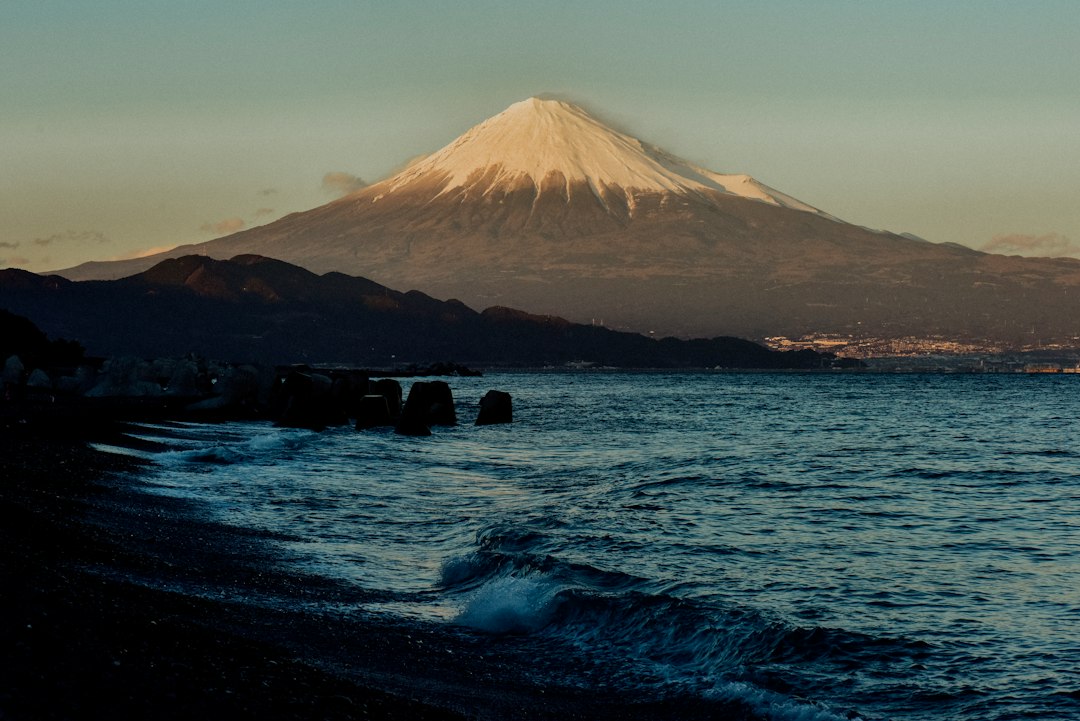
Can you see Mt. Fuji from Shizuoka?
Yes. Mt. Fuji can be seen from parts of Shizuoka's coast, tea-growing areas and the Izu Peninsula when conditions allow. From Fuji City's observation point, its long-running 8:00 AM record shows about 37% fully visible, 22% partly visible and 41% hidden mornings. Those are historical observations at one point, not your odds from every Shizuoka viewpoint. Check the live Mt. Fuji visibility forecast and a webcam before committing a morning to it.
Most people plan their Mt. Fuji trip from the Yamanashi side without ever realising there is a choice. The Fuji Five Lakes get the hotels, the pagoda and the Instagram traffic. Shizuoka gets the mountain's south face, the sea in front of it, the shrine that legally owns the summit, and something no other prefecture has: a 35-year official record of exactly how often Fuji is actually out.
That record is a useful planning clue. Seeing Fuji from Shizuoka depends on where and when you stand, and Fuji City's observations offer unusually detailed evidence for one south-side viewpoint. They cannot guarantee conditions elsewhere along the coast.
Table of contents
- Fuji City's historical visibility record
- The clear-sky trap
- Why 8 AM decides your day
- The best Mt. Fuji viewpoints in Shizuoka
- Why the south face is a different mountain
- Shizuoka or Yamanashi?
- A one-morning plan that works
Fuji City's historical visibility record
Over 35 years of observations, Mt. Fuji was fully visible from Fuji City's observation point on about 37% of mornings, partly visible on 22%, and hidden on 41%. These are observations from city hall at 8:00, 12:00 and 16:00, published on the city's Mt. Fuji observation record page. They describe that one viewpoint and observation time, not the probability of seeing Fuji from every place in Shizuoka Prefecture.
The monthly breakdown is where it gets useful. These are the 8:00 AM figures pooled across 1991 to 2025, roughly 1,050 to 1,085 observations per month.
| Month | Fully visible | Partly visible | Hidden |
|---|---|---|---|
| January | 60.0% | 22.3% | 17.7% |
| February | 52.6% | 22.3% | 25.1% |
| March | 40.7% | 20.6% | 38.7% |
| April | 36.3% | 22.0% | 41.7% |
| May | 30.2% | 20.9% | 48.8% |
| June | 12.4% | 21.4% | 66.2% |
| July | 9.9% | 14.7% | 75.4% |
| August | 14.6% | 21.0% | 64.4% |
| September | 27.2% | 26.8% | 46.0% |
| October | 41.1% | 27.6% | 31.2% |
| November | 53.9% | 24.8% | 21.3% |
| December | 61.7% | 23.2% | 15.1% |
December is the best month at 61.7%, January is a whisker behind, and July is a disaster at 9.9%. One clear morning in ten. If you visit Shizuoka in July and see the mountain, you got lucky, and you should treat it that way.
The partial-visibility column matters for photography, but it does not identify which part of the mountain was hidden. Fuji City groups every case in which some part of Fuji is visible into that category. It may mean a capped summit, a visible summit above low cloud, or another pattern. October has a high partial-visibility share in the record, so check a live camera rather than assuming the peak itself is clear.
One more honest caveat. Year to year, the variance is enormous. The best year in the record was 2021 with 162 fully visible mornings; the worst was 2018 with 98. The 35-year average is 134 mornings a year. A single-year table, which is what most articles quote when they quote anything, will mislead you.
The clear-sky trap
A clear sky over Fuji City does not mean Mt. Fuji is visible from city hall. Across 35 years, the city's records list 7,050 clear mornings at 8:00 AM but only 4,684 mornings when the whole mountain was visible. That works out to about 66% of clear mornings at that observation point; it is not a Shizuoka-wide forecast probability.
| Month | Clear mornings (35 yr) | Fuji fully visible | Hit rate on a clear morning |
|---|---|---|---|
| January | 745 | 651 | 87% |
| February | 642 | 520 | 81% |
| March | 585 | 442 | 76% |
| April | 570 | 381 | 67% |
| May | 550 | 328 | 60% |
| June | 380 | 130 | 34% |
| July | 425 | 107 | 25% |
| August | 582 | 158 | 27% |
| September | 526 | 286 | 54% |
| October | 578 | 446 | 77% |
| November | 685 | 566 | 83% |
| December | 782 | 669 | 86% |
Read the July row again. On a clear July morning in Shizuoka, with blue sky overhead and no rain in the forecast, Mt. Fuji is fully visible one time in four.
This is an important limit of a generic lowland forecast: a sunny icon over Fuji City does not guarantee an unobstructed mountain. Cloud can form or linger on Fuji while the coast is bright. Sea-breeze moisture and rising air may contribute, but this observation table alone cannot establish the cause of each hidden summit. Our weighted atmospheric model includes cloud and horizontal visibility; check a webcam for the actual view.
Why 8 AM decides your day
At Fuji City's observation point, full visibility is highest at the 8:00 AM observation and falls by more than a third by noon. The 35-year record splits by observation time:
| Observation time | Fully visible | Partly visible | Hidden |
|---|---|---|---|
| 08:00 | 36.6% | 22.3% | 41.1% |
| 12:00 | 23.3% | 30.1% | 46.6% |
| 16:00 | 22.5% | 27.2% | 50.3% |
Full visibility falls from 36.6% to 23.3% between the 8:00 and noon observations, while the partly-visible share rises from 22.3% to 30.1%. The data support visiting early when possible; they do not reveal whether the change on a given day was a summit cap, low cloud or another weather pattern.
One plausible contributor is moist air moving inland from Suruga Bay and rising along Fuji's flank as the day warms. The city recorded visibility, not the weather mechanism behind each observation, so treat that as an explanation to investigate rather than a conclusion proven by the table.
In 2025 alone, the mountain was fully visible at all three observation times on just 62 days. Seventeen percent of the year. On 77 days it was hidden at all three. The remaining 226 days, roughly six in ten, the mountain appeared at some check times and not others, which tells you how fast conditions turn.
The practical consequence catches almost every visitor out. Shizuoka's ticketed Fuji attractions open after the best window has started closing. The Mt. Fuji Shimizu Port Cruise sails between 11:30 and 15:00. Nihondaira Yume Terrace opens its indoor floors at 9:00. The Mt. Fuji World Heritage Centre opens at 9:00. If the forecast is marginal, do not spend the 8:00 hour on a train platform. Get to a free, always-open viewpoint first, and buy the ticketed experience afterwards with the mountain already in the bank.
The best Mt. Fuji viewpoints in Shizuoka
The best Mt. Fuji viewpoints in Shizuoka are Miho no Matsubara for the classic sea-and-pines composition, Satta Pass for the layered Tokaido view, Obuchi Sasaba for tea fields, Lake Tanuki for reflections, and Mizugatsuka Park if you want the mountain enormous. They are not interchangeable, and the difference is measurable.
The table below gives distance to the summit, the direction you face, and an estimated angle of the summit above the horizon from each viewpoint. That angle is useful for orientation, but it is not the mountain's apparent angular size; foreground, elevation and visible base all affect how large Fuji looks in a photograph.
| Viewpoint | Area | Distance to summit | You face | Summit above horizon |
|---|---|---|---|---|
| Mizugatsuka Park (1,450 m) | Susono | 7 km | NW | 18.7° |
| Lake Tanuki | Fujinomiya | 16 km | E | 11.2° |
| Fujisan Hongu Sengen Taisha | Fujinomiya | 19 km | NE | 10.9° |
| Obuchi Sasaba tea fields | Fuji City | 19 km | NE | 10.2° |
| Fuji City Hall / Shin-Fuji Station | Fuji City | 23-25 km | N | 8.4-9.2° |
| Mishima Skywalk | Mishima | 32 km | NW | 6.0° |
| Satta Pass | Shizuoka City | 36 km | NE | 5.8° |
| Cape Ose | Numazu | 38 km | N | 5.5° |
| Miho no Matsubara | Shizuoka City | 42 km | NE | 4.9° |
| Nihondaira Yume Terrace | Shizuoka City | 50 km | NE | 3.8° |
| Shizuoka Prefectural Office, 21F | Shizuoka City | 53 km | NE | 3.8° |
| Kumomi Coast | Matsuzaki | 66 km | N | 3.0° |
| Chureito Pagoda (Yamanashi) | Fujiyoshida | 17 km | S | 10.0° |
Mizugatsuka Park sits much closer to the summit than coastal Miho no Matsubara. Miho is especially valued for the sea, pines and mountain together, while a closer viewpoint can make Fuji more prominent. The summit-angle column cannot quantify that difference in apparent mountain size or prove that Miho's Fuji looks half as tall as it does from Chureito Pagoda.
Miho no Matsubara, Shizuoka City
About five kilometres of black volcanic sand backed by roughly 30,000 black pines, and a registered component of the Fujisan UNESCO World Heritage listing since 2013. The Hagoromo no Matsu, the pine at the centre of the celestial-maiden legend, is a short walk from the beach. Buses from JR Shimizu Station take about 25 minutes; a taxi is around 15. Free, open always, which makes it the right 8:00 AM stop.
Satta Pass, Shizuoka City
The single most historically loaded view in Japan. Hiroshige drew it for "Yui" in the Fifty-three Stations of the Tokaido, and the modern version stacks the JR Tokaido Main Line, National Route 1 and the Tomei Expressway in the foreground with Suruga Bay and Fuji behind. Walk up from JR Yui Station in about 40 minutes through the old Kurasawa and Terao houses, or from Okitsu Station in 40 to 50. There is a small car park at the pass; the Okitsu approach has better passing places on the narrow lane.
Nihondaira Yume Terrace, Shizuoka City
Kengo Kuma's octagonal timber pavilion on the 308-metre Nihondaira plateau, opened in 2018, with a 360° aerial corridor taking in Fuji, Suruga Bay, Shimizu Port and the Izu Peninsula. Two changes you will not find in older guides: the building is closed 24 to 30 September 2026 for renovation, and from 1 October 2026 the indoor observation facility becomes ticketed at ¥100 for high-school age and above, ¥50 for elementary and junior-high students. The outdoor observation deck stays free, and the aerial corridor remains accessible outside opening hours. The operator's official notice has the detail. It is three minutes on foot to the Nihondaira Ropeway and another five to Kunozan Toshogu.
Obuchi Sasaba, Fuji City
Two hectares of terraced green tea framing Fuji with no power lines in the way, which is rarer than it sounds. Best from late April into May when the new leaf is at its brightest, or in winter for the snow cap. Free parking, a small timber photo platform, and genuinely narrow approach roads. By bus it is Fuji Station to Sobina-shita plus a 20-minute uphill walk.
Lake Tanuki, Fujinomiya
The reflection lake of the Shizuoka side, and the site of the Double Diamond Fuji, when the sun rises exactly on the summit and the whole thing repeats in still water. It falls around 20 April and 20 August each year, with a viewing window of roughly a week either side, at about 6:00 AM. Pair it with Shiraito Falls, about 7 kilometres south, for a half-day on the western foothills.
The Suruga Bay Ferry and the Shimizu cruise
The ferry between Shimizu and Toi is the only scheduled service in Japan that shows you Fuji rising out of open sea. Note two 2026 updates: the adult fare rose to ¥3,000 one way on 1 May 2026, with elementary-age children and under now travelling free, and the official timetable allows 1 hour 30 minutes for the crossing, not the 65 to 75 minutes still quoted by many English guides. Three sailings each way. The 07:40 from Shimizu is the one that lands inside the good visibility window; the 11:20 and 14:40 do not.
Free indoor fallbacks
If the mountain is capped, the 21st-floor Fuji observation lobby at the Shizuoka Prefectural Office annex is free and costs you nothing but a lift ride: weekdays 08:30 to 18:00, weekends and holidays 10:00 to 18:00, closed the third Saturday and Sunday of the month. The Mt. Fuji World Heritage Centre in Fujinomiya is ¥500 for adults, free for under-15s and over-70s, open 9:00 to 17:00 and until 18:00 in July and August, closed the third Tuesday.
Why the south face is a different mountain
The Mt. Fuji you see from Shizuoka is not the symmetrical postcard cone, because the south-eastern flank carries the Hoei crater, a 1.3-kilometre-wide scar left by the 1707 Hoei eruption. It is wider than Fuji's own summit crater, which measures about 780 metres. From the Mishima Skywalk and the eastern Shizuoka viewpoints you look straight into it. From Kawaguchiko you cannot see it at all. If your mental image of Fuji is flawless bilateral symmetry, the south face will surprise you the first time, and then it will win you over, because the crater is the only visible evidence that this is an active volcano.
The south face also loses its snow first. Sun exposure strips the southern slopes back to bare andesite from roughly mid-July to late September, so the classic white cap is a shorter season here than it is on the north side. Our guide to Mt. Fuji's snow cap covers the timing in detail.
Then there is light, and this is the argument for Shizuoka that nobody makes.
Look at the "you face" column in the viewpoint table. Every Shizuoka viewpoint has you facing somewhere between north and north-east. The sun in Japan tracks across the southern sky all year, so from Shizuoka the sun is behind you or off your shoulder, and Fuji's face toward you is lit. From the Fuji Five Lakes the bearing to the summit is roughly due south, which means that at midday in winter the sun sits about 31° above the horizon, directly above and behind a mountain whose summit is only about 9° up. That is textbook contre-jour, and it is why north-side photography is so heavily concentrated at dawn.
The Izu coast takes this furthest. From Cape Ose and Kumomi the bearing to Fuji is within eight degrees of due north, so the mountain is front-lit from sunrise to sunset. If you want Fuji in usable light in the middle of the afternoon, the west coast of Izu is the best place in Japan to stand. The catch is the one the data already gave you: by mid-afternoon full visibility is down to 22.5%, so you will have gorgeous light on a hidden mountain more often than not. Shizuoka gives you better light and a shorter window. Plan accordingly, and see our Mt. Fuji photography guide for the exposure side of it.
There is a nice piece of trivia here too. The summit land above the eighth station is privately owned by Fujisan Hongu Sengen Taisha, the shrine in Fujinomiya, confirmed by a Supreme Court ruling in 1974. The prefectural boundary across the summit itself has never been settled; Shizuoka and Yamanashi agreed in 1951 not to fight about it, and both governors reaffirmed in 2014 that they would leave it alone. Fuji's peak is one of around fourteen places in Japan with no determined border.
Shizuoka or Yamanashi?
Choose Shizuoka if you want the sea in the frame, fewer crowds, front-lit afternoons and the Hoei crater. Choose Yamanashi if you want the symmetrical cone, the pagoda, mirror lakes and the deepest concentration of Fuji-facing hotels.
| Shizuoka (south) | Yamanashi (north) | |
|---|---|---|
| Signature composition | Fuji above Suruga Bay, pines, tea fields | Fuji above a lake, pagoda, torii |
| Cone shape | Asymmetric, Hoei crater visible | Symmetrical postcard cone |
| Direction you face | North to north-east, front-lit most of the day | South, backlit around midday |
| Snow cap window | Shorter; bare rock mid-July to late September | Longer on the shaded northern slopes |
| Crowds at the top spots | Light outside Golden Week | Heavy year-round |
| Public transport density | Thin between viewpoints; a car helps a lot | Dense bus and rail network |
| Access from Tokyo | Tokaido Shinkansen, 42-70 min to Mishima or Shin-Fuji | Highway bus, about 2 hr to Kawaguchiko |
The transport line is the one that decides it for most people. Shizuoka's viewpoints are spread along 90 kilometres of coast and foothills with sparse buses between them, so a rental car turns a frustrating day into an excellent one. Yamanashi's cluster around the Fuji Five Lakes is walkable and bus-served. For arriving from Tokyo, our breakdown of the Tokaido Shinkansen route covers Mishima and Shin-Fuji in detail, and our guide to the gateway cities around Fuji compares Fujinomiya, Fuji City and Gotemba as bases. If you are still weighing up the whole mountain, our ranking of the best Mt. Fuji viewing locations puts both sides side by side.
You do not actually have to choose blind, either. The two sides of the mountain cloud over on different schedules, so if you have a flexible day, look at the forecast and go to whichever side is winning.
A one-morning plan that works
If you have exactly one morning in Shizuoka and you want the best chance at the mountain, here is the sequence the data supports.
Check the Mt. Fuji visibility forecast the night before. A score of 70 or above means commit; between 40 and 70 means go anyway but keep the ticketed attractions out of the plan; below 40 in June, July or August means sleep in and do Shiraito Falls or the World Heritage Centre instead, both of which are better in flat light.
Be somewhere free and open by 07:30. Miho no Matsubara if you are based in Shizuoka City, Obuchi Sasaba if you are in Fuji City, Satta Pass if you are willing to walk. The 8:00 window is worth more than an extra hour of sleep by a factor of roughly 1.6 against noon.
Use 09:00 to 11:00 for the second viewpoint while the mountain is still likely out. Save Nihondaira Yume Terrace, the Shimizu cruise or the World Heritage Centre for after 11:00, because by then you already know whether you got the view.
And if the summit is capped, do not write the day off. Check again at 16:00. Roughly six days in ten, the mountain changes its mind at least once between morning and evening, and Shizuoka's coastline is a fine place to wait it out. You can watch conditions move in real time on our Mt. Fuji live cameras and see how today compares to the rest of the year on the visibility trends page.
More Articles
Mishima Skywalk: Fuji Views, Tickets, and When to Go
Mishima Skywalk puts Mt. Fuji 32 km to the northwest. Tickets, bus access, wind closures, and when the mountain is actually out.
Mount Fuji City: The Best Cities to Visit Near Japan's Sacred Peak
There is no single "Mount Fuji city," but four distinct gateway cities surround Japan's iconic volcano. Here's how to choose the right one.
Best Mt. Fuji Viewing Locations: Kawaguchiko vs Tokyo vs Hakone Compared
Compare the best places to see Mt. Fuji with real visibility data. Find out which location offers the best views for your trip.