Mt. Fuji from the Shinkansen: The Seat, the Minute, the Odds
How to see Mt. Fuji from the Tokaido Shinkansen: choose the Fuji-side seat, watch near Shin-Fuji and plan for cloud and window reflections.

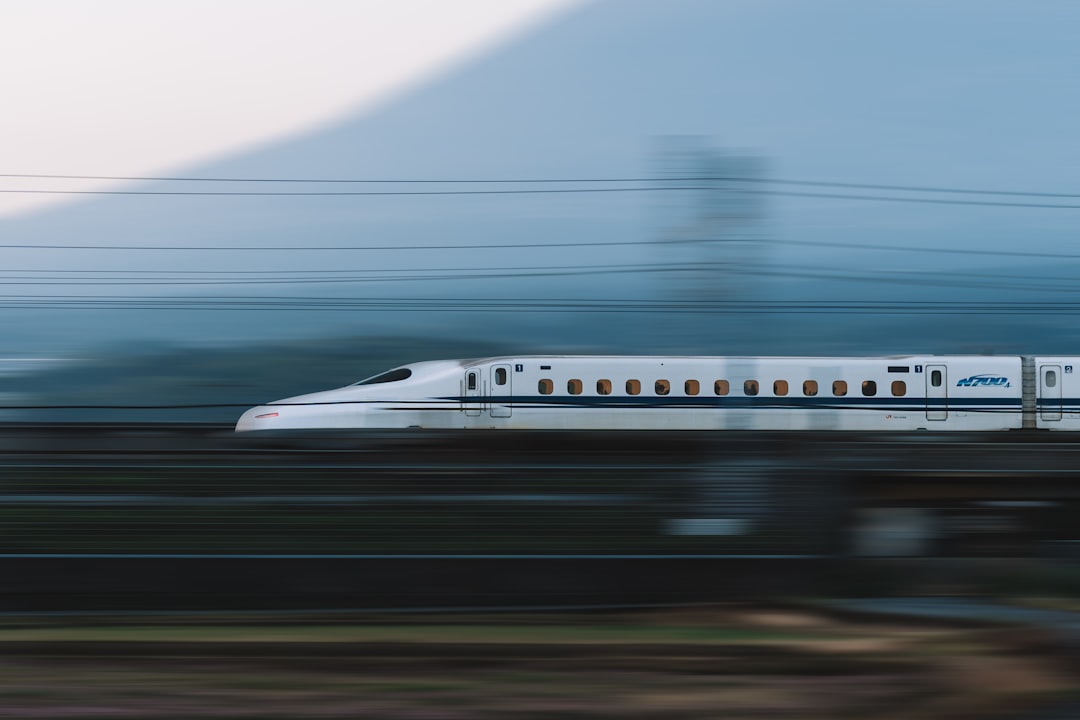
Can You See Mt. Fuji from the Shinkansen?
Yes. Mt. Fuji can be visible from the Tokaido Shinkansen between Tokyo and Shin-Osaka. Choose window seat E in ordinary cars or D in Green Cars in either direction, as JR Central advises. Watch around Shin-Fuji Station: the clearest close-up may last only a few minutes, and cloud or trackside obstructions can shorten it. Check the live Mt. Fuji visibility forecast before travel.
Seeing Mt. Fuji from the shinkansen is probably the most common Fuji sighting there is. The Tokyo to Kyoto run is the most travelled tourist corridor in Japan, and the mountain is right there beside the track.
It is also the sighting people most often miss. Not because of cloud, though cloud takes its share, but because they were watching the wrong side at the wrong minute, having read advice that was quietly wrong about both.
This guide fixes that: the seat letters, a timing table built from the line's actual kilometre posts, and the geometry that explains why the view behaves the way it does.
Table of Contents
- Which Side of the Shinkansen to See Mt. Fuji
- When to Look: Timing by Train Type
- How Close the Track Actually Gets
- Hidari Fuji: The Left-Side Consolation Prize
- What the Shinkansen View Actually Shows You
- Your Real Odds of Seeing Mt. Fuji from the Shinkansen
- The Kodama Trick: Get Off at Shin-Fuji
- Shooting Through the Glass
Which Side of the Shinkansen to See Mt. Fuji
Book seat E in an ordinary car or seat D in a Green Car, and you will be on the Fuji side of the train in both directions. Not "E going west and A coming back." E both ways.
This trips people up constantly, and you will find travel sites that get it backwards. The confusion comes from mixing up two different things: which side of the carriage Fuji appears on, and which seat letter sits on that side.
Tokaido Shinkansen trainsets never turn around. Car 1 always faces Shin-Osaka, car 16 always faces Tokyo, and at each terminus the driver simply walks to the other end. The seat letters are painted to the carriage, not to the direction of travel, so seat E is permanently on the northern flank of the train. Fuji is north of the track. The letter never changes.
| Direction | Fuji appears on your | Ordinary car | Green Car |
|---|---|---|---|
| Tokyo to Kyoto/Shin-Osaka | Right | Seat E | Seat D |
| Shin-Osaka/Kyoto to Tokyo | Left | Seat E | Seat D |
Ordinary cars use a 3+2 layout: A, B, C on one side, D and E on the other. E is the window of the two-seat pair. Green Cars use 2+2 (A, B and C, D), so the equivalent window is D. If a booking screen offers you only A, you are being offered the sea side.
One practical trap. On Nozomi services, only cars 1 and 2 are non-reserved; car 3 became reserved-only in March 2025, and during Golden Week, Obon and the New Year period every Nozomi seat is reserved. If you ride non-reserved, you cannot choose your side. Book a reserved seat through SmartEX or at a ticket window and pick the exact seat from the map. The surcharge is a few hundred yen. The view is the entire reason you took the train instead of flying.
When to Look: Timing by Train Type
Use station and landscape cues rather than a fixed minute count. Train type, stopping pattern and operating conditions change when you reach the Fuji City section. JR Central identifies the Shin-Fuji area as the key viewing stretch and advises having your camera ready around it.
Westbound from Tokyo, start paying attention after Mishima; eastbound, be ready before Shin-Fuji. The exact elapsed minutes depend on the service you booked.
Your train's live location or station announcements are more reliable than a stopwatch.
| Direction | Practical cue |
|---|---|
| Westbound, toward Kyoto or Osaka | Have your Fuji-side window ready after Mishima and before Shin-Fuji |
| Eastbound, toward Tokyo | Be ready before Shin-Fuji, then watch through the Fuji City section |
Landmarks beat stopwatches. Westbound, the Shin-Tanna Tunnel between Atami and Mishima is a useful early cue. Once you emerge, be ready for the Fuji City section rather than expecting the mountain to appear at an exact minute.
The order of landmarks going west is: tunnel, Mishima, Fuji City, Shin-Fuji Station, then the Fuji River bridge. Going east, reverse it. These are useful cues, not a minute-by-minute timetable.
How Close the Track Actually Gets
The Tokaido Shinkansen passes 24.5 km from Mt. Fuji's summit over eastern Fuji City, where the peak stands 8.6 degrees above the horizon. That is the closest any bullet train in Japan gets to the mountain.
We computed the figures below from station coordinates and the summit position, with a correction for the curvature of the earth. The bearing column is the useful one: it tells you where to point your eyes relative to the train.
| Point on the line | Distance to summit | Summit height above horizon | Bearing to Fuji |
|---|---|---|---|
| Shin-Yokohama | 82.2 km | 2.3° | 259° (ahead, right) |
| Odawara | 40.5 km | 5.1° | 287° (ahead, right) |
| Atami | 42.7 km | 4.9° | 312° (right) |
| Mishima | 30.9 km | 6.8° | 328° (right) |
| Eastern Fuji City | 24.5 km | 8.6° | 002° (abeam right) |
| Shin-Fuji Station | 25.0 km | 8.4° | 014° (abeam right) |
| Shizuoka | 53.1 km | 3.9° | 035° (behind right) |
Three things fall out of this table that no other guide mentions.
First, the line passes relatively close to Fuji City, but your best unobstructed view may be much shorter than the full time the mountain is geographically in sight. Sound barriers, wires, buildings and cuttings interrupt the scene. JR Central suggests having your camera ready around the roughly three-minute Shin-Fuji viewing stretch.
Second, the summit's angle above the horizon is not the mountain's apparent size. It cannot establish that the train view is visually equivalent to Chureito Pagoda. The practical advantage is how close the line passes Fuji City; the drawback is a moving view interrupted by foreground structures.
Third, the mountain is theoretically in line of sight from Shin-Yokohama onward. What blocks it is the Hakone and Tanna terrain, which is why the view switches on so abruptly at the tunnel mouth rather than fading in.
Hidari Fuji: The Left-Side Consolation Prize
If you are stuck in an A seat heading west, keep watching after Shizuoka: shortly after the train crosses the Abe River, Fuji reappears for about 30 seconds on the left. Japanese rail enthusiasts call it hidari Fuji, left-side Fuji, and catching it is supposed to bring luck.
The geometry is simple once you look at the bearings. West of Shizuoka the line swings southwest, and Fuji, which has been on your right all along, ends up behind your left shoulder at a bearing of roughly 35 to 40 degrees. It is the only point on the entire Tokaido Shinkansen where the mountain shows on the A side.
It is small and brief, and at 53 km the summit is under 4 degrees high, so it is nothing like the Fuji City view. But the name has pedigree: the old Tokaido highway had its own celebrated hidari Fuji spot in what is now Fuji City, where the road bent enough to throw the mountain onto travellers' left as they walked toward Edo. Hiroshige put it in his woodblock series. If your seat reservation went wrong, you at least get the historical version.
What the Shinkansen View Actually Shows You
The shinkansen shows you Fuji's south face, which is a different mountain from the one on the postcards. Almost every famous image of Fuji, from the Five Lakes to the pagoda shots, is taken from the north. The train runs along the south. Two consequences follow, and the first is the one photographers should care about.
You are looking north at the mountain, which means the sun is behind you for essentially the entire day. The cone is front-lit from mid-morning to late afternoon. Compare that with the classic north-side viewpoints, where you look south into the sun and fight backlight and flare unless you are there at dawn. Most shinkansen passengers cannot choose their departure time freely, and the good news is that they do not need to: midday light, the enemy of lakeside Fuji photography, is fine from the train.
The second consequence is the Hoei crater. The 1707 eruption left a large scar on Fuji's southeast flank, easier to pick out from the Tokaido corridor than from northern viewpoints. Around Mishima it can appear as a notch with Mount Hoei below it; the profile changes as the train continues past Fuji City. The story behind that scar is in our guide to Mt. Fuji's last eruption.
Snow behaves differently on this side too. The south face sheds its cover earlier in spring and gains it later in autumn, so the window for a fully snow-capped Fuji is a little narrower from the train than from Kawaguchiko.
Your Real Odds of Seeing Mt. Fuji from the Shinkansen
Winter generally offers better Fuji visibility than summer, but there is no measured "one in two trains" probability here. The shinkansen gives you one brief pass at a fixed time, so check current conditions rather than treating a seasonal estimate as your odds.
At a lakeside you may be able to wait for a cloud break. On a through train you get one brief pass at a fixed time. That makes a current forecast useful, though it cannot guarantee a sighting.
That makes the departure you book a real decision rather than a formality.
| Season | General visibility tendency | What it means for a train pass |
|---|---|---|
| December to February | Often clearest | Cold, dry air can help, but cloud still matters |
| March to May | Variable | Haze and weather can reduce visibility |
| June to August | Often more difficult | Rainy-season and summer cloud can hide the summit |
| September to November | Generally improving | Conditions often become clearer toward winter |
Our weighted atmospheric model blends cloud cover, visibility, humidity and precipitation into a score for planning. It is not a validated train-by-train sighting rate. Check the live number for your travel date and remember the trackside view can differ from the forecast area's average.
If you have flexibility over the day of travel, check the Fuji forecast and visibility trends before booking. A higher score is encouraging, not a guarantee from a moving train. The full seasonal picture is in our guide to the best time to see Mt. Fuji.
The Kodama Trick: Get Off at Shin-Fuji
Kodama services stop at Shin-Fuji Station, but the dwell time varies. Do not leave the train for a photo unless your itinerary explicitly allows a stopover; a short scheduled stop is not enough time to assume you can step out and reboard safely.
If you plan a proper stopover, check which platform has a clear view on the day and confirm your ticket permits the break. For most passengers, it is simpler to stay aboard and watch from the reserved Fuji-side seat.
Take it further and Shin-Fuji is a legitimate stopover. It is the closest shinkansen station to the summit at about 25 km, and the Shizuoka side is where the south-face viewpoints live, from the Mishima Skywalk suspension bridge to Shiraito Falls. Our breakdown of the Tokyo to Mt. Fuji bullet train time covers what each station connects to and what the onward legs cost, and the guide to reaching Mount Fuji from Osaka does the same from Kansai.
Shooting Through the Glass
Put the lens flat against the window and shoot at 1/1000 second or faster. At 270 km/h, near foreground objects smear badly, and anything slower than about 1/800 will drag the power lines and buildings across your frame.
Shinkansen windows are double-glazed and lightly tinted, so you are fighting two reflections and a colour cast. The fixes are mechanical rather than clever:
- Press the lens hood or phone body directly to the glass. Even a two-centimetre gap lets the carriage interior reflect in.
- Wear or drape something dark. A white shirt reflects straight back at you.
- A polarising filter can reduce some glass reflections at certain angles, but may also darken the image or interact unevenly with train windows. Test it before the brief viewing window rather than assuming it will always help or never help.
- Avoid an ultra-wide lens if you want Fuji prominent in the frame. A moderate telephoto setting can make the mountain more visible, but test the framing quickly before trackside obstacles arrive.
- Shoot the whole window, then crop. Composing precisely at that speed is a losing game.
Or consider not shooting at all. Three minutes is not much, and the mountain looks better through your eyes than through a tinted pane at 1/1000. Our Mt. Fuji photography guide covers the stationary viewpoints where the effort pays off.
Frequently Asked Questions
How long is Mt. Fuji visible from the shinkansen?
JR Central highlights roughly three minutes around Shin-Fuji for photography. You may glimpse Fuji before or after that stretch, but clouds and trackside obstacles can shorten the useful view. Do not plan around a fixed elapsed time for every service.
Which seat is best for Mt. Fuji on the shinkansen?
Seat E in an ordinary car and seat D in a Green Car, in both directions, according to JR Central's seat guide. Confirm the seat map when booking your specific service.
Can you see Mt. Fuji from the Nozomi?
Yes. The Nozomi passes through the entire viewing corridor between Mishima and Shizuoka; it simply does so faster than a Hikari or Kodama. The only thing you lose is the option of stepping onto the Shin-Fuji platform, since Nozomi does not stop there.
Is Mt. Fuji visible from the shinkansen in summer?
Sometimes. Summer cloud and haze can hide the summit, particularly during the rainy season. Check the forecast for your travel day; we do not have a measured train-specific summer sighting rate.
If your ticket is already booked, confirm your Fuji-side seat letter and check the Mt. Fuji visibility forecast for your travel window. Westbound, start watching after Mishima; eastbound, be ready before Shin-Fuji. Keep your camera ready, but let station cues do the work instead of an alarm set to an invented minute.
If it reads 30, put your book away anyway. The mountain has a habit of appearing to people who are looking.
More Articles
Tokyo to Mt. Fuji Bullet Train Time: Real Times by Station
Tokyo to Mt. Fuji bullet train time is 42 minutes to Mishima and 70 to Shin-Fuji. Neither drops you at the mountain. Here is the honest math.
Mount Fuji from Osaka: Routes, Costs, and the Best Seat on the Shinkansen
See Mount Fuji from Osaka by shinkansen, day trip, or overnight bus. Routes, 2026 prices, and visibility tips.
Best Time to See Mt. Fuji: A Complete Visibility Guide
Planning to see Mt. Fuji? Learn the best months, times of day, and weather conditions for clear views of Japan's iconic mountain.