Northern Lights Alaska Tours: Which Base and Tour to Book
Northern lights Alaska tours compared: Fairbanks, Arctic Circle and Anchorage trips, 2026-27 prices, refund rules and 10 winters of clear-night odds.
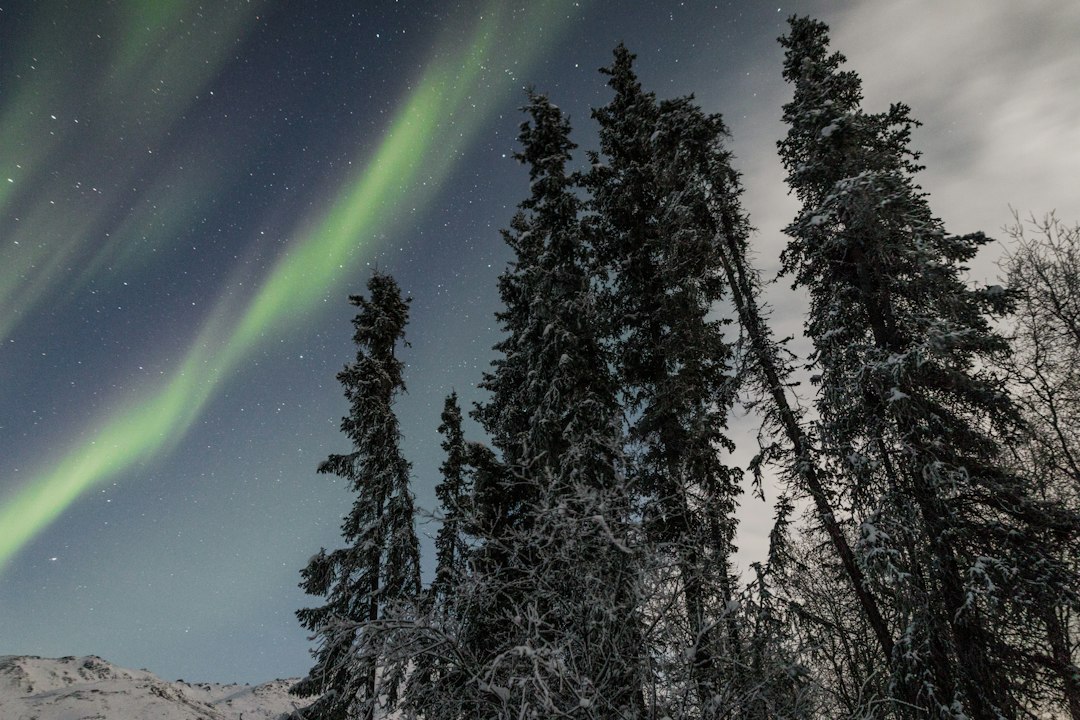
Northern lights Alaska tours come in three very different products: an evening van out of Fairbanks, a long day up the Dalton Highway toward the Arctic Circle, or a night out of Anchorage. They are sold with the same photos and the same promise. They are not equally likely to show you the aurora.
The reason is geography. Interior Alaska sits under the auroral oval, so on a clear night there the lights usually show somewhere in the sky and the tour is mostly buying you transport, warmth and a dark hilltop. Anchorage sits south of the oval, so a tour there needs clear sky and a geomagnetic boost on the same night, which turns out to be rare.
To put numbers on that, we ran ten winters of hourly cloud data and the geomagnetic record for the places these tours actually go. The results, along with 2026-27 prices and the refund terms that matter, are below. For tonight's answer at any of these bases, the live northern lights forecast folds activity, cloud, darkness and moonlight into one verdict.
Northern Lights Alaska Tours Compared
Alaska aurora tours run from about $50 for an indoor viewing site near Fairbanks to more than $1,000 for a two-night Arctic package, and price tracks distance driven far more than sighting odds. The 2026-27 season opened in late August, according to the Alaska Travel Industry Association, and most operators run through mid to late April.
| Tour | Base | Price (per person) | Where you actually watch | Refund if no aurora |
|---|---|---|---|---|
| Aurora Pointe viewing site | Fairbanks | About $50-55, 10 pm-2 am | A site with an indoor fire about 15 minutes from downtown | Not stated |
| Small-group chase van | Fairbanks or Anchorage | Varies by operator | Wherever the guide drives that night | Varies by operator |
| Chena Hot Springs evening trip | Fairbanks | $240 with one operator, about 11 hours | Chena Hot Springs Resort, about 60 miles east | No |
| Charlie Dome aurora tour (booked at the resort) | Chena Hot Springs | $125, 5 hours | Charlie Dome, reached by tracked military-style vehicle | No, but full refund with 24 hours' notice |
| Arctic Circle Aurora Drive | Fairbanks | $359 standard, $399 peak | A homestead at Joy, about 60 miles north of Fairbanks | No guarantee offered |
| Arctic Circle fly/drive (southbound) | Fairbanks | $639 standard, $679 peak | Joy, on the drive back south from Coldfoot | No guarantee offered |
| Coldfoot overnight, 2 nights | Fairbanks (van north, flight back) | $1,019 standard, $1,169 peak | Coldfoot Camp, plus an $89 Wiseman option | No guarantee offered |
| Anchorage Aurora Quest photo tour | Anchorage | From about $295, 6+ hours | Dark sites chosen on the night | Not stated |
Arctic Circle rates come from Northern Alaska Tour Company's 2026-27 pages, including its Coldfoot overnight package. The Charlie Dome price is from Chena Hot Springs Resort, and the Aurora Pointe and Aurora Quest figures are from their Alaska.org listings. Prices change, so confirm at booking.
A few things are new for 2026-27. ATIA's September 2026 release lists The Orion, a 10-room aurora lodge near Fairbanks with an indoor viewing lounge and aurora alerts; Aurora Black Truck Tours, a new Fairbanks small-group operator running four- to six-hour trips; a helicopter-access viewing dome above Knik Glacier from Outbound Heli Adventures; and a new Snowhook Adventure Guides lodge in Hatcher Pass.
How Often Each Tour Base Gets a Clear Night
Interior tour bases get a clear evening on about 40 percent of nights from October to March, while Anchorage gets one on about 26 percent. That comes from ten winters (2015-16 through 2024-25) of hourly cloud cover from the Open-Meteo historical weather archive.
We counted a night as clear if at least two consecutive dark hours between 8 pm and 4 am had cloud cover of 30 percent or less, with dark meaning the sun at least 10 degrees below the horizon. That is the same cloud and darkness cut-off our aurora forecast uses for a naked-eye verdict.
| Clear evenings (%) | Sep | Oct | Nov | Dec | Jan | Feb | Mar |
|---|---|---|---|---|---|---|---|
| Fairbanks | 29 | 38 | 33 | 40 | 49 | 42 | 43 |
| Joy (Arctic Circle Drive stop) | 31 | 37 | 30 | 38 | 49 | 42 | 45 |
| Coldfoot | 27 | 32 | 33 | 38 | 44 | 46 | 44 |
| Hatcher Pass | 19 | 30 | 38 | 27 | 39 | 33 | 39 |
| Anchorage | 26 | 29 | 28 | 15 | 19 | 24 | 39 |
Three patterns stand out.
January is the clearest month in the interior. Fairbanks hits 49 percent in January, against 29 percent in September. The mild, lake-reflection weeks of early fall are the cloudiest of the season, which is worth knowing if September is the month you were sold on.
Going farther north does not buy clearer sky. Coldfoot, about 250 road miles north of Fairbanks in the Brooks Range, averages 39 percent from October to March. Fairbanks averages 41. Joy, where the Arctic Circle Drive stops to watch, averages 40. These places share one continental weather regime, so a cloud deck over Fairbanks often covers them too.
Anchorage loses its best months to cloud. December and January, the longest nights of the year, are Anchorage's cloudiest stretch at 15 and 19 percent. March is its best month by a wide margin.
The data has limits. A reanalysis grid cell is miles across and cannot see the shallow ice fog that settles in Fairbanks on the coldest nights. A 30 percent cut-off is strict, too: the aurora often shows through gaps in thinner cloud. Loosening the cut-off to 50 percent lifts every base by 5 to 7 points but leaves the ranking unchanged. Treat the table as a comparison between bases and months, not a promise for any one night.
Why Anchorage Northern Lights Tours Need Two Things to Line Up
An Anchorage-area tour needs a clear sky and about Kp 3 on the same night, and that combination happened on only 8 percent of October-to-March nights at Anchorage and 10 percent at Hatcher Pass. In Fairbanks, adding an activity requirement trims only about five to seven points, because quiet Kp 1 activity is already enough under the oval.
The threshold comes from our location registry: about Kp 3 for naked-eye aurora at a dark site near Anchorage, versus Kp 1 for Fairbanks. If the Kp scale is unfamiliar, our guide to the Kp index explains what the number does and does not measure. We matched each clear night against the GFZ Potsdam three-hourly Kp record. On its own, Kp reached 3- or higher during Anchorage's late-evening hours on roughly 27 percent of winter nights. Multiply that by a 26 percent clear rate, and you can see why the combined figure is so low.
That ten-winter record runs from the 2019 solar minimum through the peak of Solar Cycle 25, which NASA and NOAA announced in October 2024. The 2026-27 season sits on the declining side of that peak, when strong storms still arrive more often than in the quiet years near minimum. That helps Anchorage far more than Fairbanks, where a quiet night is already enough.
| Odds of at least one usable night | 3 nights | 5 nights |
|---|---|---|
| Fairbanks, clear evening | 72% | 88% |
| Fairbanks plus nearby hills (Cleary Summit, Murphy Dome) | 80% | 92% |
| Fairbanks or Coldfoot | 83% | 94% |
| Anchorage, clear evening | 51% | 66% |
| Anchorage, clear and Kp 3 | 19% | 28% |
| Anchorage or Hatcher Pass, clear and Kp 3 | 26% | 37% |
These are counted from real consecutive nights in the record, not multiplied out, so they include the way cloudy weather tends to stick around for several days. They also explain why Explore Fairbanks can say that staying at least three nights and going out in the late evening gives better than a 90 percent chance. Our strict clear-sky count lands at 72 to 80 percent for three nights; sightings through broken cloud would plausibly account for some of the gap, though our data cannot measure that.
The practical upshot for Anchorage: do not prepay an aurora tour weeks out and hope. Book an operator that makes a same-day go or no-go call. Greatland Adventures, which runs from both Anchorage and Fairbanks, says on its Travel Alaska listing that guests get a forecast call between 3 and 5 pm on the tour day, and that it will work to rebook to another night if a tour is not recommended. Then watch for storm alerts, because a solar storm is what turns Southcentral from marginal to spectacular.
Fairbanks Tours Buy Altitude and Warmth
A Fairbanks northern lights tour is mostly a ride out of the valley to a hilltop above the city glow and ice fog, with somewhere heated to wait. That is worth paying for, but it is a different product from the cloud-chasing tours in Norway or Iceland.
The hill matters more than the extra miles. Fairbanks sits in a basin where cold air pools on still, clear nights, which are exactly the nights you want. In a Geophysical Institute column, a National Weather Service hydrologist read 44°F on his truck thermometer at Cleary Summit and minus 2°F near Chatanika Lodge in the valley below. That is an extreme case. Even a fraction of it changes how long you can stand outside at 1 am.
The chase value is real but modest. Adding the hills around town (Cleary Summit and Murphy Dome) lifts the three-night odds from 72 to 80 percent. Driving as far as Coldfoot only takes it to 83. Most of the gain comes from the first 30 miles.
That makes the cheap options better value than they look. An indoor viewing site like Aurora Pointe at about $50 a night, repeated over several nights, buys more chances than a single $240 combo. If you are staying at Chena Hot Springs or driving out yourself, book the resort's Charlie Dome tour directly at $125, because it refunds in full with 24 hours' notice. The tour starts at the resort, so the 60-mile trip from Fairbanks is on you. Package trips from Fairbanks often do not. One operator's Chena trip, for example, is non-refundable inside 30 days and offers no refund if the lights do not appear.
Arctic Circle Aurora Tours: You Watch South of the Circle
On the one-day Arctic Circle Aurora Drive, you cross the Arctic Circle in daylight and watch the aurora back at Joy, a homestead about 60 miles north of Fairbanks. The Arctic Circle itself sits at Mile 115 of the Dalton Highway, roughly 200 road miles from town, and the van passes it in the afternoon.
That is not a criticism of the tour. It is honest about where the viewing happens, and Joy is a good dark site. Our data puts Joy's clear-evening rate at 40 percent, essentially the same as Fairbanks. So the $359 to $399 fare buys you the Dalton Highway, the Yukon River, a certificate and a long day. It does not buy a better aurora sky than a $50 viewing site outside Fairbanks on the same night. The tour leaves at 9:45 am and returns around 3:30 to 4:30 am, which is a hard 18 hours if you plan anything the next morning.
Coldfoot overnights are a different case. Two or more nights in the Brooks Range, with an optional late trip to Wiseman, give you darker skies than anywhere on the road system near Fairbanks and a second and third roll of the dice. They do not give you clearer skies on average, and in April they give you less darkness. Within our 8 pm to 4 am window, Coldfoot averages 3.1 dark hours in April against 4.5 in Fairbanks and 6.0 in Anchorage, because the sun barely dips at 67 degrees north by then.
If you go north, go between October and March. If you go in April, Fairbanks is the better base.
How to Book Without Wasting a Night
The best way to book Alaska northern lights tours is to lock in nights, not tours, and leave the expensive evening flexible until you can see the forecast. Weather forecasts get useful about two to three days out, and NOAA's geomagnetic forecast runs three days ahead, so that is your decision window.
- Book four or five nights in the interior. In our data, five nights near Fairbanks gave a clear evening 88 to 92 percent of the time.
- Pick a base by the month. January to March for Fairbanks and Coldfoot. March for Anchorage. Skip April for Arctic trips.
- Put non-refundable tours on day-value activities. The Arctic Circle drive and a Chena soak are worth doing on a cloudy night. A chase van is not.
- Keep the chase night flexible. Choose operators with a same-day call or a short cancellation window, and check the Alaska aurora forecast for your base each afternoon.
- Avoid the full-moon week if you can. A bright moon washes out fainter displays. The forecast already accounts for moonlight in its verdict.
Two expectation-setters before you go. A quiet interior display often reads as a pale grey-green arc to the eye while a phone in night mode shows vivid green, which is normal and covered in our post on aurora colors. And displays come in bursts rather than as one long show, so plan on how long the northern lights last in practice: often 15 to 40 minutes at a time, with gaps between.
Where Alaska Fits Among Aurora Destinations
Alaska is the strongest aurora destination in the United States, and Fairbanks has the clearest peak-season sky of the major aurora towns we have compared, which is why a tour there is a smaller part of the story than in coastal Norway or Iceland. Our comparison of the best places to see the northern lights sets Fairbanks against Tromsø, Yellowknife and Abisko on darkness and cloud, and the general northern lights tour guide covers how to read "guaranteed sighting" fine print anywhere.
If you are combining aurora with a summer trip, they do not overlap. The midnight sun shuts aurora viewing down from roughly late April to late August, which is also when bus tours and flightseeing around Denali run. Our Denali tour guide and the Denali visibility forecast cover that half of the year.
For a winter trip, the short version is simple. Base yourself in Fairbanks between January and March, book at least four nights, treat the long tours as daytime experiences, and decide each evening's plan from the live aurora verdict rather than from the calendar.
More Articles
Northern Lights Tour: How to Choose One (and When to Skip It)
A northern lights tour can only fix two of the four things that decide whether you see aurora. Here is how to choose one, and when to skip it.
Best Place to See Northern Lights: Compared by the Three Numbers That Matter
The best place to see northern lights is where dark nights, a low Kp threshold and clear skies overlap. We compare 17 destinations on all three.
The Kp Index, Explained: Why the Aurora Number Is Not a Promise
The kp index is a 0 to 9 scale of geomagnetic activity. Here is what the aurora number really means, and why a high value is no promise.