Owakudani: Black Eggs, Fuji Odds and the 9-to-5 Rules
Owakudani is open 9 to 5 only. When Mt. Fuji shows from the valley, the black egg facts, the gas rules, and the busy days the bus skips it.

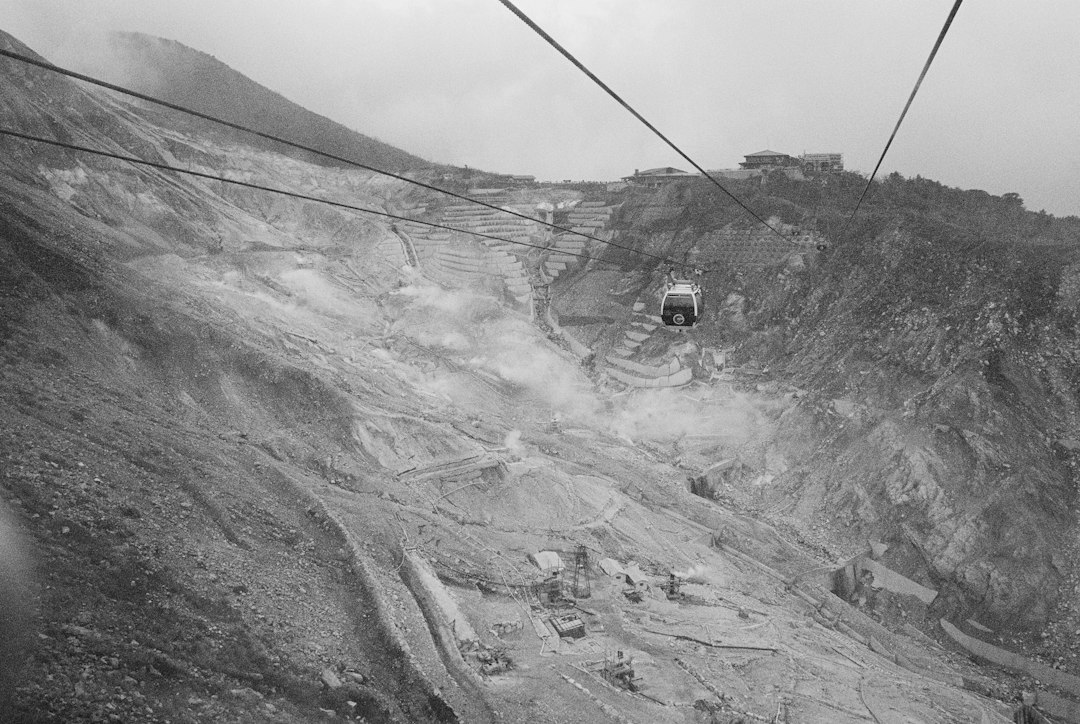
Owakudani is the steaming volcanic valley at the top of the Hakone Ropeway, 1,044 m up on the flank of Mt. Kami, where hydrogen sulfide still vents from the ground and eggs are boiled black in hot spring pools. It is also one of the few places in Hakone that looks straight at Mt. Fuji. Everything about it runs on a strict daytime clock. The access road, the car park and the shops open at 9 AM and shut by 5 PM, and the escorted trail runs only between 10 AM and mid-afternoon.
That clock shapes the visit more than the season does. So does a bus calendar that skips the valley on busy days, and a gas warning that rules some visitors out entirely.
Owakudani opens at 9 and closes by 5
Owakudani can only be reached between about 9:00 and 17:00, whether you arrive by ropeway, bus or car. Kanagawa Prefecture keeps prefectural road 734 closed from the Owakudani junction to the valley car park and opens it only from 9:00 to 17:00. The ropeway keeps the same hours, and the car park closes even earlier.
| What | Hours | Source |
|---|---|---|
| Road into the valley (prefectural road 734) | 9:00 to 17:00 | Kanagawa Prefecture |
| Hakone Ropeway | 9:00 to 17:00 (Feb to Nov), 9:00 to 16:15 (Dec and Jan) | Hakone Navi |
| Owakudani car park, entry | 9:00 to 16:20 (Feb to Nov), 9:00 to 16:00 (Dec and Jan) | Owakudani car park |
| Car park, last exit | 16:40, after which cars cannot leave | Owakudani car park |
| Kurotamago-kan shop | 9:00 to 16:30 | Kurotamago-kan |
| Black egg sales | 9:00 to 16:40, or until sold out | Kurotamago-kan |
| Escorted nature trail | 10:00, 11:30, 13:00, 14:30 | Hakone Tourist Association |
Two things in that table catch people out. The car park's last exit is 16:40, and the operator warns that a car still inside after that cannot be driven out. And the shop closes before the ropeway does, so a late-afternoon cabin arrives after the eggs have gone.
In modelled temperature data the valley runs about 6°C colder than Hakone-Yumoto, and the open decks catch the wind; our Hakone weather guide has the temperatures by altitude.
When Mt. Fuji is visible from Owakudani
Your best chance of seeing Mt. Fuji from Owakudani is in December and January, and in the first hour after opening, when the sky over the summit is most often clear. From the station plaza the summit is about 29.5 km away on a bearing of 296°, west-north-west, and stands about 5° above the horizon. That is a little over half the height it appears from the shore of Lake Kawaguchi, so expect a clear, full cone, but not a mountain that fills the frame.
We took ten years of modelled hourly cloud cover for the grid cell over Fuji's summit (Open-Meteo historical archive, 2016 to 2025) and counted how often it showed 30% cloud cover or less at each hour Owakudani is open. This is reanalysis model output, not an observation from Owakudani, and a clear summit sky does not guarantee a view through haze or low cloud along the way.
| Month | 7 AM (valley shut) | 9 AM | 11 AM | 1 PM | 3 PM | Days with any clear hour, 9 AM to 4 PM |
|---|---|---|---|---|---|---|
| Jan | 47% | 49% | 45% | 43% | 46% | 70% |
| Feb | 40% | 46% | 37% | 34% | 30% | 64% |
| Mar | 36% | 34% | 30% | 28% | 30% | 52% |
| Apr | 35% | 34% | 24% | 26% | 23% | 47% |
| May | 25% | 21% | 19% | 18% | 18% | 36% |
| Jun | 16% | 9% | 7% | 6% | 7% | 20% |
| Jul | 21% | 18% | 9% | 7% | 6% | 25% |
| Aug | 29% | 20% | 13% | 9% | 6% | 34% |
| Sep | 22% | 19% | 11% | 10% | 8% | 31% |
| Oct | 22% | 23% | 17% | 15% | 16% | 37% |
| Nov | 47% | 43% | 41% | 34% | 38% | 65% |
| Dec | 45% | 49% | 46% | 45% | 46% | 73% |
| Year | 32% | 30% | 25% | 23% | 23% | 46% |
Three findings matter for planning.
The 9 AM gate costs less than you would think. On only about 7% of days was the summit clear at dawn and then clouded over before the valley opened. Most clear days stay clear past 9.
In summer, the hour is everything. In August the summit is clear at 9 AM on 20% of days and at 3 PM on 6%. Arrive at lunchtime from June to September and you are betting against long odds. In December and January the hour barely matters.
Morning light is better here, too. At 9 AM the sun is low in the south-east, almost directly behind you as you face Fuji, so the mountain is lit from the front. By 4 PM in June and July the sun has swung round to within about 20° of Fuji's bearing, and you are squinting into glare and haze.
Fuji City's own observations, made by eye from the south side of the mountain from 1991 to 2025, show the same drop through the day: Fuji fully visible on 36.6% of days at 8 AM and 23.3% at noon (Fuji City record, 2025 edition).
On the ground, the open decks of the station's Earth Valley area, including the circular Wind Circle Terrace, give the clearest outlook. The ropeway between Ubako and Owakudani gives the best moving view; our Hakone Ropeway guide has the seat side, fares and station details.
These are historical odds, not a forecast. For your actual day, our live Mt. Fuji visibility forecast scores each hour on cloud, humidity, visibility distance and rain using our published scoring model. If the morning scores high and the afternoon low, do Owakudani first and the museums after.
The bus that skips Owakudani
The Izuhakone Bus J line is a scheduled route bus that serves Owakudani, and on busy days it does not stop there at all. Izuhakone Bus publishes a calendar each month of days when the bus will "not enter Owakudani" because of expected traffic jams around the valley. Adding up its notices from 25 April to the end of November 2026 gives 73 days on which the bus was scheduled to skip the stop:
- Golden Week: every day from 25 April to 6 May
- May and June: every Sunday
- July: 18 to 21, 26 and 27 July
- August: 17 days, including the Obon holidays (13 to 16 August)
- September: 10 days, including all of Silver Week (19 to 23 September)
- October: 8 days, including the 10 to 12 October holiday weekend
- November: every Saturday, Sunday and public holiday, plus Monday 2 November
The bus also skips the valley without notice whenever gas readings or road conditions close the access road. Check the Izuhakone bus notices the day before; the November calendar was last updated on 23 October.
On days when the bus does stop, it runs from Odawara and from bus platform 1 at Hakone-Yumoto Station, taking about 37 minutes from Yumoto in the current timetable. Izuhakone raised its route bus fares on 1 July 2026 and announced further fare changes from 1 October, so check the fare in its timetable search. Izuhakone is a separate operator from Odakyu, and the Hakone Freepass does not cover it.
The ropeway is the reliable way in: about 10 minutes from Sounzan, untouched by road traffic, and covered by the Hakone Freepass. On weekends and holidays, plan around it.
The exception is winter maintenance, which falls in the months with the best Fuji odds. The operator has announced that Owakudani to Sounzan closes from 7 to 24 December 2026, and Togendai to Owakudani from 12 January to 26 February 2027. Replacement buses run about every 15 minutes on the closed section and accept the Freepass, but the operator warns they get crowded and caught in traffic, so on those dates ride the section that is still running.
Driving costs double on weekends. The valley car park charges ¥500 for two hours on weekdays (¥1,300 daily maximum), but ¥1,000 for two hours on weekends and holidays (¥2,600 maximum), with a queue to get in. Hakone Navi suggests parking at Togendai, Ubako or Sounzan and riding the ropeway up; Ubako's car park is free, with about 90 spaces.
Black eggs: what is actually true
Kuro-tamago are ordinary chicken eggs, boiled in a hot spring pool at about 80°C for an hour and then steamed at about 100°C for 15 minutes. Components of the hot spring water stick to the porous shell and turn it black, according to Kurotamago-kan. Inside, it is a normal hard-boiled egg.
The rest comes from the producer, the official Kurotamago-kan:
- Four eggs cost ¥500. They come in a bag of four, not five.
- You can only buy them at Owakudani, at Kurotamago-kan and Gokuraku-chaya. They are not sold anywhere else.
- They are sold only on the day they are made. Leftovers become smoked eggs and furikake seasoning.
- They ride their own ropeway. Because they are also sold at the shop below the cooking pools, the eggs are carried down on a small dedicated ropeway.
- The seven years is just a lucky number. The valley has an Enmei Jizo, a longevity statue said to have been carved by the monk Kobo Daishi in the Heian period. Kurotamago-kan says the "seven years" figure simply grew up because seven is a lucky number.
The valley's name changed too. It was Ojigoku, "Great Hell", until it was renamed Owakudani, "Great Boiling Valley", ahead of a visit by Emperor Meiji. Kurotamago-kan dates that visit to 5 August 1873.
Volcanic gas: who should not go, and what it closes
The gas at Owakudani can be dangerous to some visitors, and Kanagawa Prefecture is blunt about it. People with asthma, bronchial or other respiratory disease, heart disease, or a pacemaker are asked not to visit the Owakudani area, because the gas can be life-threatening for them. The gases are hydrogen sulfide and sulfur dioxide. If the smell gets strong or your eyes, nose or throat sting, leave the area.
Gas and the eruption alert level are separate things. The Japan Meteorological Agency keeps Hakone at alert level 1, the lowest, and the prefecture says the ropeway currently has no volcano-related restrictions. Even so, a spike in gas readings can close the nature trail, the access road or a ropeway section on a day when the volcano is officially quiet. In 2015 rising volcanic activity shut the nature trail from May, and a very small eruption followed at the end of June.
Most hiking from Owakudani is still off-limits. About 3 km of trail around the valley, toward Sounzan, Ubako and the ridge, remains closed. The ridge path between the summits of Komagatake and Kamiyama, Hakone's highest peak, reopened on 28 March 2025, but you reach it from the Komagatake Ropeway on the far side of Lake Ashi, not from Owakudani.
The valley also feeds Hakone's baths. Kurotamago-kan's history page credits a hot spring supply network built out of Owakudani with laying the foundation for the Sengokuhara resort area; our Hakone onsen guide covers where to bathe.
The Owakudani Nature Trail: booking and fine print
The Owakudani Nature Trail is the only way to walk into the fumarole field, and it is a 700 m escorted loop that must be booked online. It reopened on 28 March 2022 after being closed since May 2015, and the Hakone Tourist Association booking site sets the terms:
- Four departures a day, at 10:00, 11:30, 13:00 and 14:30, each limited to 30 people and lasting about 40 minutes.
- Check in 20 minutes early at the Owakudani Information Center, on the ground floor of Kurotamago-kan on the ropeway side.
- ¥800 per person, cashless only. Cash is not accepted; pay by card or transit IC card.
- Guidance is in Japanese, and the site asks only Japanese speakers to apply. The two staff with the group are safety monitors, not guides.
- Helmets are issued, and rockfall shelters line the route. Kanagawa Prefecture requires participants to be of elementary-school age or older and able to run to safety on their own.
- The decision is made 30 minutes before each departure. Walks are cancelled when gas readings exceed the limits and also in rain, strong wind or fog.
Plan for that last rule. In the same ten years of modelled weather, rain of 0.5 mm or more fell at Owakudani in about one trail hour in six from June to October, and one in twenty in December and January, before counting fog and wind. Book an early slot so a later one is your fallback, and allow for traffic, which the booking site warns can make people late.
Frequently asked questions
Is Owakudani open today?
Usually from 9:00, but gas, weather and traffic can close parts of it. Kurotamago-kan's "today's Owakudani" page shows whether the shop is open, and Kanagawa Prefecture lists current road and trail restrictions.
Is Owakudani safe to visit?
The station, decks and shops are open to the public at the current alert level 1. Kanagawa Prefecture asks people with asthma, respiratory or heart conditions, or a pacemaker not to visit, because the gas can be life-threatening for them.
Can you see Mt. Fuji from Owakudani?
Yes, on clear days, about 29.5 km away to the west-north-west. In ten years of modelled cloud data, the summit sky was clear for at least one opening hour on about 70% of days in December and January, but on only about 20 to 35% of days from June to September, most often in the morning.
Before you go up
Allow 45 to 60 minutes for the decks, the shop and an egg, plus an hour for the nature trail. Most people stop here on the Hakone loop between Sounzan and Lake Ashi; our Hakone overview covers which way to ride it, and Mt. Fuji from Hakone covers the other viewpoints. If you're coming for the day, the Tokyo to Hakone guide lists the earliest trains and buses for an opening-time arrival.
The steam and the eggs are there in any weather. The Fuji view is not. Check the Mt. Fuji forecast the night before, and if the morning looks clear, be on the first ropeway and make Owakudani your first stop.
More Articles
Hakone Ropeway: Fares, Route, Mt. Fuji Views and When It Closes
The Hakone Ropeway now charges one flat fare. Real 2026 prices, exactly where Mt. Fuji appears, and the closures nobody warns you about.
Hakone: Where Fuji Shows, How the Loop Runs, When to Go
Hakone is a volcanic caldera 80 minutes from Tokyo. Which parts actually see Mt. Fuji, which way to ride the loop, and 2026 prices for each leg.
Mt. Fuji from Hakone: Best Viewpoints and Visibility Guide
Can you see Mt. Fuji from Hakone? Yes, on about half of all days. Here are the best viewpoints, when to go, and how to check conditions.