Northern Lights Norway: Where the Clear Skies Actually Are
Northern lights Norway trips fail on cloud, not aurora. Ten winters of modelled cloud data show which bases clear most and where to drive when they don't.

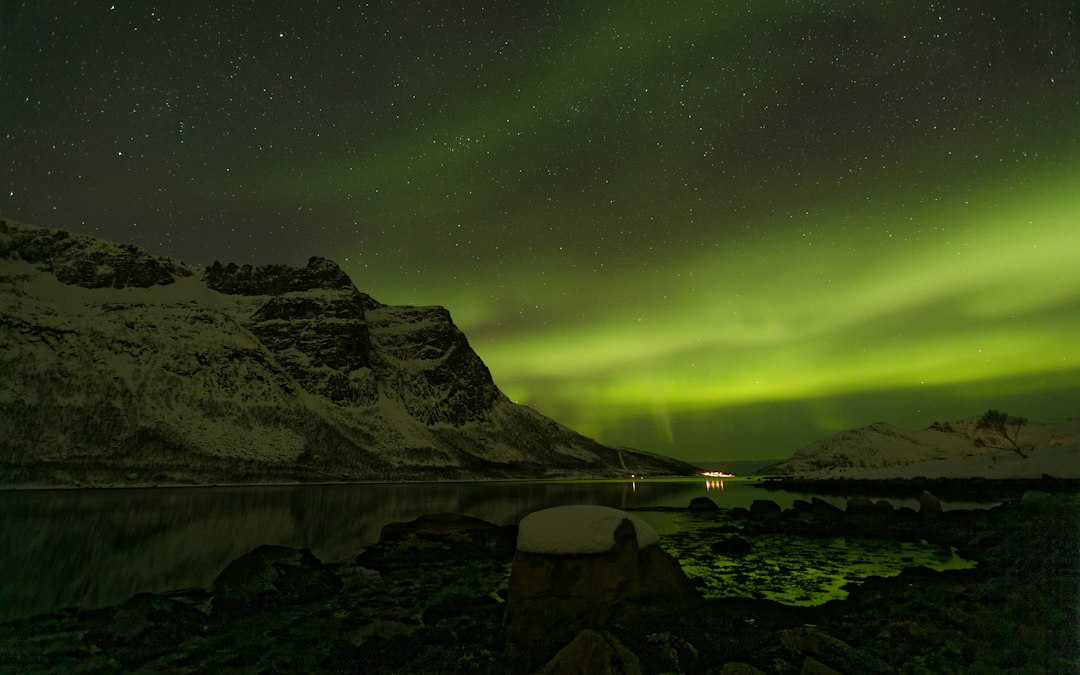
Planning a northern lights Norway trip usually starts with the wrong question. People ask where the aurora is strongest. North of the Arctic Circle the answer barely matters, because the whole coast from Bodø to Kirkenes sits under the auroral oval, and an ordinary quiet night is enough.
The real question is where the sky clears. Norway's aurora coast also faces straight into the wet North Atlantic, so your trip comes down to the weather on the night, and how far you can drive when it closes in.
We looked at ten winters of modelled evening cloud cover for about a dozen places across Norway and the border valleys next door. Then we compared each base on how often it clears, how often a short drive rescues a cloudy night, and how much darkness each latitude gets.
Table of Contents
- The Aurora Is the Easy Part in Northern Norway
- Northern Lights Norway Odds: Ten Winters of Clear-Evening Data
- Tromsø vs Lofoten vs Senja vs Alta
- When to See the Northern Lights in Norway
- Svalbard Plays by Different Rules
- Can You See the Northern Lights in Southern Norway?
- Getting Around Northern Norway in Winter
- Frequently Asked Questions
The Aurora Is the Easy Part in Northern Norway
Every town in Norway north of the Arctic Circle sits at about 66 to 68 degrees geomagnetic latitude. That puts it right under the quiet-time auroral oval, so in our forecast a Kp 1 night is enough to expect naked-eye aurora under a dark, clear sky away from town lights.
The NOAA Space Weather Prediction Center puts the equatorward edge of the oval at about 66 degrees geomagnetic latitude at Kp 0, moving about two degrees toward the equator for each step up the Kp scale. Geomagnetic latitude is what counts, not the latitude on your map. The magnetic pole is tilted toward Canada, so northern Norway sits one to three degrees lower than its map position suggests. Tromsø, at 69.6°N, behaves like 67.5°. It still sits comfortably inside the oval because it is so far north to begin with.
| Place | Map latitude | Geomagnetic latitude (approx.) | Behaves like | Kp needed for naked eye |
|---|---|---|---|---|
| Tromsø | 69.6°N | 67.5° | Under the oval | 1 |
| Alta | 70.0°N | 67.2° | Under the oval | 1 |
| Lofoten | 68.2°N | 67.0° | Under the oval | 1 |
| Bodø | 67.3°N | 66.0° | Oval edge, like Fairbanks | 1 to 2 |
| Trondheim | 63.4°N | 63.1° | Just south of the oval | about 3 |
| Bergen | 60.4°N | 61.0° | Shetland | about 3 to 4 |
| Oslo | 59.9°N | 59.7° | Inverness, Scotland | about 5 |
| Longyearbyen | 78.2°N | 75.3° | North of the night-time oval | Different rules (see below) |
Geomagnetic latitudes are from a dipole approximation with the pole at 80.8°N, 72.6°W. The Kp figures for southern Norway borrow the thresholds our forecast uses for Scotland and Shetland, which sit at the same geomagnetic latitudes.
That table explains why the Kp index, the number most aurora apps lead with, is close to irrelevant in Tromsø. If you are sitting in Tromsø, Kp 1 versus Kp 4 changes how big and bright the show is, not whether there is one. Cloud is what gets in the way.
Northern Lights Norway Odds: Ten Winters of Clear-Evening Data
Over ten modelled winters, the grid point at Tromsø had a usable clear spell on about 42 percent of October-to-March evenings. The point at Skibotn, two hours inland, cleared on 52 percent and came out ahead of Tromsø in each of the ten winters. Lofoten managed 34 percent, and Senja and Bodø about 30.
How we measured it. We pulled hourly total cloud cover for winters 2011-12 through 2020-21 from CERRA, the Copernicus regional reanalysis for Europe, via the Open-Meteo historical weather API. CERRA's 5.5 km grid is fine enough to tell a fjord from the mountain beside it. Each place is a single grid point. An evening counts as clear if it had at least two hours in a row at 30 percent cloud or less between 6 pm and 2 am (Norwegian winter time). That 30 percent cutoff is the same one our aurora forecast uses for its naked-eye tier.
| Location | Clear evenings, Oct-Mar | Clearest month | Cloudiest month |
|---|---|---|---|
| Skibotn, Lyngen valley | 52% | October (59%) | March (45%) |
| Abisko, Sweden (for comparison) | 38% to 49%* | October | varies by point |
| Tromsø | 42% | January (51%) | March (33%) |
| Alta | 41% | Nov-Jan (44%) | Oct, Feb (38%) |
| Narvik | 36% | October (43%) | March (29%) |
| Lofoten (Leknes) | 34% | October (40%) | March (30%) |
| Honningsvåg, North Cape | 33% | January (36%) | March (28%) |
| Bodø | 30% | October (37%) | March (26%) |
| Senja | 30% | January (38%) | March (20%) |
| Kirkenes | 29% | March (37%) | Nov, Jan (26%) |
| Kilpisjärvi, Finland | 28% | Oct, Mar (31%) | February (23%) |
| Oslo (for comparison) | 44% | March (49%) | January (40%) |
*Abisko depends strongly on the exact grid point: 49 percent at Abisko village, 38 percent at our Abisko forecast point about 2 km west.
Three things in that table are worth knowing before you book.
Alta is not clearer than Tromsø. Alta sits in a drier, more sheltered fjord, but cloud cover is a different measure from precipitation. On clear evenings the two towns came out within a point of each other over the decade, which in a model like this is a tie. Less snow and rain does not mean fewer grey skies.
The clear pocket is on the Norwegian side of the border. Skibotn sits at the head of Lyngenfjord, in the rain shadow of the Lyngen Alps. Its weather station, Skibotn II, was one of the three driest in all of Norway in 2020, with 335 mm, according to the Norwegian Meteorological Institute's 2020 climate summary. Kilpisjärvi, about 50 km further up the road in Finland, sits higher on the fells and cleared less often than Tromsø itself. Its value is that it occasionally clears on a night when Skibotn does not, not that it is clear more often. The next section covers why that matters.
March is not the clear month on the coast. In this decade of data, March was the cloudiest aurora month at Tromsø, Lofoten, Senja and Bodø. ERA5, the coarser global reanalysis, puts it last at Tromsø as well. March is still a pleasant month for milder cold and daylight to enjoy. Clearer skies are not one of its strengths.
Two honest caveats. First, a reanalysis is a model rebuilt from observations, not a camera on a roof, and single grid points are sensitive to exactly where you put them. Moving a few kilometres changes the answer: neighbouring low-lying CERRA points around Tromsø ranged from about 30 to 44 percent, around Skibotn from about 40 to 52, and Abisko from 38 percent at our Abisko forecast point to 49 at the village. Treat the table as a rough way to compare places, and treat gaps of a few points as ties. ERA5's grid, roughly 25 to 30 km wide, agrees that Alta is no clearer than Tromsø and that March is weak, but it cannot resolve the narrow Skibotn valley and scores it lower. Second, a clear evening is not a guaranteed sighting. Under the oval the aurora shows up on many clear, dark nights, but not all of them.
Tromsø vs Lofoten vs Senja vs Alta: Pick the Base With an Escape Road
The best base for the northern lights in Norway is the one with a clearer valley within two hours' drive. On that test Tromsø comes out ahead, because in the model a single road east to Skibotn turns a 42 percent evening into a 57 percent one.
The reason is that a cloudy night in one place is often clear somewhere nearby. We checked every cloudy evening at each base against other places within driving range on the same night. These are modelled odds for the grid points in the table above, not tour success rates.
| Base | Stay put | With a chase | Chase destination and drive |
|---|---|---|---|
| Tromsø | 42% | 57% (Skibotn), 60% (plus Kilpisjärvi) | Skibotn ~126 km, about 2 hours; Kilpisjärvi 50 km beyond |
| Senja | 30% | 58% (Tromsø or Skibotn) | 2.5 hours or more, too far for most nights |
| Lofoten (Leknes) | 34% | 37% (Svolvær) | Svolvær about 1 hour, same weather system |
| Lofoten (Leknes) | 34% | 44% (plus Evenes) | Evenes ~3.5 hours, an overnight relocation |
Tromsø is clouded out on more than half its evenings, but it has the best way out of it. The E8 runs inland through dry country toward Skibotn and the Finnish border, so cloud at the coast does not end the night. Across every run of three consecutive nights in the data, staying in Tromsø gave at least one clear evening 75 percent of the time. With Skibotn and Kilpisjärvi as fallbacks, that rose to 91 percent. That is why driving east is the default escape from Tromsø, and why a northern lights tour that will make that drive is especially worth it here.
Lofoten is the opposite. The islands are a single weather system. Moving from Leknes to Svolvær rescued under 4 percent of cloudy Leknes evenings in the data, because when one end of the archipelago is socked in, the other usually is too. The real escape is the mainland, three and a half hours away. Come to Lofoten for the mountain-and-beach foregrounds, and stay long enough for the weather to turn. Five consecutive nights gave at least one clear evening 82 percent of the time.
Senja tied with Bodø for the lowest clear-evening share of the main bases, 30 percent, and March was especially poor at 20. What it offers is dark, empty viewpoints without the Tromsø crowds. Treat it as a quiet extension of a Tromsø trip, not a replacement for one.
Alta gets the same sky odds as Tromsø with far fewer visitors. It also has a place in aurora science: the observatory on Mount Haldde, built on Kristian Birkeland's initiative and in use from 1899, is described by Alta Museum as the world's first northern lights observatory. Choose Alta for the history, the Northern Lights Cathedral and the calm, not for clearer skies.
Kirkenes and the North Cape are scenic outliers with cloudier evenings than Tromsø in this data. Many visitors arrive on a coastal ship rather than for a dedicated aurora stay. If that is your plan, our northern lights cruise breakdown covers how many nights a ship actually spends above the Arctic Circle.
When to See the Northern Lights in Norway
The northern lights season in Norway runs from about late August to mid-April north of the Arctic Circle. October to early March gives the most darkness, and January had the clearest evenings at Tromsø in the data. Darkness, not cloud, sets the calendar, and it shifts noticeably with latitude.
Our forecast treats the sky as dark enough for naked-eye aurora once the sun is 10 degrees below the horizon. Here is roughly how many hours of that each place gets, calculated with the same solar-position code the forecast uses (2026-27 dates):
| Location | 1 Sep | 15 Sep | 15 Oct | 15 Dec | 15 Feb | 15 Mar | 1 Apr | 15 Apr |
|---|---|---|---|---|---|---|---|---|
| Oslo | 7.2 | 8.6 | 11.4 | 14.9 | 12.2 | 9.8 | 8.1 | 6.5 |
| Bodø | 5.0 | 7.4 | 11.3 | 16.4 | 12.5 | 9.1 | 6.6 | 3.9 |
| Lofoten | 4.6 | 7.2 | 11.3 | 16.6 | 12.6 | 9.0 | 6.3 | 3.2 |
| Tromsø | 3.7 | 6.8 | 11.3 | 17.1 | 12.7 | 8.8 | 5.8 | 1.5 |
| Alta | 3.5 | 6.7 | 11.3 | 17.2 | 12.7 | 8.7 | 5.7 | 0.7 |
| North Cape | 2.3 | 6.3 | 11.3 | 17.7 | 12.8 | 8.5 | 5.1 | 0.0 |
| Longyearbyen | 0.0 | 0.0 | 11.1 | 24.0 | 13.5 | 6.2 | 0.0 | 0.0 |
Hours with the sun at least 10 degrees below the horizon, rounded to a tenth. Astronomical darkness, at 18 degrees, starts later in autumn and ends earlier in spring.
Counting days with at least two hours of that darkness, the season opens around 21 August in Bodø, 28 August in Tromsø and 1 September at the North Cape. It closes around 20 April, 14 April and 10 April respectively. Bodø gets about ten more days at each end of the season than the North Cape. If your only free week is early September or mid-April, go south within the Arctic, not north.
At the other end of the calendar, Tromsø's polar night runs from late November to mid-January, when the sun does not rise at all. That gives about 17 hours of usable dark and a blue noon twilight that is beautiful in its own right. It is not, however, the clearest stretch. December was among Tromsø's cloudier months in the data, and January its best.
Two more timing notes. In October 2024 NASA and NOAA announced that the Sun had reached the maximum phase of Solar Cycle 25 and expected it to last another year or so before the declining phase. Under the oval in northern Norway that matters less than you might think, because a quiet night is enough. Within a night, NOAA's viewing tips say the best aurora is usually within an hour or two of local midnight, roughly 10 pm to 2 am, with the window widening when activity is high. Our guide to how long the northern lights last covers the timing inside a single night.
Svalbard Plays by Different Rules
Svalbard sits slightly north of the main auroral oval, so its aurora is often weaker and more diffuse than further south. What it has instead is daytime aurora during the polar night, which almost nowhere else accessible can offer.
Longyearbyen is at about 75 degrees geomagnetic latitude. The oval is lopsided: it sits closer to the magnetic pole on the side of Earth facing the sun. So around midday Svalbard rotates underneath it while mainland Norway is well south of it. Visit Svalbard notes that between November and January it is dark enough at noon to see this dayside aurora with the naked eye.
The trade-off is a short season. From the darkness table, Longyearbyen has less than two dark hours a night until about 19 September and drops below two again around 23 March. In the middle of winter it gets all 24. Go to Svalbard for the polar night itself, the strange midday aurora and the Arctic wilderness. For the bright, rippling green curtains in the photos, the mainland is the better bet.
Can You See the Northern Lights in Southern Norway?
Yes, but only on active nights, and in Oslo only during geomagnetic storms. Oslo sits at almost exactly the same geomagnetic latitude as Inverness in Scotland, where our forecast uses Kp 5 as the dark-site naked-eye threshold for aurora on the northern horizon. On the same reasoning Bergen needs about Kp 3 to 4, and Trondheim about Kp 3.
There is a twist. The Oslo grid point cleared on 44 percent of evenings over the decade, level with or above most northern sites in the table. The south is not short of clear skies. It is short of aurora. NOAA's space weather scales list about 900 days of minor (Kp 5) storming per 11-year solar cycle, with fewer days at the stronger levels. Only some of those storms peak during darkness over Norway, and fewer still on clear nights.
If you live in or are visiting southern Norway, do not plan a trip around it. Set an alert, drive out of the city glow toward an open northern horizon when a storm hits, and expect your camera to see more colour than your eyes. Our guide to photographing the northern lights explains why a low southern aurora often shows up as "camera only".
Getting Around Northern Norway in Winter
Tromsø is the easiest gateway, with direct flights from Oslo of roughly two hours. Alta also has direct flights from Oslo. Lofoten connects through Bodø, Evenes or the small airports at Leknes and Svolvær.
For chasing, three practical points:
- Check the road before you check the sky. Mountain passes and exposed coastal roads in Troms and Finnmark close or run in convoy during winter storms. Statens vegvesen's traffic information shows live closures, and the E8 toward Skibotn and Finland is the road that matters most from Tromsø.
- Rent or ride, but do not stay in town. Street light washes out fainter aurora, and the clearer skies are often inland. A guided chase handles the driving and the weather calls; a rental car with winter tyres gives you more flexibility over several nights, if you are comfortable on dark, icy roads. Check current tour prices directly with operators, since they vary by group size and season.
- Book nights, not a night. In the modelled data, three consecutive nights in Tromsø included at least one clear evening 75 percent of the time without driving anywhere.
Frequently Asked Questions
Where is the best place to see the northern lights in Norway?
Tromsø is the best all-round base. Its sky clears less often than inland valleys, but the road east to Skibotn, the clearest point in our modelled data, rescued about a quarter of its cloudy evenings. Lofoten has better scenery but almost no escape from its weather. For how Norway compares with Alaska, Finland and Iceland, see our destination comparison.
What month is best to see the northern lights in Norway?
October through early March. January had the clearest evenings at Tromsø over ten winters, and October was best at Lofoten, Bodø and Skibotn. March gives milder weather but was the cloudiest aurora month at most coastal sites in the data.
Can you see the northern lights in Oslo?
Occasionally. Oslo needs a geomagnetic storm of roughly Kp 5, the same as northern Scotland. That happens on a minority of nights even near solar maximum, and the aurora usually sits low on the northern horizon.
How many nights do you need to see the northern lights in Norway?
Plan for at least three, ideally four or five. In ten modelled winters, staying put in Tromsø, three consecutive nights included at least one clear evening 75 percent of the time and five nights 89 percent. Being willing to drive inland raised the three-night figure to 91 percent.
If You Are Booking a Northern Norway Trip Now
Base yourself in Tromsø for four or five nights between late October and early March, and lean toward January, the clearest month at Tromsø in the data, if you can stand the cold. Keep each evening open to a two-hour drive east, by rental car or on a chase tour that will go as far as Skibotn or the Finnish border. Add Lofoten or Senja afterwards if you want the dramatic foregrounds, and give them extra nights to make up for the weather.
Then check the sky, not the Kp, each afternoon. The live northern lights forecast combines geomagnetic activity, hourly cloud, darkness and moonlight into a plain answer for Tromsø, Lofoten, Senja and nearby Abisko. Our field guide to seeing the aurora covers what to do once you are standing in the dark.
More Articles
Best Place to See Northern Lights: Compared by the Three Numbers That Matter
The best place to see northern lights is where dark nights, a low Kp threshold and clear skies overlap. We compare 17 destinations on all three.
Northern Lights Tour: How to Choose One (and When to Skip It)
A northern lights tour can only fix two of the four things that decide whether you see aurora. Here is how to choose one, and when to skip it.
Northern Lights Cruise: What a Ship Buys You, and What It Cannot
A northern lights cruise buys dark hours and a moving sky, not aurora. Compare its high-latitude nights before you compare brochures.